
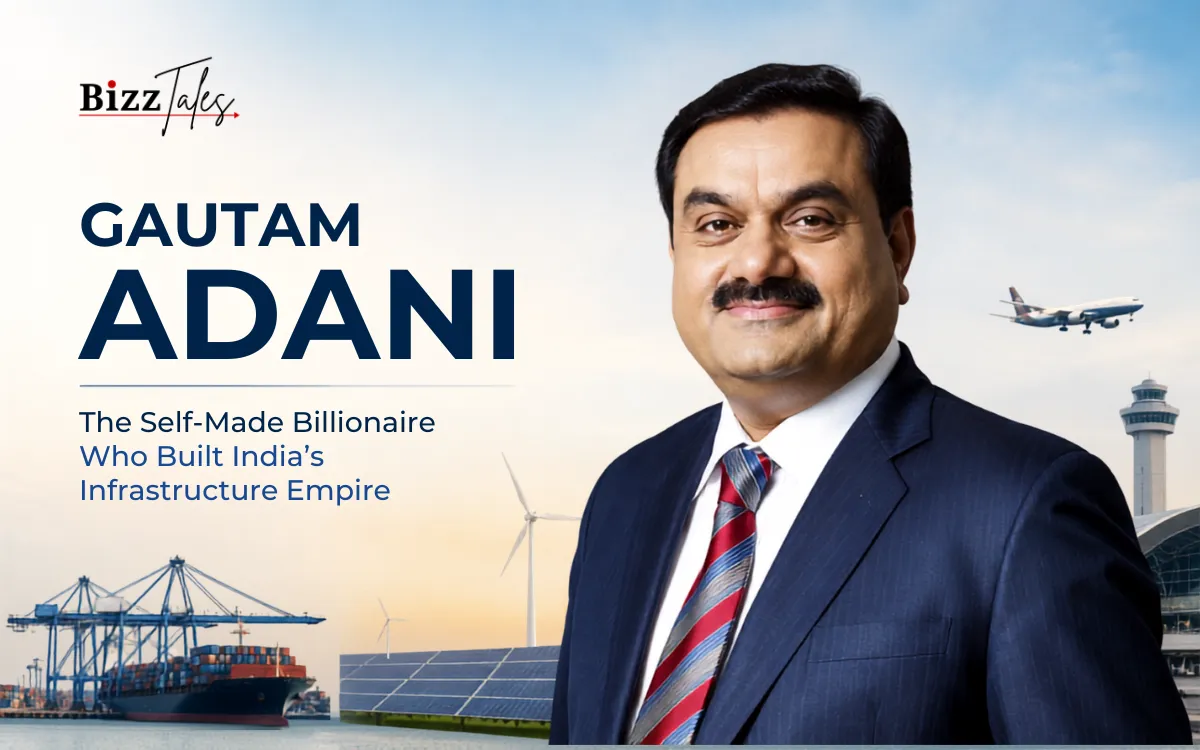
Gautam Adani is one of the most influential entrepreneurs in modern India and one of the world’s richest businessmen. As the founder and chairman of the Adani Group, he transformed a small trading business into a massive multinational conglomerate spanning ports, airports, energy, logistics, mining, data centers, cement, renewable energy, and infrastructure. His rise from a middle-class family in Ahmedabad to becoming one of Asia’s wealthiest individuals is among the most remarkable business success stories of the 21st century.
Unlike many billionaires who built fortunes through technology, Adani created his empire by focusing on infrastructure and industries critical to economic growth. His business philosophy centered on identifying sectors essential for India’s development and investing aggressively for the long term.
Over the decades, Adani Group expanded into multiple strategic industries and became one of India’s largest private-sector employers. Today, the group’s influence extends across energy, transportation, logistics, utilities, and digital infrastructure. His journey reflects ambition, resilience, calculated risk-taking, and a deep understanding of India’s growth potential.
Forbes Ranking & Net Worth History
| Year | Forbes Global Rank | Net Worth |
| 2026 | #31 | $82 Billion |
| 2025 | #18 (India Rich List) | $92 Billion |
| 2024 | Top 25 Global Billionaires | ~$84 Billion |
According to Forbes’ 2026 Billionaires List, Gautam Adani ranked #31 globally with an estimated net worth of approximately $82 billion. Despite market fluctuations and business challenges, he remains among the richest individuals in Asia.
Early Life and Family Background
Gautam Shantilal Adani was born on June 24, 1962, in Ahmedabad, Gujarat, India.
His family belonged to a modest Jain business background. His father operated a small textile-related business, and financial resources were limited compared to many of India’s major business families.
Unlike entrepreneurs who inherited large corporations, Adani started without a vast family empire.
From an early age, he displayed strong business instincts and an interest in commerce.
Growing up in Ahmedabad exposed him to Gujarat’s entrepreneurial culture, which would later influence his business ambitions.
His journey would eventually become one of India’s most celebrated examples of self-made success.
Education and Leaving College
Adani attended school in Ahmedabad and later enrolled in commerce studies.
However, traditional education could not hold his interest for long.
Driven by a desire to enter business, he left college before completing his degree.
This decision involved significant risk.
At a time when higher education was considered essential for success, Adani chose practical business experience instead.
His willingness to follow his instincts would become a recurring theme throughout his career.
Moving to Mumbai
As a teenager, Adani moved to Mumbai to pursue business opportunities.
With limited resources but enormous ambition, he began working in the diamond industry.
He secured employment as a diamond sorter and trader, gaining firsthand experience in sales, negotiation, and international commerce.
These early years taught him valuable lessons about markets, risk management, and entrepreneurship.
The experience also helped him develop confidence in identifying profitable opportunities.
Mumbai became the training ground where Adani learned the fundamentals of business.
Returning to Ahmedabad
In the early 1980s, Adani returned to Ahmedabad to help manage his brother’s plastics business.
The role introduced him to import-export operations and international trade.
He began importing polyvinyl chloride (PVC), which was in high demand in India’s growing industrial sector.
This exposure to global trade proved transformative.
Adani recognized that large-scale trading and infrastructure could create enormous opportunities.
These insights eventually led him toward entrepreneurship.
Founding Adani Group
In 1988, Gautam Adani founded the Adani Group.
Initially focused on commodity trading, the company handled agricultural products, metals, and energy-related materials.
The business expanded rapidly as India’s economy liberalized during the 1990s.
Adani understood that economic growth would require better infrastructure, logistics, and transportation networks.
Rather than remaining solely a trading company, the Adani Group began investing in strategic assets capable of supporting long-term national development.
This shift became the foundation of its future success.
The Mundra Port Success Story
One of the most important milestones in Adani’s career was the development of Mundra Port in Gujarat.
At the time, many investors considered large-scale port infrastructure projects highly risky.
Adani saw an opportunity.
He believed that India’s growing economy would require world-class logistics facilities.
Mundra eventually became India’s largest commercial port and one of the most important logistics hubs in the country.
The success of the port transformed the Adani Group and established Gautam Adani as a major force in Indian business.
This project demonstrated his ability to think on a national scale.
Building India’s Largest Infrastructure Conglomerate
Following the success of Mundra Port, the Adani Group expanded aggressively.
The company entered sectors including:
- Ports and logistics
- Airports
- Power generation
- Electricity transmission
- Renewable energy
- Natural gas distribution
- Mining
- Cement
- Data centers
- Infrastructure development
This diversification created one of India’s most powerful corporate ecosystems.
Rather than operating isolated businesses, Adani built interconnected infrastructure assets that strengthened one another.
Expansion into Energy
Energy became one of the group’s largest growth engines.
The Adani Group developed significant operations in thermal power, renewable energy, transmission networks, and gas distribution.
Today, companies such as Adani Power, Adani Green Energy, and Adani Energy Solutions play major roles in India’s energy sector.
Renewable energy has become especially important.
The group invested heavily in solar and wind projects while positioning itself as a leader in India’s clean energy transition.
Airports and Transportation
Adani expanded into airport management through strategic acquisitions and operational partnerships.
The group now manages several major Indian airports, including Mumbai Airport, one of the country’s busiest aviation hubs.
These investments strengthened the company’s presence across transportation and logistics infrastructure.
Combined with ports and logistics operations, airport ownership created a powerful transportation network supporting economic growth.
Data Centers and Artificial Intelligence
Recognizing the growing importance of digital infrastructure, Adani invested heavily in data centers and AI-ready infrastructure.
The group announced plans to invest billions of dollars in large-scale data center projects across India.
These facilities are designed to support cloud computing, artificial intelligence applications, and digital services.
The investments position Adani Group as a key player in India’s future digital economy.
Challenges and the Hindenburg Crisis
One of the most difficult periods in Gautam Adani’s career occurred in 2023 following allegations published by Hindenburg Research.
The report triggered significant market volatility and caused a sharp decline in the value of Adani Group companies.
The situation attracted global attention and led to regulatory reviews and legal scrutiny.
Despite the challenges, Adani Group continued operating and gradually stabilized its businesses.
Subsequent regulatory developments and legal proceedings resulted in varying outcomes, and the group consistently denied wrongdoing.
Philanthropy and Social Impact
Gautam Adani has increasingly expanded his philanthropic activities through the Adani Foundation.
The organization supports initiatives involving:
- Education
- Healthcare
- Rural development
- Skill development
- Community welfare
In 2025, the Adani family announced major investments in healthcare infrastructure, including plans to support large not-for-profit hospitals.
Leadership Style
Adani is known for bold decision-making and long-term strategic planning.
He often enters industries requiring large capital investments and extended development timelines.
His leadership philosophy emphasizes infrastructure creation, national development, and scale.
Colleagues frequently describe him as highly ambitious, execution-focused, and willing to pursue opportunities that others consider too challenging.
These characteristics have helped him build one of India’s largest corporate groups.
Personal Life
Gautam Adani is married to Priti Adani, who plays a significant role in the Adani Foundation and various philanthropic initiatives.
The family remains deeply involved in both business and social development projects.
Despite global recognition, Adani continues to maintain close ties to Gujarat and frequently emphasizes the importance of entrepreneurship and nation-building.
Official Social Media Accounts
Through these platforms, Adani shares updates regarding business developments, sustainability projects, infrastructure initiatives, and philanthropy.
Lessons Entrepreneurs Can Learn from Gautam Adani
One of the most important lessons from Adani’s journey is the power of thinking long term.
Many of his most successful investments required years before generating significant returns.
His story also highlights the importance of identifying sectors that support broader economic growth.
Entrepreneurs can learn from his willingness to take calculated risks, build large-scale infrastructure, and remain focused during periods of adversity.
Most importantly, his career demonstrates that ambitious goals combined with disciplined execution can create extraordinary outcomes.
Conclusion
Gautam Adani’s rise from a young trader in Mumbai to the founder of one of the world’s largest infrastructure conglomerates is a remarkable entrepreneurial success story. Through ports, airports, energy, logistics, data centers, and renewable energy, he helped shape critical components of India’s economic development.
His journey has included both extraordinary achievements and significant challenges, yet his influence on business and infrastructure remains substantial.
Today, the Adani Group continues investing in energy transition, digital infrastructure, artificial intelligence, transportation, and national development projects.
For entrepreneurs and business leaders, Gautam Adani’s story offers valuable lessons about vision, resilience, risk-taking, and the importance of building for the future.
FAQs
1. Who is Gautam Adani?
Gautam Adani is the founder and chairman of the Adani Group and one of India’s richest businessmen.
2. What is Gautam Adani’s net worth in 2026?
According to Forbes, his estimated net worth is approximately $82 billion.
3. What is the Adani Group?
The Adani Group is a multinational conglomerate involved in ports, airports, energy, logistics, infrastructure, cement, and data centers.
4. Where was Gautam Adani born?
He was born in Ahmedabad, Gujarat, India.
5. Did Gautam Adani complete college?
No. He left college early to pursue business opportunities.
6. What is Mundra Port?
Mundra Port is India’s largest commercial port and one of Adani Group’s most significant assets.
7. Is Gautam Adani involved in renewable energy?
Yes. Through Adani Green Energy, the group is one of India’s largest renewable energy operators.
8. What challenges has Gautam Adani faced?
He has faced market volatility, regulatory scrutiny, and business controversies, including the Hindenburg Research allegations.
9. Is Gautam Adani active on social media?
Yes. He maintains active accounts on X, Instagram, and LinkedIn.
10. What can entrepreneurs learn from Gautam Adani?
Entrepreneurs can learn long-term thinking, strategic risk-taking, infrastructure-focused investing, resilience, and large-scale execution.