
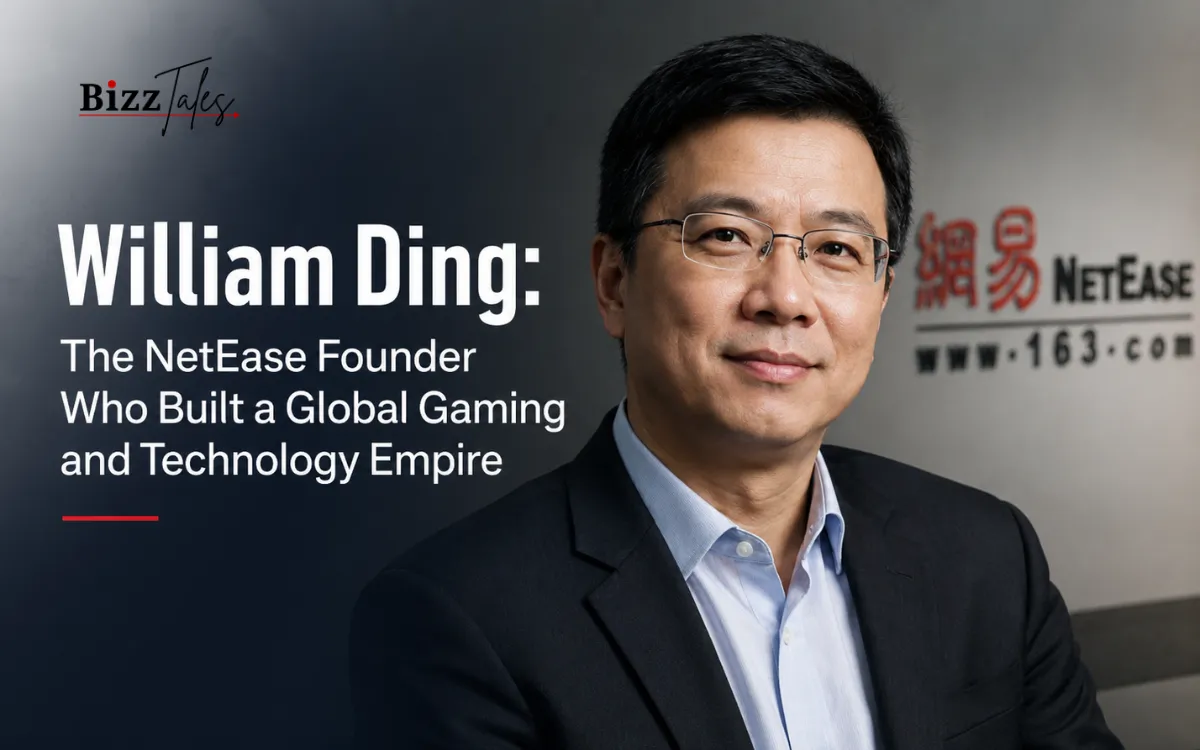
In the history of China’s internet industry, few entrepreneurs have had an impact as significant as William Ding. Known in China as Ding Lei, he is the founder and CEO of NetEase, one of the country’s largest technology companies and one of the world’s leading online gaming businesses. Long before China’s technology sector became a global force, William Ding recognized the immense potential of the internet and built a company that would help shape the digital habits of hundreds of millions of users.
What makes William Ding’s story particularly remarkable is that he became China’s first internet billionaire. At a time when many people were still skeptical about internet businesses, he launched NetEase and successfully navigated the company through market crashes, regulatory challenges, and fierce competition. His ability to adapt and reinvent the company over nearly three decades transformed NetEase from a simple internet portal into a diversified technology powerhouse.
Today, William Ding ranks among the richest people in the world and continues to influence the future of gaming, artificial intelligence, cloud computing, music streaming, and digital entertainment. His journey serves as an inspiring example of how vision, persistence, and innovation can create extraordinary success.
Forbes Rankings and Net Worth
| Year | Forbes Ranking | Net Worth |
| 2026 | #55 World’s Billionaires | $37.9 Billion |
| 2025 | Among China’s Richest Tech Entrepreneurs | Approximately $35 Billion |
| 2024 | Forbes Global Billionaire | Approximately $33.3 Billion |
William Ding remains one of China’s wealthiest technology entrepreneurs, with most of his fortune tied to his ownership stake in NetEase.
Early Life and Education
William Ding was born on October 1, 1971, in Ningbo, Zhejiang Province, China. Growing up during a period of significant economic transformation in China, he developed an interest in science, engineering, and technology from an early age. Unlike many modern entrepreneurs who grew up surrounded by computers and the internet, Ding’s childhood was relatively modest, shaped by traditional educational values and a strong emphasis on academic achievement.
His aptitude for mathematics and engineering became evident during his school years. Teachers recognized his analytical thinking abilities, and he consistently performed well academically. These strengths eventually led him to pursue higher education in telecommunications engineering.
William attended the University of Electronic Science and Technology of China, one of the country’s leading engineering institutions. There, he earned a bachelor’s degree in telecommunications engineering. The program provided him with a solid technical foundation and exposed him to the rapidly evolving fields of computing and communications.
The knowledge he gained during his university years would later become instrumental in building NetEase. More importantly, his education helped him understand how technology could transform communication, entertainment, and business on a large scale.
Career Journey
After graduating from university, William Ding began his career as an engineer in a state-run telecommunications department in Ningbo. While the position provided stability and valuable experience, he quickly realized that entrepreneurship offered far greater opportunities for innovation and impact.
Seeking broader exposure to the technology industry, he later joined Sybase in Guangzhou. Working in software development and enterprise technology allowed him to deepen his understanding of business operations, digital systems, and emerging internet technologies. During this period, he became increasingly convinced that the internet would become one of the most transformative industries of the future.
In 1997, at the age of 26, William Ding founded NetEase. The internet industry in China was still in its infancy, and many investors remained skeptical about the long-term potential of online businesses. Nevertheless, Ding believed that internet services would eventually become essential to everyday life.
NetEase initially focused on internet portal services, offering email, news, search functions, and online communities. The company quickly gained popularity among Chinese internet users and became one of the country’s most recognizable online brands.
A major milestone came in 2000 when NetEase became one of the first Chinese internet companies to list on NASDAQ. The public offering provided international recognition and access to capital. However, shortly afterward, the dot-com crash created severe challenges for technology companies worldwide. NetEase faced declining investor confidence and significant financial pressure.
Instead of retreating, Ding adapted. He shifted the company’s focus toward online gaming, a decision that would redefine NetEase’s future and ultimately make him a billionaire.
Business Ventures
NetEase remains William Ding’s most important business venture and the primary source of his wealth.
The company’s gaming division became one of the most successful businesses in China’s technology sector. Through a combination of original game development and strategic partnerships, NetEase established itself as one of the world’s largest online gaming companies. Popular titles attracted millions of users and generated substantial recurring revenue.
The company expanded aggressively into mobile gaming as smartphone adoption increased across Asia. This strategic shift allowed NetEase to capture new audiences and remain competitive in a rapidly changing industry.
Beyond gaming, NetEase diversified into music streaming through NetEase Cloud Music. The platform became one of China’s most popular music services, known for its strong community engagement and personalized recommendations.
The company also entered cloud computing, education technology, digital media, artificial intelligence, and e-commerce. These ventures reduced dependence on gaming revenue and created additional growth opportunities.
One of William Ding’s most unusual ventures involved technology-driven pig farming. While the project initially surprised many observers, it reflected his belief that technology could improve efficiency and sustainability even in traditional industries. The initiative attracted global attention and demonstrated his willingness to explore unconventional opportunities.
Today, NetEase operates as a diversified technology company serving hundreds of millions of users across multiple sectors.
Success Story and Major Achievements
William Ding’s entrepreneurial achievements are extraordinary.
One of his most notable accomplishments was becoming China’s first internet billionaire. At a time when the country’s internet industry was still developing, he demonstrated that technology entrepreneurship could create immense value.
Another major achievement was successfully guiding NetEase through the dot-com crash. While many internet companies disappeared during that period, Ding transformed the business by focusing on online gaming and digital entertainment.
Under his leadership, NetEase became one of the world’s largest gaming companies. The firm’s success generated billions of dollars in annual revenue and positioned it as one of China’s most influential technology enterprises.
William Ding has consistently appeared on Forbes billionaire rankings and remains one of China’s most successful self-made entrepreneurs. His contributions to gaming, digital entertainment, and internet services have influenced millions of users and inspired countless startup founders.
Another significant accomplishment is NetEase’s ability to remain relevant over multiple technological eras. Few internet companies have sustained growth and innovation for nearly three decades, making Ding’s leadership particularly impressive.
Challenges, Failures, and Setbacks
Like every successful entrepreneur, William Ding faced substantial challenges throughout his career.
The dot-com crash represented one of the most difficult periods for NetEase. Investor confidence collapsed, technology stocks plummeted, and many internet companies went bankrupt. NetEase faced financial uncertainty and had to reinvent its business model to survive.
The gaming industry itself presents ongoing challenges. Competition from rivals such as Tencent has forced NetEase to continually innovate and invest in new products. Maintaining user engagement in an industry driven by rapidly changing preferences requires constant adaptation.
Regulatory changes in China’s gaming sector have also created difficulties. Restrictions on gaming approvals and evolving compliance requirements occasionally affected revenue growth and investor sentiment.
International expansion introduced additional complexities. As NetEase pursued opportunities beyond China, it encountered new competitors, cultural differences, and operational challenges.
Despite these obstacles, Ding consistently demonstrated resilience and strategic flexibility, allowing the company to overcome setbacks and continue growing.
Investments and Assets
The majority of William Ding’s wealth comes from his ownership stake in NetEase. As the company expanded and its market value increased, so did his personal fortune.
His investment strategy reflects a strong belief in technology, innovation, and long-term growth. Through NetEase and personal investments, he has supported ventures involving artificial intelligence, cloud computing, gaming, and digital services.
Ding also owns significant real estate assets. Reports indicate that he has invested in premium properties both within China and internationally. One of his notable acquisitions was a luxury mansion in Los Angeles purchased in 2020.
Unlike many billionaires who diversify heavily into unrelated industries, Ding’s investments often remain connected to technology and innovation. This approach reflects his confidence in the continued growth of digital industries.
His willingness to invest in unconventional areas, including agricultural technology, further demonstrates a broad perspective on future opportunities.
Leadership Style and Business Philosophy
William Ding is known for a leadership style that combines technical expertise with entrepreneurial vision.
One of his greatest strengths is adaptability. Throughout his career, he repeatedly adjusted NetEase’s strategy in response to changing market conditions. This flexibility helped the company survive industry downturns and remain competitive.
Innovation plays a central role in his philosophy. Rather than simply following trends, Ding encourages experimentation and long-term investment in emerging technologies.
He also believes strongly in diversification. By expanding beyond gaming into music, cloud computing, education, and artificial intelligence, he reduced risk while creating new avenues for growth.
Another defining characteristic is patience. Many of NetEase’s most successful initiatives required years of development before generating substantial returns. Ding’s willingness to think long term has been a major factor behind the company’s sustained success.
His leadership demonstrates the importance of resilience, continuous learning, and strategic thinking.
Personal Life
Despite being one of China’s richest individuals, William Ding maintains a relatively private lifestyle.
He generally avoids excessive media attention and prefers to focus on business operations and innovation. This low-profile approach has earned him a reputation as one of China’s more reserved technology billionaires.
Outside of business, he has expressed interest in sustainability, agriculture, technology, and education. These interests have influenced several of his investments and philanthropic initiatives.
Ding is also involved in charitable activities aimed at supporting education and social development. His contributions reflect a belief that technological progress should benefit society more broadly.
Colleagues often describe him as analytical, disciplined, and deeply committed to long-term value creation.
Legacy and Future Outlook
William Ding’s legacy is inseparable from the growth of China’s internet and gaming industries.
Through NetEase, he helped introduce millions of people to online entertainment and digital services. The company played a crucial role in shaping China’s digital economy and continues to influence global gaming markets.
His achievement as China’s first internet billionaire demonstrated the potential of technology entrepreneurship and inspired future generations of founders.
Looking ahead, artificial intelligence, cloud computing, digital entertainment, and gaming are expected to remain key growth areas for NetEase. Ding’s willingness to invest in emerging technologies suggests that innovation will continue to drive the company’s future.
His influence extends beyond wealth creation. By building one of China’s most successful technology companies, he helped establish the country as a major force in the global digital economy.
Conclusion
William Ding’s journey from telecommunications engineer to billionaire entrepreneur is one of the most remarkable success stories in modern technology history.
Through vision, persistence, and adaptability, he transformed NetEase from a small internet startup into one of the world’s largest gaming and technology companies. His ability to survive market crashes, navigate competition, and embrace innovation demonstrates exceptional leadership.
Today, William Ding remains one of China’s most influential business leaders. His contributions to gaming, digital entertainment, cloud services, and technology entrepreneurship have shaped the lives of millions of people.
For aspiring entrepreneurs, his story offers valuable lessons about resilience, long-term thinking, and the importance of adapting to change. His legacy as a pioneer of China’s internet economy is firmly established and will continue influencing future generations.
FAQs
1. What is William Ding’s net worth in 2026?
William Ding’s estimated net worth in 2026 is approximately $37.9 billion, according to Forbes rankings.
2. How did William Ding become a billionaire?
He became a billionaire by founding NetEase and transforming it into one of China’s largest gaming and technology companies.
3. What company does William Ding own?
William Ding is the founder and CEO of NetEase, a leading Chinese technology, gaming, and digital entertainment company.
4. What is William Ding’s leadership style?
His leadership style emphasizes innovation, adaptability, diversification, and long-term strategic thinking.
5. What is William Ding’s biggest business achievement?
His biggest achievement is building NetEase into one of the world’s largest online gaming companies and becoming China’s first internet billionaire.