
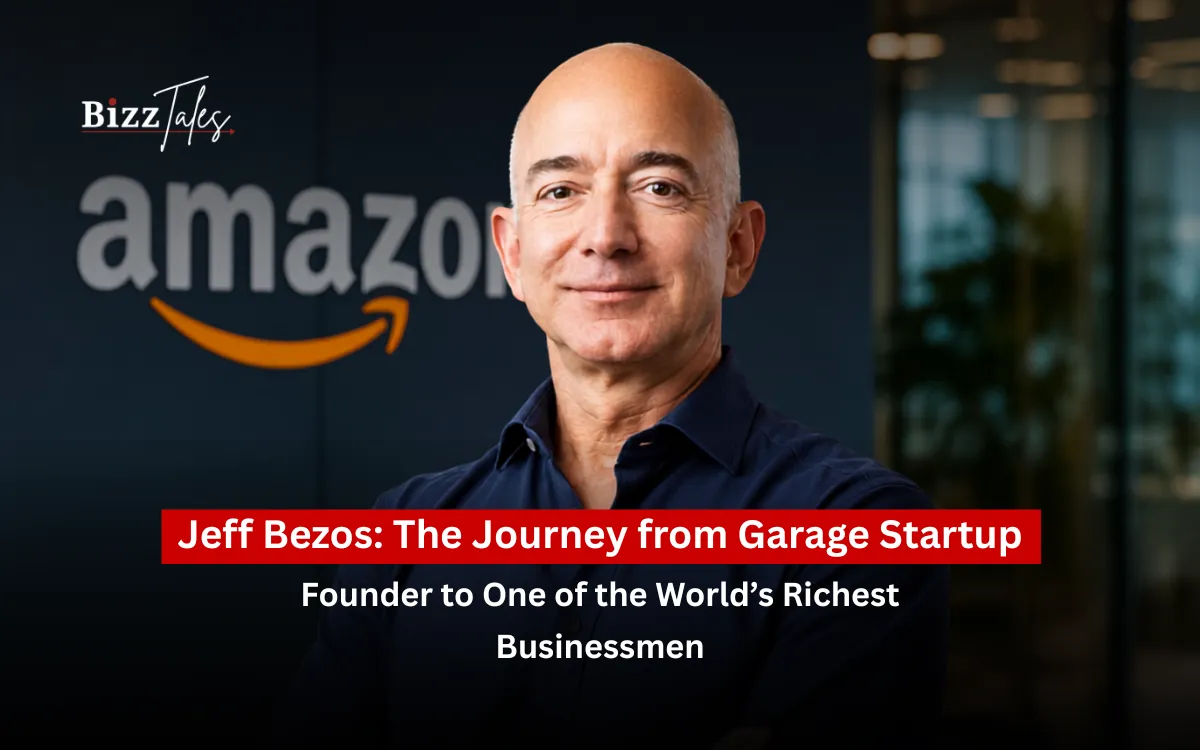
Jeff Bezos is one of the most influential entrepreneurs in modern history. Best known as the founder of Amazon, Bezos transformed a small online bookstore into one of the world’s most valuable companies. His journey is a remarkable example of vision, risk-taking, innovation, and perseverance. Through Amazon, he revolutionized e-commerce, cloud computing, logistics, digital entertainment, and artificial intelligence, fundamentally changing the way people shop and businesses operate.
Today, Jeff Bezos is recognized as one of the wealthiest individuals on the planet. However, his rise to success was not a straight path. Behind Amazon’s dominance lies a story filled with uncertainty, bold decisions, financial risks, market crashes, criticism, and relentless determination. His entrepreneurial journey has inspired millions of aspiring business owners worldwide and remains one of the greatest business success stories of all time.
Forbes Ranking & Net Worth History
| Year | Forbes Rank | Net Worth |
| 2026 | #4 | $277 Billion |
| 2025 | #2 | $215 Billion |
| 2024 | #2 | $194 Billion |
Over the last three years, Bezos has continued to expand his wealth through Amazon, Blue Origin, strategic investments, and ownership stakes in various businesses and assets.
Early Life and Education
Jeffrey Preston Bezos was born on January 12, 1964, in Albuquerque, New Mexico, United States. From a very young age, Bezos displayed an extraordinary curiosity about how things worked. He loved science, technology, and engineering and often spent hours experimenting with mechanical devices.
During his childhood, Bezos showed strong academic abilities and developed a fascination with innovation. Family members often recalled how he would dismantle toys and household objects to understand their inner workings.
Bezos attended Miami Palmetto Senior High School, where he excelled academically and demonstrated leadership qualities. His passion for learning eventually led him to Princeton University, where he earned a degree in Electrical Engineering and Computer Science.
At Princeton, Bezos further developed the analytical and technical skills that would later become critical to his entrepreneurial success. Upon graduation, he entered the finance and technology sectors, working for several prominent firms before launching his own venture.
Early Career Before Amazon
Before founding Amazon, Bezos worked at multiple financial and technology companies. One of his most notable positions was at D. E. Shaw, a highly respected investment management firm.
At D. E. Shaw, Bezos quickly climbed the corporate ladder and became one of the youngest senior executives in the company’s history. The position offered financial stability, prestige, and a promising career path.
However, during the mid-1990s, Bezos noticed a significant trend that would change his life forever. Internet usage was growing at an astonishing rate, with annual growth exceeding 2,000 percent.
Recognizing the enormous potential of the internet, Bezos began exploring business opportunities that could capitalize on this emerging technology.
Eventually, he made a life-changing decision.
The Birth of Amazon
In 1994, Bezos left his lucrative Wall Street career and moved to Seattle to launch an online business.
The decision surprised many people. Friends, colleagues, and industry experts questioned why he would leave a secure, high-paying job to pursue an uncertain internet startup.
Bezos saw things differently.
He believed the internet would fundamentally transform commerce and consumer behavior. After researching various product categories, he decided to start with books because of their vast selection and relatively simple logistics.
Amazon officially launched in 1995 from a garage.
In its early days, Bezos personally packed orders and transported packages to shipping facilities. The company operated with limited resources, but Bezos remained committed to his long-term vision.
Amazon’s growth quickly exceeded expectations.
Customers appreciated the convenience of online shopping, and sales increased rapidly.
What started as an online bookstore soon evolved into something much larger.
Expanding Beyond Books
Bezos never intended for Amazon to remain solely a bookstore.
His vision was to create “The Everything Store”—a platform where customers could purchase virtually anything online.
Over time, Amazon expanded into electronics, clothing, household goods, groceries, entertainment, and countless other product categories.
The company continuously improved its logistics network, customer service systems, and technology infrastructure.
Bezos focused obsessively on customer satisfaction, often emphasizing that customers should remain at the center of every business decision.
This philosophy became one of Amazon’s greatest competitive advantages.
As online shopping became more mainstream, Amazon emerged as the global leader in e-commerce.
Surviving the Dot-Com Crash
One of the biggest challenges Bezos faced occurred during the early 2000s when the dot-com bubble burst.
Many internet companies collapsed as investors lost confidence in technology startups.
Amazon’s stock price dropped dramatically, and critics questioned whether the company would survive.
Some analysts predicted bankruptcy.
Bezos remained calm and continued investing in the business despite intense pressure.
Instead of focusing on short-term market fluctuations, he concentrated on long-term growth.
His strategy eventually paid off.
Amazon survived while many competitors disappeared.
This period demonstrated Bezos’s resilience and ability to lead during difficult times.
The Rise of Amazon Web Services
Perhaps one of Bezos’s most important business decisions was the creation of Amazon Web Services (AWS).
Originally developed to support Amazon’s internal operations, AWS eventually became a cloud computing platform available to external businesses.
Many people underestimated the significance of cloud computing during its early years.
Today, AWS powers countless websites, applications, and enterprise systems worldwide.
The division generates billions of dollars in annual revenue and remains one of Amazon’s most profitable businesses.
AWS transformed Amazon from an e-commerce company into a technology powerhouse.
Its success significantly contributed to Bezos’s growing fortune.
Blue Origin and Space Exploration
Jeff Bezos has long been fascinated by space exploration.
To pursue this passion, he founded Blue Origin in 2000.
The company’s mission is to reduce the cost of space travel and enable future generations to live and work in space.
Although Blue Origin initially operated quietly, it eventually became one of the leading private aerospace companies.
The company has developed reusable rocket technology and conducted successful space tourism missions.
Bezos views space exploration as a long-term investment in humanity’s future.
His commitment to this vision reflects his willingness to tackle ambitious challenges beyond traditional business opportunities.
Other Businesses and Investments
In addition to Amazon and Blue Origin, Bezos has invested in numerous industries.
He acquired The Washington Post in 2013, helping modernize the historic newspaper’s digital operations.
Bezos has also invested in healthcare, biotechnology, artificial intelligence, robotics, renewable energy, and venture capital projects.
His investment portfolio reflects a strong interest in innovation and long-term growth opportunities.
These ventures have diversified his wealth and expanded his influence across multiple sectors.
Challenges and Criticism
Despite his extraordinary success, Bezos has faced criticism throughout his career.
Amazon has encountered scrutiny regarding workplace conditions, labor practices, market dominance, and competition policies.
Regulators in various countries have investigated the company’s business practices.
Bezos has also faced public criticism related to wealth inequality and corporate power.
Additionally, Amazon’s rapid growth created logistical and operational challenges that required constant adaptation.
Like many successful entrepreneurs, Bezos learned to navigate controversy while maintaining focus on long-term objectives.
Leadership Style
Jeff Bezos is known for his analytical, customer-focused leadership style.
He encourages innovation, experimentation, and long-term thinking.
Bezos often emphasizes the importance of being willing to fail. He believes that innovation requires taking risks and accepting occasional setbacks.
His leadership philosophy has helped Amazon maintain a culture of continuous improvement and innovation.
Many business leaders study Bezos’s management principles as a model for building scalable organizations.
Philanthropy and Personal Life
Over the years, Bezos has increased his involvement in philanthropy.
His initiatives focus on climate change, education, homelessness, scientific research, and social impact projects.
The Bezos Earth Fund represents one of his largest philanthropic commitments, supporting environmental and sustainability efforts worldwide.
Despite his public profile, Bezos generally maintains a relatively private personal life compared to many celebrities and public figures.
Official Social Media Accounts
Bezos uses social media primarily to share updates about space exploration, innovation, philanthropy, and major business developments.
Lessons Entrepreneurs Can Learn from Jeff Bezos
One of the most important lessons from Bezos’s journey is the power of long-term thinking. While many businesses focus on short-term profits, Bezos consistently prioritized future growth.
His story also highlights the importance of customer obsession. Amazon’s relentless focus on customer satisfaction became a major driver of its success.
Entrepreneurs can also learn the value of embracing innovation and taking calculated risks.
Perhaps most importantly, Bezos demonstrates that perseverance during difficult periods can ultimately lead to extraordinary outcomes.
Conclusion
Jeff Bezos’s journey from a Wall Street executive to one of the richest businessmen in the world is a testament to vision, innovation, and determination. Through Amazon, he transformed global commerce and built one of the most influential companies in history.
His willingness to embrace uncertainty, invest in long-term opportunities, and continuously innovate has made him one of the defining entrepreneurs of the modern era.
Whether through e-commerce, cloud computing, media, or space exploration, Bezos continues to shape industries and inspire future generations of entrepreneurs.
His story proves that extraordinary success often begins with a simple idea, executed with relentless commitment and long-term vision.
FAQs
1. Who is Jeff Bezos?
Jeff Bezos is the founder of Amazon and one of the world’s richest entrepreneurs.
2. What is Jeff Bezos’s net worth in 2026?
His estimated net worth is approximately $277 billion.
3. When did Jeff Bezos found Amazon?
He founded Amazon in 1994 and launched it in 1995.
4. What was Amazon’s original business?
Amazon started as an online bookstore before expanding into multiple product categories.
5. What is Blue Origin?
Blue Origin is Bezos’s private aerospace company focused on space exploration and reusable rockets.
6. Did Jeff Bezos work on Wall Street?
Yes, he worked at D. E. Shaw before leaving to start Amazon.
7. What is Amazon Web Services?
AWS is Amazon’s cloud computing division and one of the company’s most profitable businesses.
8. Does Jeff Bezos own The Washington Post?
Yes, Bezos acquired The Washington Post in 2013.
9. What leadership style is Jeff Bezos known for?
He is known for customer obsession, long-term thinking, innovation, and data-driven decision-making.
10. What can entrepreneurs learn from Jeff Bezos?
Entrepreneurs can learn the importance of long-term vision, customer focus, innovation, resilience, and calculated risk-taking.