
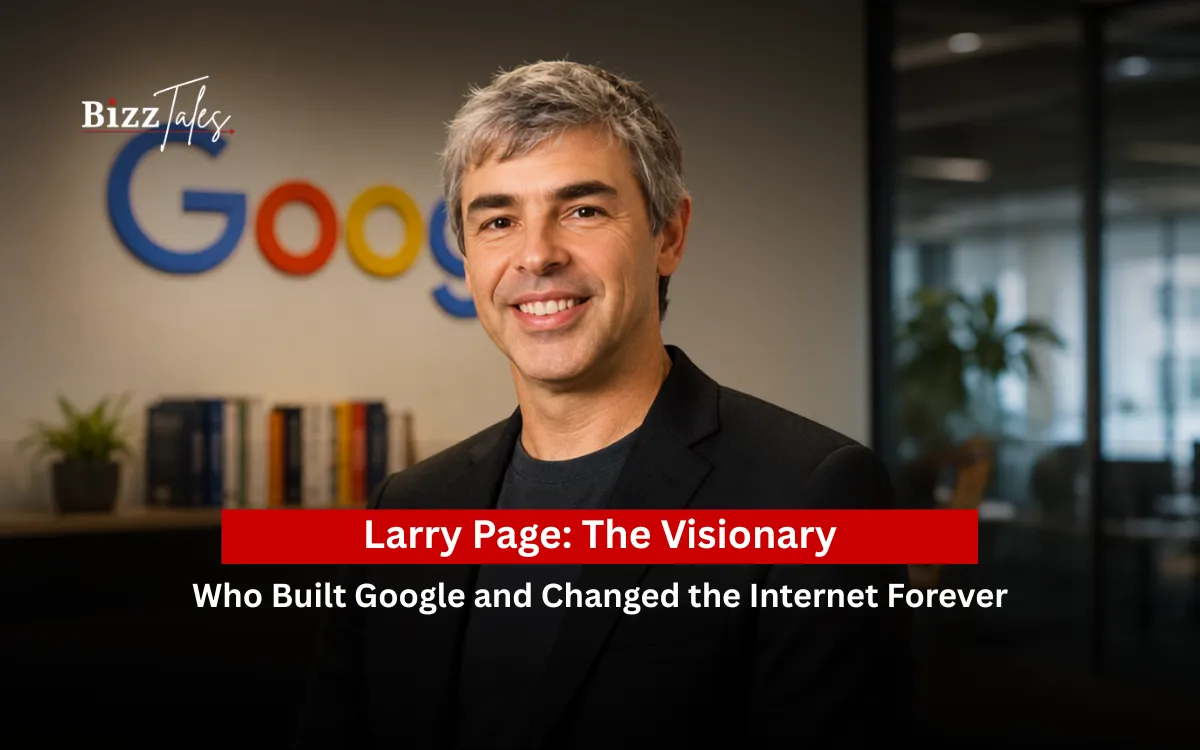
Few entrepreneurs have changed the world as profoundly as Larry Page. As the co-founder of Google, Page transformed the way people access information, communicate, learn, and conduct business online. What started as a research project in a university dorm room evolved into one of the most valuable technology companies in history. Today, Google influences billions of lives every day through search, advertising, cloud computing, artificial intelligence, mobile software, and countless digital services.
Larry Page’s rise to becoming one of the richest businessmen in the world was not driven by luck. His success is rooted in a deep passion for technology, a relentless focus on innovation, and an unwavering belief that difficult problems can be solved through engineering. Over the years, he has helped build products that have reshaped entire industries while maintaining a long-term vision that continues to influence the future of technology.
His journey from a curious child fascinated by computers to one of the wealthiest entrepreneurs in history is a story of ambition, intelligence, persistence, and groundbreaking innovation.
Forbes Net Worth History
| Year | Estimated Net Worth |
| 2026 | $300 Billion |
| 2025 | $156 Billion |
| 2024 | $114 Billion |
The dramatic increase in Larry Page’s wealth has been fueled by Alphabet’s rapid growth in artificial intelligence, cloud computing, digital advertising, and emerging technologies.
Early Life and Education
Lawrence Edward Page was born on March 26, 1973, in East Lansing, Michigan, United States. Unlike many entrepreneurs who discovered technology later in life, Page grew up in a household deeply connected to computer science. His father, Carl Page, was a computer science professor, while his mother was also involved in computer programming and education.
Surrounded by computers, scientific journals, and technology discussions, Larry developed a fascination with innovation from an early age. He often explored how machines worked and became interested in creating solutions that could improve people’s lives.
During his childhood, Page displayed remarkable curiosity and creativity. He spent significant time experimenting with technology and developing problem-solving skills that would later become crucial in his entrepreneurial journey.
After completing high school, Page attended the University of Michigan, where he earned a degree in computer engineering. His interest in technology continued to grow, eventually leading him to Stanford University to pursue graduate studies in computer science.
It was at Stanford that his life changed forever.
Meeting Sergey Brin and the Birth of an Idea
While studying at Stanford University, Larry Page met fellow graduate student Sergey Brin. Initially, the two often disagreed on various topics and held different viewpoints. However, they soon realized they shared a passion for solving complex technological problems.
At the time, the internet was expanding rapidly, but finding useful information online remained difficult. Existing search engines often produced poor results and struggled to organize the growing amount of online content.
Page became fascinated with the structure of the web and began researching how links between websites could be used to determine relevance and importance.
Together, Page and Brin developed a search algorithm known as PageRank. Instead of simply matching keywords, PageRank analyzed how websites linked to one another, providing more accurate search results.
This innovation became the foundation of Google.
The Launch of Google
In 1998, Larry Page and Sergey Brin officially launched Google from a rented garage in California.
At the time, the technology industry was crowded with competing search engines. Many people believed there was little room for another company in the market. However, Google’s superior search results quickly attracted users.
The company grew rapidly because people appreciated its speed, simplicity, and accuracy. As internet usage expanded worldwide, Google became the preferred search engine for millions of users.
Page focused on creating products that solved real problems rather than simply generating short-term profits. This philosophy became a defining characteristic of Google’s culture.
Within a few years, Google evolved from a startup into one of the most influential technology companies in the world.
Building a Technology Empire
Google’s success extended far beyond search.
Under Larry Page’s leadership, the company expanded into online advertising through Google Ads, creating one of the most profitable business models in history. The advertising platform allowed businesses to reach targeted audiences while generating billions of dollars in revenue.
The company also launched Gmail, Google Maps, Google Chrome, Google Drive, Google Photos, YouTube integration, and Android.
Each product strengthened Google’s ecosystem and increased its influence across the digital world.
Page believed that technology should make information universally accessible. This mission guided many of Google’s most important innovations.
As smartphone adoption increased globally, Android became the world’s most widely used mobile operating system, further expanding Google’s reach.
Becoming CEO and Driving Innovation
Larry Page served as Google’s CEO during critical periods of growth. His leadership style focused heavily on innovation, engineering excellence, and ambitious long-term projects.
Rather than concentrating solely on quarterly profits, Page encouraged employees to think about transformative ideas capable of changing the future.
This approach led to investments in artificial intelligence, self-driving vehicles, cloud computing, quantum computing, and numerous experimental technologies.
Many of these initiatives appeared risky at the time, but they positioned Google for long-term success.
Page consistently pushed the company to pursue bold projects that competitors often considered unrealistic.
The Creation of Alphabet
In 2015, Google underwent one of the most significant corporate restructurings in technology history.
Larry Page announced the creation of Alphabet Inc., a new parent company designed to oversee Google’s growing collection of businesses and research projects.
The restructuring allowed Google to focus on its core products while giving other divisions greater independence.
Alphabet became home to ventures involving artificial intelligence, healthcare technology, autonomous vehicles, life sciences, robotics, and advanced research.
Page became CEO of Alphabet and continued guiding the company’s long-term vision.
The move demonstrated his ability to think strategically about organizational growth and innovation.
Challenges and Difficulties
Despite Google’s extraordinary success, Larry Page faced numerous challenges throughout his career.
The company encountered criticism regarding privacy concerns, data collection practices, and market dominance. Regulators around the world launched investigations into Google’s business operations and advertising practices.
Competition from other technology companies also intensified over the years. Rivals constantly attempted to challenge Google’s leadership in search, advertising, cloud computing, and artificial intelligence.
Page had to balance innovation with increasing regulatory scrutiny while maintaining Google’s competitive position.
Like many successful entrepreneurs, he also faced pressure from investors, government agencies, competitors, and the media.
These challenges required strong leadership and strategic decision-making.
Other Businesses and Investments
Beyond Google and Alphabet, Larry Page has invested in numerous innovative ventures.
He has shown strong interest in aviation technologies, artificial intelligence, renewable energy, and advanced transportation systems.
Page has funded projects focused on electric aircraft and futuristic mobility solutions. His investments reflect a consistent desire to support technologies capable of solving large-scale global problems.
Although he maintains a relatively private lifestyle compared to many billionaires, his influence extends across multiple sectors beyond internet technology.
His investment philosophy emphasizes innovation, engineering excellence, and long-term impact.
Leadership Style
Larry Page is widely regarded as one of the most visionary leaders in technology.
His leadership style prioritizes creativity, ambitious goals, and engineering-driven decision-making. He encourages teams to pursue breakthrough innovations rather than incremental improvements.
Page often emphasizes the importance of focusing on difficult challenges that have the potential to improve billions of lives.
His willingness to take calculated risks helped Google expand into numerous industries and maintain its position as a global technology leader.
Many entrepreneurs admire his ability to balance innovation with business execution.
Philanthropy and Personal Life
Despite his enormous wealth, Larry Page maintains a relatively low public profile.
He has supported various philanthropic initiatives involving education, healthcare, environmental sustainability, scientific research, and technological innovation.
Page prefers to focus on long-term societal impact rather than seeking public attention.
His personal life remains largely private, reflecting his preference for staying out of the spotlight compared to many other billionaire entrepreneurs.
Lessons Entrepreneurs Can Learn from Larry Page
One of the most valuable lessons from Larry Page’s journey is the importance of solving meaningful problems. Instead of focusing solely on revenue opportunities, he concentrated on improving how people access information.
His story also demonstrates the power of innovation. The PageRank algorithm fundamentally changed internet search and created an entirely new standard for information discovery.
Another key lesson is the value of long-term thinking. Many of Google’s biggest successes emerged from investments that required years of development.
Page also teaches entrepreneurs the importance of surrounding themselves with talented individuals and fostering a culture of creativity.
His journey proves that transformative businesses often begin with a simple idea supported by strong execution and vision.
Conclusion
Larry Page’s journey from a computer science student to one of the richest businessmen in the world is one of the greatest entrepreneurial success stories of the digital age. Through Google and Alphabet, he transformed how billions of people access information, communicate, learn, and conduct business.
His relentless pursuit of innovation, commitment to solving difficult problems, and willingness to think beyond conventional limits have made him one of the most influential technology leaders in history.
As artificial intelligence, cloud computing, and emerging technologies continue shaping the future, Larry Page’s legacy will remain deeply embedded in the digital world. His story continues to inspire entrepreneurs who dream of building companies capable of changing the world.
FAQs
1. Who is Larry Page?
Larry Page is the co-founder of Google and one of the richest entrepreneurs in the world.
2. What is Larry Page’s net worth in 2026?
His estimated net worth is approximately $300 billion.
3. Where was Larry Page born?
He was born in East Lansing, Michigan, United States.
4. Who co-founded Google with Larry Page?
Sergey Brin co-founded Google alongside Larry Page.
5. What is PageRank?
PageRank is Google’s original search algorithm that ranks websites based on link relationships.
6. What is the Alphabet?
Alphabet is Google’s parent company, created in 2015 to oversee multiple businesses and projects.
7. Is Larry Page still involved with Google?
While not involved in daily operations, he remains a significant shareholder and influential figure.
8. What industries has Larry Page invested in?
He has invested in artificial intelligence, aviation, transportation, renewable energy, and advanced technology ventures.
9. Does Larry Page use social media?
He maintains a very limited public presence and is not active on major social media platforms.
10. What can entrepreneurs learn from Larry Page?
Entrepreneurs can learn the value of innovation, long-term thinking, problem-solving, and building products that create meaningful impact.