
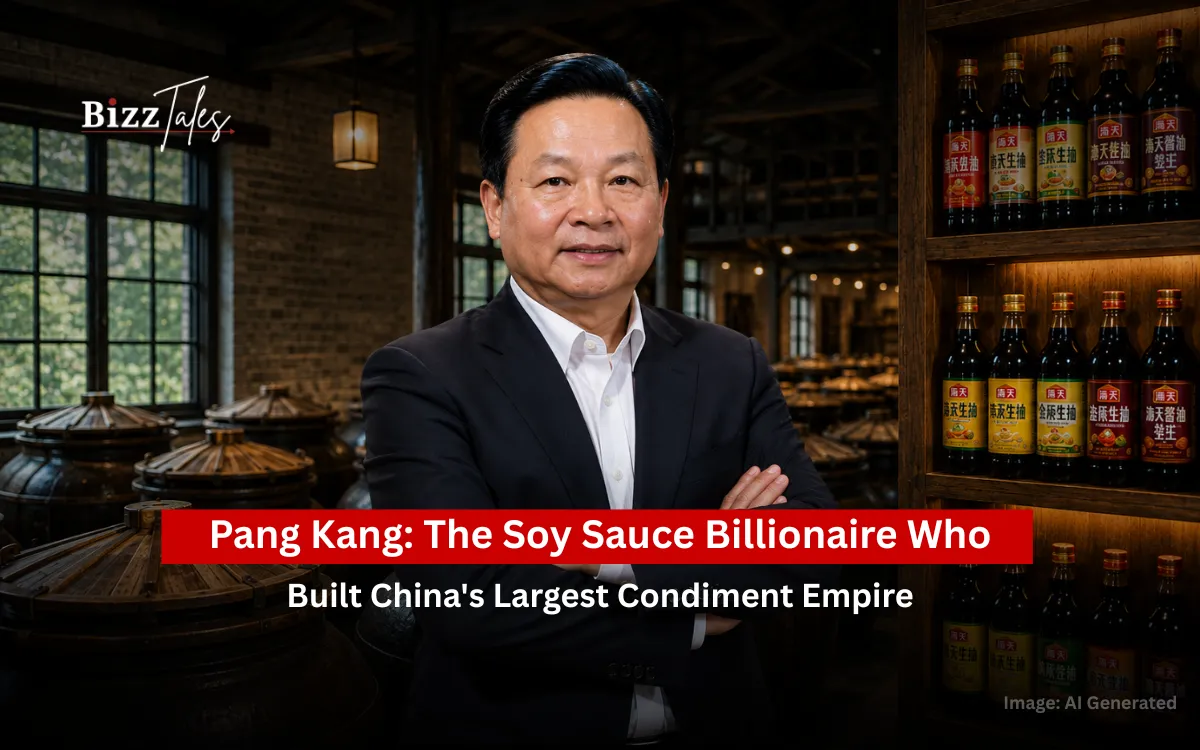
When people think about billionaires, they often imagine technology founders, real estate tycoons, or financial investors. However, some of the world’s wealthiest entrepreneurs built their fortunes in industries that have existed for centuries. Pang Kang is one such example. Known as the driving force behind Foshan Haitian Flavouring & Food Company, Pang transformed a traditional soy sauce business into the largest condiment manufacturer in the world. His journey proves that extraordinary wealth can be created not only through innovation but also through modernizing and scaling an established industry.
For decades, Pang Kang has been one of China’s most respected business leaders. Under his leadership, Haitian evolved from a local sauce producer into a global food giant whose products are found in millions of households. The company’s success turned Pang into one of China’s richest individuals and earned him the nickname “The Soy Sauce King.”
His story is remarkable because it demonstrates the power of operational excellence, long-term vision, and strategic transformation. Rather than creating an entirely new product category, Pang focused on improving quality, expanding distribution, and building a trusted brand. The result was one of the most successful food businesses in modern China.
Forbes Rankings and Net Worth
| Year | Forbes Ranking | Net Worth |
| 2026 | #415 World’s Billionaires | Approximately $8.4 Billion |
| 2025 | Among China’s Richest Entrepreneurs | Approximately $8.6 Billion |
| 2024 | Forbes Global Billionaire | Approximately $8 Billion |
Pang Kang remains one of China’s wealthiest food industry entrepreneurs, with most of his fortune derived from his ownership stake in Foshan Haitian Flavouring & Food Company.
Early Life and Education
Pang Kang was born in 1956 in Guangdong Province, China. Unlike many modern billionaires whose lives are extensively documented, relatively little public information exists about his childhood and educational background. What is known is that he grew up during a period of significant economic and social transformation in China.
His early years were closely connected to Foshan, a city with a long history of food production and manufacturing. This environment would later play a crucial role in shaping his career path.
Pang’s professional journey began within the condiment industry itself. Rather than entering finance, technology, or manufacturing, he devoted his career to understanding food production, operations, and consumer preferences. His practical business experience became one of his greatest strengths.
Over time, he developed a deep understanding of how traditional Chinese condiments could be produced more efficiently and marketed on a much larger scale. This insight eventually became the foundation of his success.
Career Journey
Pang Kang’s career began at Hai Tian Sauce Shop, the predecessor of what would later become Foshan Haitian Flavouring & Food Company. At the time, the company operated as a collective enterprise focused on traditional sauce production.
Unlike entrepreneurs who launch startups from scratch, Pang’s challenge was transforming an existing organization into a modern business capable of competing on a national and global scale.
His leadership abilities became increasingly evident as he advanced through management positions. He recognized that China’s economic reforms would create enormous opportunities for consumer brands capable of achieving scale and maintaining quality.
A pivotal moment arrived in 1995 when Pang played a leading role in restructuring the collective enterprise into a limited company. During this transformation, he personally invested approximately $60,000 and became a significant shareholder. This decision represented both a financial risk and a strong vote of confidence in the company’s future.
Following the restructuring, Pang focused on modernization. He invested in production technology, quality control systems, and distribution networks. These improvements enabled the company to increase efficiency while maintaining consistent product quality.
His efforts paid off as Haitian steadily expanded across China. What was once a regional producer gradually became a nationally recognized brand.
The company’s biggest milestone arrived in 2014 when Foshan Haitian Flavouring & Food was listed on the Shanghai Stock Exchange. The public offering provided additional capital for expansion and significantly increased the company’s visibility among investors.
Business Ventures
Although Pang Kang is primarily associated with Haitian, the scale and diversity of the company’s operations make it a business empire in its own right.
Haitian produces a wide range of condiments, including soy sauce, oyster sauce, vinegar, hoisin sauce, bean paste, seasoning powders, and numerous specialty products. The company offers more than a thousand product varieties and serves both domestic and international markets.
One of Pang’s greatest achievements was transforming Haitian from a soy sauce producer into a comprehensive food seasoning company. This diversification reduced reliance on a single product category and strengthened the company’s market position.
The company expanded aggressively throughout China, building extensive manufacturing facilities and distribution networks. As consumer demand increased, Haitian continued investing in production capacity and automation.
International expansion became another important growth driver. Haitian products eventually reached more than 100 countries and regions, helping establish the brand as a global leader in the condiment industry.
Today, Haitian is widely recognised as the largest soy sauce manufacturer in the world.
Success Story and Major Achievements
Pang Kang’s success story is built on transformation rather than invention.
His greatest achievement was converting a traditional collective enterprise into a publicly traded global food company. This transformation required strategic planning, operational excellence, and long-term commitment.
Under his leadership, Haitian became the dominant force in China’s condiment market. The company achieved widespread brand recognition and earned consumer trust through consistent quality and product availability.
Another significant accomplishment was the successful IPO in 2014. The stock market listing validated years of growth and positioned the company for future expansion.
Pang also played a crucial role in modernizing production methods. Investments in technology, automation, and quality control allowed Haitian to maintain high standards while serving millions of customers.
His business achievements earned him recognition as one of China’s leading entrepreneurs and one of the wealthiest individuals in the food and beverage industry.
Challenges, Failures, and Setbacks
Like every major business leader, Pang Kang faced numerous challenges throughout his career.
One of the biggest challenges involved transforming a traditional enterprise into a modern corporation. Organizational restructuring often creates uncertainty, resistance, and operational difficulties. Successfully navigating this process required strong leadership and strategic clarity.
The food industry itself presents unique challenges. Maintaining quality, managing supply chains, complying with regulations, and responding to changing consumer preferences require constant attention.
Competition also intensified as China’s consumer market expanded. Both domestic and international brands sought to capture market share, forcing Haitian to continually improve products and operations.
As a publicly traded company, Haitian also faced pressure from investors, analysts, and market fluctuations. Managing expectations while maintaining long-term growth became an ongoing responsibility.
Despite these obstacles, Pang’s disciplined approach enabled the company to continue expanding and strengthening its market position.
Investments and Assets
Most of Pang Kang’s wealth originates from his ownership stake in Haitian.
As the company grew and its market valuation increased, his personal fortune expanded significantly. The success of the IPO further amplified the value of his holdings.
His investment strategy has largely focused on the food industry and long-term business ownership rather than speculative ventures.
The company’s manufacturing facilities, distribution infrastructure, intellectual property, and global brand presence represent valuable assets that contribute to shareholder value.
Pang’s wealth creation strategy demonstrates the power of concentrated ownership in a highly successful business. Rather than diversifying aggressively across unrelated industries, he focused on building and expanding a market-leading company.
This disciplined approach helped him accumulate billions of dollars in wealth while maintaining a strong connection to the business that created it.
Leadership Style and Business Philosophy
Pang Kang is known for a leadership philosophy centered on quality, efficiency, and long-term growth.
One of his defining principles is modernization. Throughout his career, he consistently invested in technology and operational improvements to increase productivity and maintain competitiveness.
He also emphasizes brand trust. In the food industry, consumer confidence is critical, and Pang recognized that maintaining product quality was essential to long-term success.
Another important aspect of his philosophy is scale. By expanding production capacity and distribution networks, Haitian achieved efficiencies that strengthened its market position.
Pang’s leadership style combines pragmatism with patience. Rather than pursuing rapid diversification, he focused on building dominance within a core industry.
This approach demonstrates how disciplined execution can create extraordinary business outcomes.
Personal Life
Pang Kang maintains a highly private personal life despite his billionaire status.
Public information about his family and personal interests is limited. Reports indicate that he is married and does not have children.
Unlike many high-profile entrepreneurs, Pang rarely seeks media attention and prefers to keep the focus on the business rather than himself.
His low-profile lifestyle has contributed to a reputation for humility and professionalism. Colleagues often describe him as focused, disciplined, and deeply committed to the company’s success.
Outside business, he has been associated with interests in culture and traditional Chinese arts, though he generally avoids public discussion of personal matters.
Legacy and Future Outlook
Pang Kang’s legacy is closely tied to the modernization of China’s food industry.
Through Haitian, he demonstrated that traditional consumer products could become the foundation of a global business empire. His success challenged the notion that only technology companies could create extraordinary wealth in modern China.
The company he helped build remains a dominant force in the global condiment market. Its products are consumed by millions of people every day, making Haitian one of the most influential food brands in Asia.
Even after stepping down from certain leadership responsibilities, his influence continues to shape the company’s strategy and culture. Reports indicate that he stepped down as chairman in 2024 after decades of leadership, marking the beginning of a new chapter for the organization.
His long-term impact will likely be measured not only by his personal fortune but also by the transformation of a traditional business into a global industry leader.
Conclusion
Pang Kang’s journey from company executive to billionaire entrepreneur is a powerful example of how vision, discipline, and operational excellence can create extraordinary success.
Rather than inventing a new technology or launching a disruptive startup, he built wealth by modernizing a centuries-old industry and creating one of the world’s most successful food companies.
Through strategic leadership, product diversification, and relentless focus on quality, he transformed Haitian into the largest soy sauce manufacturer on the planet. His achievements demonstrate that great businesses can emerge from traditional industries when guided by strong leadership and long-term thinking.
For entrepreneurs and business leaders, Pang Kang’s story offers valuable lessons about patience, execution, and the power of building a trusted brand.
FAQs
1. What is Pang Kang’s net worth in 2026?
Pang Kang’s estimated net worth in 2026 is approximately $8.4 billion.
2. How did Pang Kang become a billionaire?
He became a billionaire through his leadership and ownership stake in Foshan Haitian Flavouring & Food Company, the world’s largest soy sauce manufacturer.
3. What company does Pang Kang own?
Pang Kang is best known for leading Foshan Haitian Flavouring & Food Company, a global condiment and food seasoning producer.
4. What is Pang Kang’s leadership style?
His leadership style focuses on modernization, operational efficiency, product quality, and long-term business growth.
5. What is Pang Kang’s biggest business achievement?
His biggest achievement is transforming Haitian from a traditional sauce producer into the world’s largest soy sauce and condiment manufacturer.