
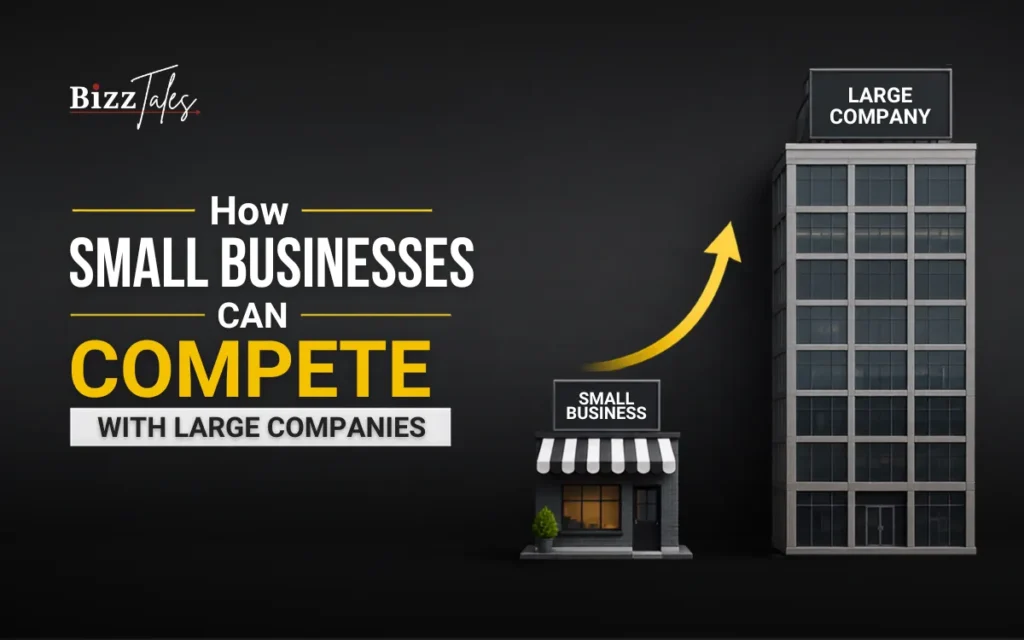
When a large business spends a lot more on advertising than a small business, employs hundreds of people, has a country’s distribution network and is already well-known by customers, the small business can sometimes feel completely outnumbered. However, the fact that a business has more resources does not necessarily mean that they have a stronger relationship with their customers.
Small business has advantages that large businesses can’t reproduce: personal service, deep knowledge, specialization, quickness, and proximity. What might be a disadvantage for a large business can be a real advantage for a small one if used intentionally.
The aim is not to mimic a company’s strategy on a lower budget. It is to compete in a different way. By identifying a niche, providing great service, establishing a solid local foothold, leveraging digital marketing intelligently and employing affordable technology, small companies can develop loyal customers and growth.
1. Focus on a Specific Niche
Big companies tend to try and service mass markets. But a small business might focus in the other direction by providing extreme value for a limited niche of customers.
Rather than providing a broad range of general accounting services-for instance, an accountant might specifically help independent medical practices. A clothing retailer might concentrate solely on eco-friendly workwear aimed at professionals rather than trying to be all things to all men.
Niche specialization simplifies your marketing. It may also enable you to achieve higher levels of specialist knowledge.
How to put this into practice
- Identify the customers you understand best.
- Find a problem they repeatedly struggle with.
- Develop products or services specifically around that problem.
- Use language that speaks directly to that audience.
- Create useful content that demonstrates your expertise.
You do not need to appeal to everyone. Being the obvious choice for the right customers can be more valuable than being vaguely relevant to a much larger audience.
2. Provide Better Customer Service
One of the biggest small business strategies is customer service because frequently customers have direct access to the owner or staff.
A local bakery could remember what a customer usually ordered. A consultant could get back to a question within an hour rather than having to send a customer from department to department. A home-services company might call after a job is completed to make sure the customer is satisfied.
Those seemingly insignificant exchanges can give your customer a dramatically different experience than when interacting with a large company.
Identify yourself clearly. Make yourself accessible, dependable, sincere. Make it easy for customers to get in touch with you and follow up quickly. Willingly make adjustments to the service to suit your customers.
Excellent customer service isn’t about spending a lot of money on software. It’s about care and consistency.
3. Build a Strong Local Presence
For a local business, competing against large businesses can begin with becoming very recognizable and trusted within your own community.
Keep your Google Business Profile up to date and accurate. Ask happy clients to leave honest reviews of your business. Ensure your website is user friendly and informs customers of your location and the services you offer. Publish content on local questions and needs and attend community events when relevant to your business.
Partnerships can also extend your reach. A fitness studio may join forces with a neighboring nutritionist. A photographer may form a partnership with local wedding venues. A local retailer may take part in a community event together with other merchants.
Reputation within the local community can become a significant element of a small business, because consumer preferences tend to lean towards local comforts and word-of-mouth recommendations.
4. Use Digital Marketing Strategically
Small business marketing does not have to mean trying every social network or spending heavily on advertising. The better approach is to identify where your ideal customers actually spend time and concentrate your resources there.
Depending on the business, that might mean:
- Search engine optimization for people actively looking for your services.
- Social media for demonstrating products and personality.
- Email marketing for staying connected with existing customers.
- Content marketing for answering common customer questions.
- Online reviews for strengthening trust.
- Paid advertising for specific products, locations, or campaigns.
For example, a local landscaping company may get more value from local SEO, before-and-after photos, customer reviews, and seasonal email campaigns than from maintaining accounts on every social platform.
Choose a few channels and measure what generates meaningful inquiries, sales, or repeat business.
5. Build a Memorable Brand
Your brand is not simply a logo and color scheme. It is the feelings that your customers have after they have interacted with your business.
Use the companies personality and story to build a human brand.small business can leverage who they are, what they stand for and what is unique about the businesses approach.
For instance, a family owned coffee shop may promote expertise, community, and friendliness. For a software consulting firm, the brand may revolve around honesty, ease of use and pragmaticity.
Consistent. Your website, packaging, social media, customer service, location should reflect the same general identity.
A memorable brand gives your customers a reason to buy you, not just because of price.
Want to know why some brands earn more trust? Read our guide on the psychology of premium brands.
6. Be Faster and More Flexible
Speed is one of the greatest benefits small businesses have.
A big corporation may require several “sign-offs” before they can alter a product, revise a process, or react to a consumer comment. A little company can do that in one afternoon.
Just use that flexibility.
Pilot a new service with select customers. Adapt a offering as demand varies. Try out a different promotion. If customers keep asking for a certain feature, put it in place swiftly.
The trick is to consider small business agility a strategic advantage, not just a result of being small.
7. Compete on Value, Not Just Price
Trying to beat a large corporation purely by offering lower prices can become a difficult race. Larger companies may have purchasing power, scale, and operational efficiencies that allow them to compete aggressively on price.
Instead, compete on overall value.
That value might come from:
- Specialized expertise
- Better quality
- Faster service
- Convenience
- Customization
- Personal attention
- A unique experience
- Stronger local relationships
For instance, an independent furniture maker may never beat a mass retailer on price. But customers looking for custom dimensions, distinctive materials, and personal service may value what the independent maker provides.
The question is not, “How can we be cheaper?” It is, “Why would the right customer consider us worth choosing?”
8. Build Customer Loyalty
Landing the new customer is only half of the battle. Developing relationships that motivate customers to come back will set up a steadier platform for small business growth.
Some easy loyalty ideas can be tailored offers, referral schemes, benefits of membership, helpful follow-up emails or incentives for re-purchasing.
But loyalty isn’t built on discounts alone. Customers recall if you fixed their problem, listened to them, kept your word and treated them kindly.
Remain useful after a sale-don’t keep selling. Send them maintenance tips, suggestions, updates or other helpful information. A customer who feels appreciated is more likely to remember you.
Curious how trust drives business growth? Explore how billion-dollar companies build customer trust.
9. Use Technology to Work Smarter
Technology enables a small team to do more with less of a giant corporate infrastructure.
Cost-effective solutions can help automate mundane chores like appointment reminders, follow ups through email, invoicing, customer relationship management, scheduling and even simple reporting.
We are not trying to buy every new piece of technology that comes along. Select the technology that eliminates one particular bottleneck.
For example, a small service business might implement online scheduling to cut down on back-and-forth e-mailing, automated reminders to cut down missed appointments, and a simple customer database to keep track of past history.
When technology eliminates the need for certain time-consuming activities, employees have more focus available for tasks that demand human judgment.
10. Turn Customer Feedback Into an Advantage
The small business is often within a close proximity to its customers so it can receive good feedback. That can be a significant factor.
Interview customers to find out what they liked, what annoyed them, what they thought should happen and what they would change. Listen to the repeated complaints and common requests and don’t react to every single comment.
Let’s say you have a bunch of customers complain that ordering is confusing. Making changes could also help future customers. If you find that customers consistently request a specific feature, that might be an opportunity for a test.
Incorporate feedback into your daily operation. Monitor customer comments, analyze them to look for common issues, and address those issues where you can.
Conclusion: Compete Differently, Not Bigger
Small companies do not have to spend more than big companies in order to challenge big companies. They need to grasp how being small could be a strength.
The specialization can allow you to become the specialist in a valuable niche. The possibility of providing personalized service can improve customer relationships. Your local reputation can help to create the feeling of reliability.
A well-planned digital marketing strategy can enlarge your outreach without increasing the advertising budget.
Technology can enable a small team to work more efficiently, agility can allow it to adapt fast in case of changing customer needs.
The best strategies for small businesses are never those that try to do everything. They are those that understand your customers, provide compelling value, and get better quicker than your rivals.
As soon as you add good relationships, targeted marketing, adaptability and good use of technology-you can leverage the fact that you are small to your advantage.
FAQs
1. How can small businesses compete with large companies?
Small businesses can compete by focusing on niche markets, offering personalized service, building strong customer relationships, and using their flexibility to respond quickly to changing needs.
2. What is the biggest competitive advantage for small businesses?
Personalized customer service, specialized expertise, local knowledge, and faster decision-making can give small businesses an advantage over larger companies.
3. How can small businesses compete without a large marketing budget?
They can focus on cost-effective small business marketing methods such as SEO, social media, email marketing, content, referrals, and online reviews.
4. Should small businesses compete with large companies on price?
Not necessarily; instead of lowering prices, small businesses can compete through quality, convenience, customization, expertise, and exceptional service.
5. Can technology help small businesses grow?
Yes, affordable technology can automate repetitive tasks, improve customer management, streamline operations, and help small businesses make better decisions.