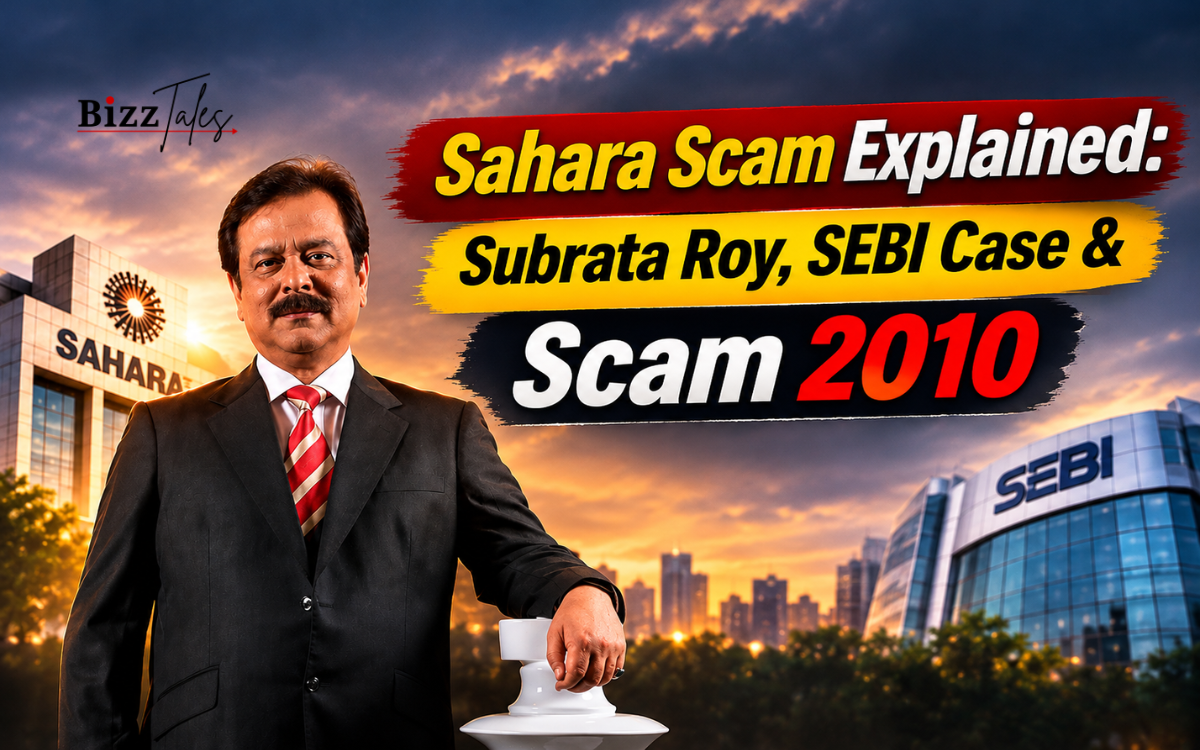
The Sahara Scam is one of the most widely discussed financial controversies in Indian corporate history. It involved Subrata Roy, the founder of Sahara India Pariwar, and two companies associated with the Sahara Group that raised thousands of crores of rupees from investors through financial instruments known as Optionally Fully Convertible Debentures (OFCDs).
What initially appeared to be a major fundraising exercise eventually turned into a prolonged legal battle involving the Securities and Exchange Board of India (SEBI), the Supreme Court of India, investor protection, and corporate financial regulations.
At its peak, Sahara was among India’s most recognised business groups, with interests in finance, real estate, hospitality, media, entertainment, aviation, and sports. Subrata Roy became a prominent businessman whose influence extended beyond the corporate world. However, the financial controversy surrounding two Sahara companies changed the group’s position and brought its fundraising activities under intense regulatory scrutiny.
The dispute involved approximately ₹24,000 crore in investor funds and raised important questions about how companies collect money from the public, maintain financial records, and fulfil repayment obligations.
The Sahara controversy is receiving renewed attention following the announcement of Scam 2010: The Subrata Roy Saga, an upcoming web series directed by Hansal Mehta. Starring Siddharth Bodke as Subrata Roy, the series is scheduled to premiere on Sony LIV in January 2027.
Understanding the Sahara Scam requires looking beyond the headlines. It involves the rise of a major Indian business empire, the financial instruments used to raise money, a landmark regulatory dispute, and the challenges of protecting investors when a large fundraising exercise becomes a legal controversy.
What Is the Sahara Scam?
The Sahara Scam refers primarily to the financial controversy involving two Sahara Group companies: Sahara India Real Estate Corporation Limited (SIRECL) and Sahara Housing Investment Corporation Limited (SHICL).
These companies raised money from investors by issuing Optionally Fully Convertible Debentures, commonly known as OFCDs. The companies maintained that the fundraising was conducted through private placements. However, SEBI questioned whether the fundraising activities were actually public issues that required compliance with securities market regulations.
The regulator argued that the companies had collected money from a very large number of investors without following the required procedures for public offerings. It also raised concerns about investor disclosures, regulatory approvals, and the protection of individuals who had invested their savings.
The matter eventually reached the Supreme Court of India, which delivered a landmark judgment on August 31, 2012.
The Supreme Court upheld the regulatory position and directed the two companies to refund the money collected through the OFCDs, along with 15% annual interest.
The case became one of India’s most significant corporate legal disputes because of the amount involved, the scale of the fundraising exercise, and the challenges associated with identifying and refunding investors.
Who Was Subrata Roy? The Founder Behind Sahara Group
Subrata Roy was born on June 10, 1948. He founded Sahara India Pariwar and transformed it into a large business organisation with operations across multiple industries.
His entrepreneurial journey began with relatively modest business activities. Over time, he developed a business model that focused on reaching customers and small savers, particularly in towns and rural areas where access to conventional banking services was limited.
Sahara’s network of agents played an important role in its expansion. The organisation built relationships with individuals who wanted accessible savings options and gradually developed a large customer and business network.
Roy became known for his ambitious business decisions, public appearances, and association with major sporting and entertainment events.
His business interests expanded into hospitality, real estate, media, aviation, and other sectors. Sahara also became a recognised name in Indian cricket through its sponsorship activities.
At the height of its influence, the group had a significant presence in India’s corporate and social landscape.
However, the financial controversy involving two Sahara companies eventually became the defining challenge of Roy’s business career.
Subrata Roy died on November 14, 2023, at the age of 75. His death did not automatically resolve the financial and legal matters associated with Sahara, and the group’s investor-related issues continued to attract attention.
How Did Sahara Group Build Its Business Empire?
Sahara’s growth is an important part of the story because the organisation was not limited to financial services.
The group gradually developed interests in several sectors, making it one of the more diversified business organisations in India.
Its expansion was supported by a large network of employees, agents, offices, customers, and business operations.
1. Financial Services and Savings Business
Financial services played an important role in Sahara’s early development. The group became known for collecting relatively small amounts from individuals through its extensive network.
This approach helped it reach customers who were not always comfortable with traditional banking systems or had limited access to formal financial services.
2. Real Estate and Property Development
Sahara expanded into real estate and property development, including large-scale projects.
One of its most recognised developments was Aamby Valley City near Lonavala in Maharashtra. The project became associated with luxury living, hospitality, and large property investments.
3. Hospitality and Luxury Hotels
The group also developed interests in hospitality and luxury properties.
Sahara became associated with prominent hotel assets, including international properties such as The Plaza Hotel in New York and Grosvenor House in London.
These investments helped establish the group’s image as a major corporate player.
4. Media and Entertainment
Sahara entered media and entertainment through television, film production, and related businesses.
The group’s involvement in entertainment increased its visibility among Indian audiences and helped build its public profile.
5. Sports and Cricket Sponsorship
Sahara became particularly popular through its association with Indian cricket.
The group sponsored the Indian cricket team for several years and also owned the Pune Warriors India franchise in the Indian Premier League.
Its association with sports helped Sahara become a familiar brand among millions of Indian consumers.
6. Aviation and Other Investments
The group also entered the aviation industry through Air Sahara, which was later acquired by Jet Airways in 2007.
These different business activities demonstrated the scale of Sahara’s expansion under Subrata Roy.
However, the group’s diversification and public visibility could not protect it from the regulatory questions surrounding its fundraising activities.
What Were OFCDs and How Did Sahara Raise Money?
To understand the Sahara Scam, it is important to understand the financial instrument at the centre of the controversy.
OFCD stands for Optionally Fully Convertible Debenture.
A debenture is a financial instrument through which a company borrows money from investors. Depending on its terms, a convertible debenture may be converted into company shares at a specified time or under specified conditions.
In Sahara’s case, the two companies issued OFCDs to collect funds from investors.
The companies maintained that these instruments were issued through private placements. This meant they considered the fundraising to be a private arrangement rather than a public offering.
However, SEBI examined the actual nature and scale of the fundraising.
The regulator found that the companies had approached a very large number of people through an extensive distribution network. The Supreme Court judgment discussed the use of approximately 10 lakh agents and more than 2,900 branch offices to invite subscriptions from over 3 crore investors.
SEBI argued that the fundraising exercise had the characteristics of a public issue and therefore had to follow the applicable legal requirements.
This distinction became the central issue in the Sahara-SEBI dispute.
The controversy demonstrated that the legal classification of a fundraising exercise depends on its actual structure and circumstances, not simply on the label used by a company.
How Did the Sahara Scam Come to Light?
The regulatory dispute became public after SEBI started examining the fundraising activities of the two Sahara companies.
The companies had raised money through OFCDs under their respective offer documents. SEBI questioned whether the fundraising process complied with the Companies Act and the securities market regulations.
On November 24, 2010, SEBI passed an interim order restricting the two companies from mobilising further funds through the OFCDs.
The regulator subsequently issued an order on June 23, 2011, directing the companies and the concerned individuals to refund the money collected through the securities, along with 15% annual interest.
The order also restricted the companies from accessing the securities market for raising funds until the repayment requirements were satisfied.
Sahara challenged the regulatory action before the Securities Appellate Tribunal (SAT). However, the tribunal upheld SEBI’s directions in October 2011.
The companies then approached the Supreme Court of India.
The matter developed into a major legal battle that attracted national attention because of the scale of the fundraising and the financial obligations involved.
SEBI vs Sahara: The Supreme Court’s Landmark Judgment
The legal dispute between Sahara and SEBI reached a major turning point on August 31, 2012.
The Supreme Court of India delivered its judgment in the matter involving Sahara India Real Estate Corporation and Sahara Housing Investment Corporation.
The court upheld the regulatory position that the OFCD fundraising exercise had to comply with the applicable public issue requirements.
It directed the two companies to refund the money collected from investors, along with 15% annual interest.
The repayment was to be made through the prescribed process under SEBI’s supervision.
The judgment also required the companies to provide the necessary investor information so that claims could be examined and refunds could be processed.
The Supreme Court’s decision became a landmark development in Indian securities regulation.
It reinforced the importance of investor protection and clarified that companies cannot avoid public issue regulations by presenting large-scale fundraising as a private placement when the actual circumstances indicate otherwise.
The case also demonstrated SEBI’s role in regulating securities-related fundraising and protecting the interests of investors.
How Much Money Was Involved in the Sahara Scam?
The amount of money involved was one of the biggest reasons the Sahara case attracted widespread attention.
The two companies were directed to refund approximately ₹24,000 crore collected through their OFCD issues, along with interest.
The original SEBI order also specified 15% annual interest from the dates on which the money was received until repayment.
The scale of the fundraising was considerable, involving more than 3 crore investor accounts according to the figures discussed in the Supreme Court proceedings.
The size of the case created several challenges for the regulator.
First, the authorities needed to examine the investor records and verify the claims submitted by individuals.
Second, they had to determine whether the submitted documents were genuine and whether investors had already received repayments.
Third, the regulator needed to ensure that the refund process followed the directions of the Supreme Court.
The controversy therefore became more than a dispute about the amount raised by a company. It also became a major test of India’s ability to manage large-scale investor claims and enforce financial regulations.
Why Was Subrata Roy Arrested?
One of the most significant moments in the Sahara controversy occurred in February 2014.
The Supreme Court had been monitoring compliance with its repayment directions. However, the court was not satisfied with the progress made by Sahara in meeting the requirements.
After Subrata Roy failed to appear before the Supreme Court as directed, a non-bailable warrant was issued.
On February 28, 2014, Roy was arrested in Lucknow and produced before the court.
His arrest became national news because he was one of India’s most prominent business personalities.
The proceedings were connected to the company’s failure to comply with the court’s refund-related directions. Roy remained in custody for an extended period and was subsequently released on parole in 2016, subject to court-imposed conditions.
The arrest marked a major turning point in the Sahara story.
It also became a reminder that even powerful business leaders and large corporate groups must comply with court orders and financial regulations.
What Happened to the Investors’ Money?
The refund of investor money became one of the most complicated aspects of the Sahara controversy.
Following the Supreme Court’s directions, SEBI began receiving funds from the Sahara companies and processing claims from eligible investors.
However, the refund process faced several challenges.
The regulator needed to verify the identities of investors, examine original investment documents, check repayment records, and establish whether the claims were genuine.
Sahara maintained that it had already repaid substantial amounts directly to investors. However, SEBI questioned the supporting documentation and the extent to which those repayments could be verified.
This disagreement made the refund process more complicated.
The regulator also had to ensure that money was returned only to eligible investors and that duplicate or unsupported claims were not accepted.
As a result, the issue of investor refunds continued for years after the original Supreme Court judgment.
The case highlights an important financial lesson: collecting money from millions of individuals requires strong record-keeping, transparent disclosures, and a clear repayment mechanism.
Sahara Refund Portal: What Investors Should Know
In 2023, the Union Government introduced the CRCS-Sahara Refund Portal to facilitate the return of eligible deposits from certain Sahara cooperative societies.
The initiative was designed to help genuine depositors submit their claims online by providing the required documents and investment details.
The portal was introduced following directions from the Supreme Court concerning the transfer of funds for refunding eligible depositors.
However, it is important to understand that the cooperative societies refund process is different from the original SEBI-Sahara OFCD case.
The two matters involve different entities, legal proceedings, and administrative mechanisms.
The CRCS-Sahara Refund Portal concerns eligible depositors of specified Sahara cooperative societies. It should not be confused with the original refund proceedings involving SIRECL and SHICL.
This distinction matters because not every person who invested in a Sahara-related financial product automatically qualifies under the cooperative societies refund process.
Investors should check the official government portal and follow the current eligibility requirements before submitting claims.
What Happened to Sahara Group After the Controversy?
The legal dispute and financial pressure significantly affected Sahara’s business operations and public image.
The group that had once been associated with large corporate investments, sports sponsorships, and luxury properties faced increasing challenges.
Its fundraising activities came under regulatory scrutiny, while asset-related proceedings and financial disputes continued.
Several of its business interests faced difficulties, and the organisation’s earlier public prominence gradually declined.
The controversy also affected the way investors and businesses viewed large financial organisations that collect money from the public.
For the wider Indian corporate sector, the Sahara case became an important example of why business expansion must be supported by financial transparency, regulatory compliance, and effective corporate governance.
Subrata Roy’s Death and the Continuing Sahara Controversy
Subrata Roy died on November 14, 2023, in Mumbai, at the age of 75.
His death brought an end to the life of a businessman who had built one of India’s most recognisable corporate groups.
However, his death did not automatically resolve the financial and legal matters involving Sahara.
Investor refund claims, regulatory proceedings, asset-related issues, and questions surrounding the group’s financial obligations continued to remain relevant.
The Sahara case also remained an important subject in discussions about investor protection and the responsibilities of companies that raise money from the public.
Even years after the original dispute began, the case continues to offer lessons for regulators, business owners, financial institutions, and investors.
Business Lessons from the Sahara Scam
The Sahara controversy provides several important lessons for the Indian business community. It demonstrates that building a large company requires more than an effective sales network, strong brand visibility, and aggressive expansion.
Financial discipline and legal compliance are equally important.
1. Regulatory Compliance Should Be a Business Priority
Every company must understand the laws and regulations applicable to its business activities.
Companies raising funds through securities must follow the relevant disclosure, approval, and investor protection requirements.
A fundraising model that does not comply with the applicable regulations can create serious legal and financial consequences.
2. Investor Trust Must Be Supported by Transparency
Trust is an important part of every business relationship.
However, companies that collect money from investors must provide accurate information about the investment, risks, repayment conditions, and financial position.
Transparent communication helps protect both the business and its customers.
3. Financial Records Must Be Accurate and Verifiable
Businesses handling large numbers of customers or investors need reliable financial records.
Proper documentation makes it easier to verify transactions, process refunds, respond to regulatory investigations, and resolve disputes.
The Sahara controversy demonstrated how complicated the process can become when millions of investor accounts need to be examined.
4. Business Expansion Requires Strong Financial Management
Expanding into multiple industries can create new revenue opportunities, but diversification also increases management responsibilities.
Companies must ensure that their financial commitments, investments, and operational activities remain sustainable.
Rapid expansion without effective financial controls can create long-term business risks.
5. Corporate Reputation Is Not a Substitute for Accountability
A popular brand and a powerful founder may help a company attract customers and investors.
However, reputation cannot replace legal compliance.
Businesses must remain accountable to investors, regulators, employees, and other stakeholders regardless of their size or market position.
6. Investors Should Understand Financial Products Before Investing
Investors should understand the structure, risks, repayment conditions, and regulatory status of financial products before committing their savings.
They should carefully examine investment documents and avoid making decisions based only on attractive return promises or brand reputation.
The Sahara case reinforces the importance of financial awareness and independent research.
Scam 2010: The Subrata Roy Saga – Upcoming Web Series on the Sahara Scam
The Sahara controversy is set to return to public attention through an upcoming web series titled Scam 2010: The Subrata Roy Saga.
Directed by Hansal Mehta, the series is the third instalment in the popular Scam franchise.
The previous seasons explored two major financial controversies in India: the stock market scam involving Harshad Mehta and the counterfeit stamp paper scam involving Abdul Karim Telgi.
The upcoming season will focus on Subrata Roy, the Sahara Group, and the financial controversy that changed the course of the business empire.
The series is based on journalist Tamal Bandyopadhyay’s book Sahara: The Untold Story.
Actor Siddharth Bodke will portray Subrata Roy. The first-look teaser released on November 2, 2026, introduced Bodke in the role and offered a glimpse of the upcoming story.
Scam 2010 Release Date and OTT Platform
Scam 2010: The Subrata Roy Saga is scheduled to premiere in January 2027 on Sony LIV.
Here are the key details about the upcoming web series:
| Detail | Information |
|---|---|
| Series Name | Scam 2010: The Subrata Roy Saga |
| OTT Platform | Sony LIV |
| Release Window | January 2027 |
| Exact Release Date | Yet to be announced |
| Director | Hansal Mehta |
| Lead Actor | Siddharth Bodke |
| Story Based On | Subrata Roy and Sahara Group |
| Source Material | Sahara: The Untold Story |
| Author | Tamal Bandyopadhyay |
| Production Houses | Applause Entertainment and Birla Studios |
What Is Scam 2010 About?
The upcoming series will explore Subrata Roy’s entrepreneurial journey, the growth of Sahara India Pariwar, and the financial controversies surrounding the organisation.
The story is expected to cover the business decisions, investor relationships, and regulatory developments that eventually brought Sahara into a major legal dispute with SEBI.
Unlike a fictional financial thriller, Scam 2010 draws inspiration from real corporate events that affected India’s financial and business landscape.
The series also has the opportunity to explain complicated financial topics, including OFCDs, fundraising regulations, investor protection, and corporate accountability, through an entertainment format.
Who Plays Subrata Roy in Scam 2010?
Siddharth Bodke will play Subrata Roy in the upcoming series.
The actor will portray one of India’s most recognised business personalities and explore the different aspects of his public and professional life.
Hansal Mehta’s return as director has also increased interest in the project, particularly among viewers who enjoyed the earlier Scam seasons.
The first-look teaser has already introduced the central character, while viewers are waiting for the full trailer and additional details about the series.
Scam 2010 vs Scam 1992 vs Scam 2003: What Is the Difference?
The Scam franchise focuses on real-life financial controversies that attracted national attention in India.
Each instalment explores a different personality, business activity, and financial dispute.
Scam 1992: The Harshad Mehta Story was released in 2020 and explored the 1992 Indian stock market scam. Pratik Gandhi played stockbroker Harshad Mehta.
Scam 2003: The Telgi Story was released in 2023 and focused on Abdul Karim Telgi and the counterfeit stamp paper scam. Gagan Dev Riar portrayed Telgi.
Scam 2010: The Subrata Roy Saga will explore the Sahara Group controversy and the life of its founder, Subrata Roy.
| Web Series | Main Personality | Financial Controversy |
|---|---|---|
| Scam 1992 | Harshad Mehta | Indian stock market scam |
| Scam 2003 | Abdul Karim Telgi | Counterfeit stamp paper scam |
| Scam 2010 | Subrata Roy | Sahara Group OFCD controversy |
The upcoming series continues the franchise’s focus on major financial events while introducing a different chapter of Indian corporate history.
Why the Sahara Scam Remains Important for India’s Business Sector
The Sahara controversy is important because it highlights the relationship between corporate fundraising, financial regulation, and investor protection.
India has a large population of retail investors and savers. Companies that raise money from the public must follow strict rules designed to ensure that investors receive accurate information and appropriate protection.
The case also highlights the importance of regulatory institutions such as SEBI in monitoring securities-related activities and enforcing compliance.
For entrepreneurs, the controversy demonstrates that a company’s long-term success depends on more than revenue growth and market expansion.
Businesses need strong financial systems, transparent operations, responsible leadership, and effective corporate governance.
For investors, the case reinforces the need to understand financial products and verify investment opportunities before committing money.
The upcoming Scam 2010 series may bring these important business lessons to a wider audience by presenting the Sahara story through a real-life financial drama.
Conclusion
The Sahara Scam remains one of the most significant financial controversies in India’s corporate history. What began as a large fundraising exercise by two Sahara companies eventually became a prolonged legal battle involving SEBI, the Supreme Court, and investor refund obligations.
Subrata Roy built Sahara India Pariwar into a major business organisation with interests across several industries. However, the controversy surrounding its OFCD fundraising activities created serious regulatory and financial challenges that affected the group’s reputation and operations.
The case serves as an important reminder that business growth must be supported by transparency, proper financial records, investor protection, and regulatory compliance.
With Hansal Mehta’s upcoming Scam 2010: The Subrata Roy Saga, the story is set to reach another generation of viewers. Scheduled to premiere on Sony LIV in January 2027, the series will bring renewed attention to the rise of Sahara Group and the financial controversy that became a major chapter in Indian business history.
FAQs
1. What is the Sahara Scam in India?
The Sahara Scam refers to the financial controversy involving two Sahara Group companies that raised approximately ₹24,000 crore through Optionally Fully Convertible Debentures. SEBI challenged the fundraising process, leading to a major legal battle and Supreme Court-ordered refunds.
2. Who was responsible for the Sahara Scam?
The case involved Sahara India Real Estate Corporation Limited and Sahara Housing Investment Corporation Limited, companies associated with Sahara Group founder Subrata Roy. The Supreme Court proceedings concerned the companies’ fundraising activities and compliance with securities regulations.
3. How much money did Sahara collect from investors?
The two companies raised approximately ₹24,000 crore through OFCDs. The Supreme Court directed them to refund the collected money along with 15% annual interest.
4. Why did SEBI take action against Sahara Group?
SEBI found that the two companies had raised money through OFCDs without complying with the applicable public issue requirements. The regulator argued that the fundraising was effectively a public issue rather than a private placement.
5. When was Subrata Roy arrested?
Subrata Roy was arrested on February 28, 2014, following a non-bailable warrant issued by the Supreme Court in connection with the ongoing Sahara refund proceedings.
6. What happened to Sahara investors’ money?
SEBI initiated a refund process under the Supreme Court’s directions. The process involved verifying investor identities, examining documents, and checking repayment claims. The separate CRCS-Sahara Refund Portal was later introduced for eligible depositors of specified Sahara cooperative societies.
7. What is Scam 2010: The Subrata Roy Saga?
Scam 2010 is an upcoming web series based on Subrata Roy’s life, the rise of Sahara Group, and the financial controversy involving its fundraising activities. It is directed by Hansal Mehta and stars Siddharth Bodke.
8. When will Scam 2010 be released?
Scam 2010: The Subrata Roy Saga is scheduled to premiere in January 2027 on Sony LIV. The exact release date has not yet been announced.
9. Is Scam 2010 based on a true story?
Yes. The series is inspired by real events and based on journalist Tamal Bandyopadhyay’s book Sahara: The Untold Story.
10. What is the difference between the Sahara Scam and the Sahara Refund Portal?
The original Sahara-SEBI case involved OFCD fundraising by two Sahara companies. The CRCS-Sahara Refund Portal concerns eligible deposits held in specified Sahara cooperative societies. These are separate legal and administrative processes.