
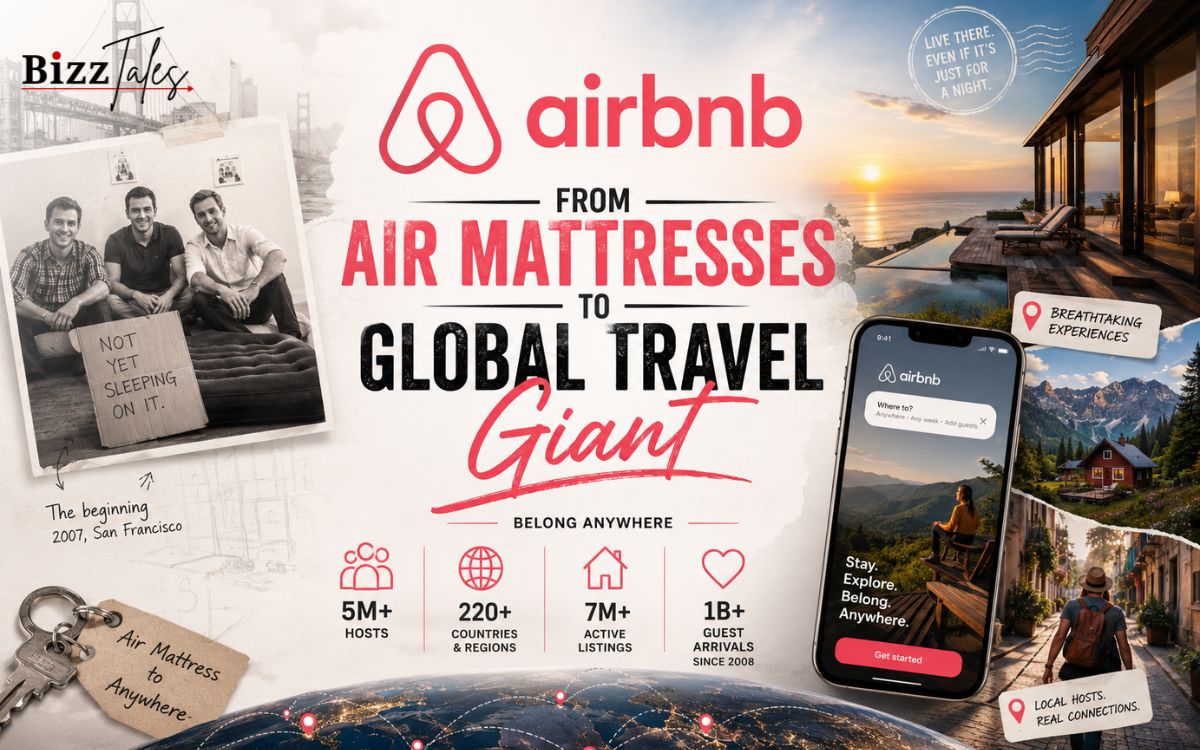
Airbnb is considered one of the most successful startup stories in recent business history. It all began from a straightforward concept of using airbeds to accommodate guests in a humble apartment which eventually transformed into one of the largest travel and hospitality services around the world.
Today, millions of people use Airbnb to book homes, apartments, and one-of-a-kind stays in every country around the world. The company revolutionized the way travelers think about where they stay.
But the ride hasn’t been smooth for Airbnb in the beginning, the early years were marred with rejection, financial struggles and a lot of uncertainty. The idea was rejected by many investors because nobody believed that people would like to stay in someone’s else’s home.
Undaunted by this skepticism, the founders persisted in developing the platform, gradually establishing one of the world’s most recognized travel brands.
- The Beginning of Airbnb
- The Meaning Behind Airbnb
- Early Struggles and Rejections
- Building Trust Among Users
- Slow Growth in the Beginning
- Turning Point for Airbnb
- Expansion Across the World
- Disrupting the Hotel Industry
- Technology and User Experience
- Challenges and Criticism
- Impact of the Pandemic
- Business Lessons from Airbnb
- Future of Airbnb
- FAQs
The Beginning of Airbnb
Airbnb was founded in 2008 by Brian Chesky, Joe Gebbia, and Nathan Blecharczyk.
It was conceived during a time of financial struggle when the founders could barely pay the apartment rent in San Francisco.
Simultaneously, the city was hosting a large design convention, so the hotels were all booked.
The founders identified a gap in the market. They decided to offer conference visitors the opportunity to rent an air mattress in their flat, and offer a simple lodging option with breakfast.
This simple experiment was the beginning of Airbnb.
The Meaning Behind Airbnb
Named after an A.I.R. Bed and Breakfast, the official name of the company was derived from this.
The concept was to place temporary low cost lodgings inside peoples homes instead of regular hotels.
The idea had never crossed my mind before, but I believed that it solved an urgent and crucial issue – cheap and flexible accommodation while travelling.
Early Struggles and Rejections
Airbnb’s early days were very tough.
The startup received pushback from many investors who felt the idea would never scale.
Another point that caused discomfort was the notion of being inside a stranger’s home. Building trust was one of the biggest problems for the platform.
Building Trust Among Users
As the founders quickly saw, trust was the secret to growth.
Airbnb introduced features such as:
- User reviews
- Verified profiles
- Ratings
- Secure payments
- Host and guest communication systems
These features allowed the users to feel more secure when using the platform.
Slow Growth in the Beginning
There was no magic moment when Airbnb took off.
However, it took a long time before the service gained any traction among users, and growth was slow in the beginning.
In order to make ends meet, the founders even designed and sold special cereal boxes during the US elections to fund the company.
Turning Point for Airbnb
The new company gradually began to attract interest as more travelers sought economical substitutes for hotels.
However people also wanted to experience local culture through home stays.
While the internet usage increased and the number of smartphones raised, it became easier to use the Airbnb platform for travelers and hosts.
Expansion Across the World
Rapid expansion to international markets.
Table 1: The platform offers the homeowners an opportunity to earn additional income by renting the spare rooms, apartments, or houses to travelers.
Produced, then, jobs, prospectus and opportunity to millions of people all over the world.
Disrupting the Hotel Industry
In a way, it has overhauled the travel and hospitality industry.
Travelers no longer had to settle for staying in a traditional hotel.
It was amazing, a cheaper option, and there was never any problem with flexibility in my stay.
Technology and User Experience
An important factor that contributed to the success of Airbnb was its easy-to-use and straightforward technology platform.
The company concentrated on advancing search systems, booking processes, reviews and customer service.
This provides better trust and convenience to users.
Challenges and Criticism
After all the successes there was a number of challenges facing Airbnb.
A lot of cities and governments had raised issues about regulation of housing, taxes, and short term rentals.
Hotel industries in certain areas also made an attack to Airbnb’s way of business.
Impact of the Pandemic
COVID-19 pandemic became one of the most challenging issues for Airbnb.
International travel came to a halt during lockdowns. This significantly impacted bookings and revenues for companies.
A lot of people thought, at one point, that Airbnb wouldn’t make it.
Airbnb’s Comeback Strategy
Airbnb immediately changed its business strategy and quickly responded to the social situation in the country rather than giving up.
The company was about local travel, for the longer term, etc. To be away, to work remotely.
After travel rebounded, Airbnb was back on track.
Brian Chesky’s Leadership Style
Brian Chesky is pioneering and customer-centric in his approach to leadership.
Community building, user trust and experience driven business models are his firm beliefs.
His resilience under extreme conditions was a key factor for the survival of Airbnb, and his ability to adapt in times of crisis helped to bring it back to life.
Business Lessons from Airbnb
There are a few important lessons to be learned from the journey of Airbnb.
We also learned that wacky ideas can turn into billion dollar ideas when they actually solve a big problem.
Lesson 2: Persistence. The founders continued to seek funding even after being rejected by many investors.
The story also emphasizes the significance of trusting a digital business.
Importance of Innovation
Airbnb changed the way we think about traveling and as a result, succeeded.
The company took the concept of hotels and built a platform that linked travelers with the owners of property.
Impact on Global Travel
Airbnb has revolutionized tourism and hospitality industries worldwide.
It opened new income streams for homeowners and provided travelers with more economical and unique accommodation choices.
Future of Airbnb
In 2026, Airbnb continues focusing on:
Unique travel experiences
Long-term stays
Remote work accommodations
AI-based recommendations
Global travel expansion
The Company is constantly adapting to the evolution of travel trends.
Conclusion
Airbnb’s humble beginnings, renting air mattresses in a tiny apartment to a worldwide travel empire, is one of the most inspiring stories of entrepreneurship in modern business history.
The success of the company was due to the founders’ recognition of a genuine issue, their determination in the face of denial and lack of funds.
Its story shows how the most disruptive innovations do not have to involve advanced technology. Sometimes, just by changing people’s mindset on how current things work, you can create billion-dollar businesses.
As an entrepreneur, there are many lessons to be learned from Airbnb about persistence, building trust, customer experience, and other issues.
FAQs
What is Airbnb?
Airbnb is an online community that enables people to rent or list various accommodations such as a house, apartment, or even a tree house.
Who established Airbnb?
Airbnb was founded by Brian Chesky, Joe Gebbia, and Nathan Blecharczyk.
What makes Airbnb so successful?
So what made Airbnb so successful? Because it provided (and still provides) cheap, flexible and unusual places to stay.
What problems did Airbnb encounter?
During the pandemic, Airbnb encountered investor rejection, trust concerns, legal problems, and travel interruptions.
What can entrepreneurs learn from Airbnb when it comes to business?
Beginning entrepreneurs can take examples from the path to success of Airbnb where: