
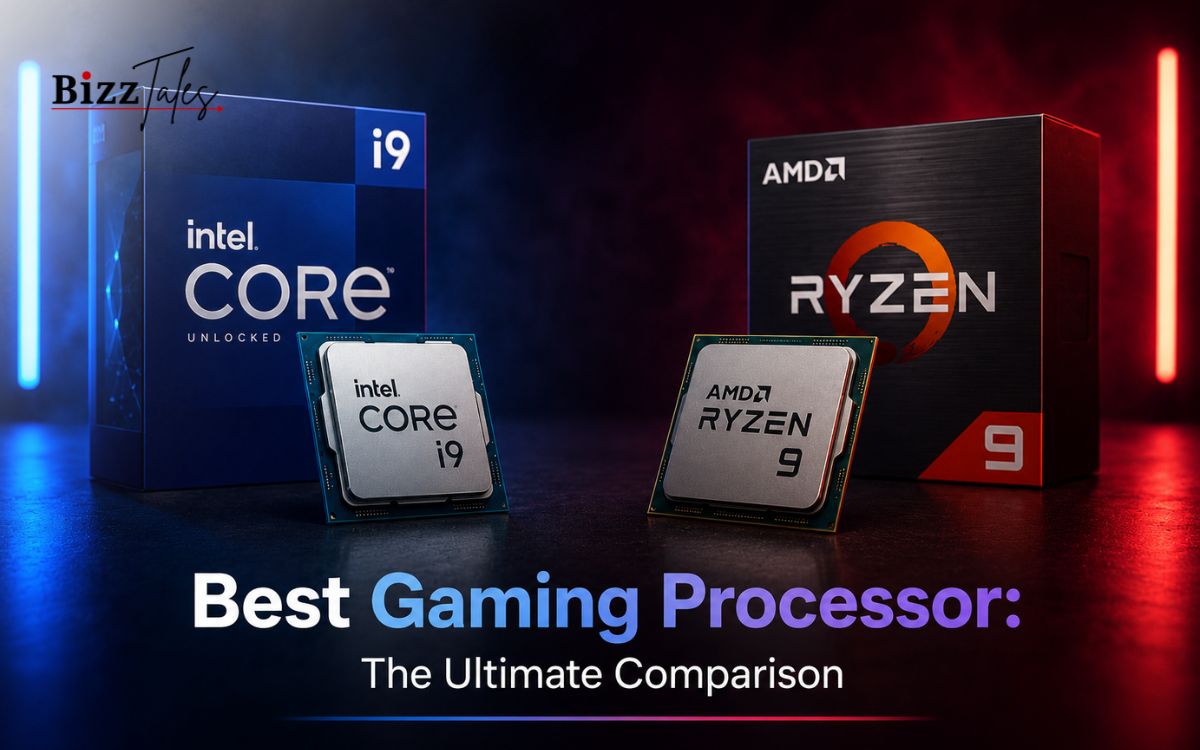
Gone are the days when most of the tinkering during the assembly of a gaming PC was concerned with the graphics card. While the importance of the GPU in a gaming PC has not diminished, gaming has now become very processor-dependent. The advent of complex physics engines, huge open-world environments, characters driven by AI, real-time calculations, and online multiplayer nature of today’s gaming mean that CPU performance is key.
As game Developers keep challenging technological frontiers selecting the right processor has become one of the most crucial decision for the avid gamer. Building a high end gaming machine, upgrading or simply putting together a budget gaming PC, processor makes all the difference.
The processor market has become more crowded than ever. AMD and Intel are still fighting for the crown and both are pushing powerful new architectures, aimed at gaming, content creation and getting a job done. From AI boosted processing to better cache architectures and hybrid core processor design.
Choosing the right gaming processor is more than just looking at the raw specs of the chip. Gaming performance, future proofing, power consumption and platform investment all play a part.
This in-depth comparison of discussion is among the top gaming processors 2026 and discusses the technologies that are to make gaming CPUs.
Why the Processor Matters in Gaming
A common misconception among gamers is that the graphics card is the sole component responsible for gaming performance. Since the GPU is in charge of displaying everything on the screen, it’s easy to overlook that there are a number of jobs the CPU has to do:
The CPU is responsible for processing game logic, the behavior of AI characters, physics calculations, moving elements of the game world, networking, and connecting the components of the hardware together. (In MMO’s, strategy games, simulators and sandbox games processor performance can be just as important as graphics.)
Bottlenecking: If you have a weak CPU and even the fastest graphic card then you’ll suffer this issue. It becomes increasingly apparent when gaming at lower resolutions where the CPU has to do more work.
Today, modern game development is leaning more and more towards utilization of multiple threads and task schedules. Games are getting more technically complex and processor speed is ever more crucial towards attaining higher frame rate and interactivity.
The Evolution of Gaming Processors
The evolution of gaming processors has been incredible over the past 20 years.
In the early days of gaming CPU performance enhancement was about speed. The realization that the higher the clock the faster the CPU was was thought to give an overall performance boost was the main goal of CPU manufacturers. However, this was never what it appeared.
Industry moved on to multi-core designs where multiple pieces of hardware could execute multiple instructions at the same time. Today’s gaming CPU’s have sophisticated architectures and can split tasks and execute instructions on multiple cores and thread.
In recent advancements, there has been the advent of bigger cache, performance cores, artificial intelligence acceleration engines, and manufacturing processes. These have led to a significant boost in gaming performance and increased energy efficiency.
Modern gaming chipsets are not only more powerful than those before, but they are also new forms of computing designed around the ever more complicated applications.
AMD’s Rise in Gaming Performance
Modern AMD AMD through the years- Over the years AMD has come to be one of the dominating forces in gaming processors as the “beat” competitor.
With Ryzen AMD changed the game, by bringing to CPU market stronger performing cheap solutions with great multitasking ability. AMD’s ongoing focus on architectural enhancements successfully challenged Intel dominance.
3D V-Cache. One of the most significant advancements AMD introduced to enhance gaming performance is the 3D V-Cache technology. They have managed to increase cache memory to a new level where delays can be minimized and performance levels maximized in various types of games.
This technology has shown to be very effective for CPU-heavy titles where the differential between latency of cache and main memory for example can clearly make a big difference.
As a consequence, having become a favorite among many gamers who want the highest numbers of frames per second, but also the longevity of platform value.
Intel’s Continued Gaming Leadership
Even though it faces intense competition from AMD, it is still a leading company in the gaming processor market.
Intel’s hybrid architecture is the execution of performance core + efficiency core resulting from combining two individual cores (performance core + efficiency core) into one processor design. It allows a processor to handle the gaming workload and background tasks concurrently, which can improve multitasking performance, efficiency and system responsiveness.
Most likely intel cpu will crush as for games that depend on high frequency and good ‘single core’ architecture compared to AMD Some popular game still running better:
The company has also made a significant investment in manufacturing technology, artificial intelligence capabilities and platform improvements, all targeted at enabling new gaming technologies.
Intel’s broad ecosystem, killer motherboard support and software advantages still makes it the choice of many a builder.
What Makes a Gaming Processor Great?
There are a number of different factors that influence whether a processor is good for gaming or not.
Single-core performance still persists as high clock speed, high performance architecture is a key component in many game engines.
As more developers design games to take advantage of more threads, multi-core performance is more important. More cores not only provide a performance boost in today’s games but also allow support for streaming, recording and multitasking.
Cache: Cache is one of most heavily used components in the gaming workload. The bigger the cache, the faster frequent data access is carried out
Power efficiency Finally, power efficiency is another crucial factor to keep in mind. More power efficient CPUs emit less heat, have lower cooling requirements and can hold up higher sustained performance for longer periods of playing games.
Finally, platform lifetime affects long-term value. Future chip-set upgrades should keep this processor viable for the future more.
Gaming Performance at Different Resolutions
It all depends on the gaming resolution how vital is processor.
Handbrake is a good example where 1080p frequently turns into a CPU bottleneck as the graphics card can often produce frames so quickly that the processor bottleneck is exposed. High-end competitive gamers are always after a fully loaded CPU to max out the FPS.
At 1440p the performance is dominated by the CPU and GPU. This makes choosing components for performance more critical.
At 4K resolution, most of the work tends to be done on the GPU. The processor still has to do some work but overall it is generally the GPU which affects the best FPS.
Having a good understanding of this relation is essential in order to help gamers properly estimate budgets when he/she has to build a system from scratch or upgrade their equipment.
Gaming Processors and Esports
Gaming within the scope of esports puts the processor through a different set of paces.
However, high responsive titles like first person shooters, battle royale and multi player online battle arena concentrates mainly on responsiveness, consistent frame, and low latency. The players typically set their graphic options to the lowest possible to obtain a higher fps and minimum delay between input/output.
In such cases the effectiveness of a processor becomes paramount. The clock rate, the performance in single threads and as well as the memory performance can make or break gaming experience.
Even on high refresh rate gaming monitors professional players in the lower tiers will generally opt for a CPU that is able to push many hundreds of frames per second with a high refresh rate gaming monitor.
With the rise of pro gaming all around the world, performance of a CPU still talks.
Streaming and Content Creation Considerations
Sometimes, with the claim that all they do is play games, the latter is merely the pretext for something far more serious.
Streaming/Content creation/video recording/production/Social media production has become intergrated into the gaming medias. Additional pressure is on the processor even from the standard gaming workload.
Being able to run your gaming, streaming, and background applications all at once definitely makes for a more enjoyable experience. Multi-core performance is definitely more appealing for a creator doing a lot of video editing, content creation or running applications while gaming.
In addition, more and more gamers are looking for every-bit-of-gaming-capability combined with every-bit-of-productivity capability, making all-around nature a more desirable trait.
Power Efficiency and Thermal Performance
Processor efficiency is now a big factor of PC builds.
Higher performing CPUs tend to require a greater amount of power and interfere with greater amounts of heat. This could lead to the need for more cooling, more power consumption and more noise.
Manufacturers further increase efficiency through advanced manufacturing processes and best processor architectures. Faster, cooler processors can sustain high performance.
When designing a smaller system for gamers or another system that needs to operate as quietly as possible, efficiency is vital equally to speed.
The future of CPU development is likely to move more towards optimizing performance in harmonious conjunction with economic and E nvironmental sustainability.
Future Technologies Shaping Gaming CPUs
The gaming processor industry always updated so fast.
Today we have modern integrated torchs for our processors, that focus on different breakdowns of artificial intelligences. These built features are a real breakthrough for games optimization, game control and performances.
Cutting-edge packaging technologies are allowing bigger cache sizes to be used on even more efficient chips. This could potentially improve the gaming performance without looking too much on the higher clock speeds.
New processors might also include more advanced machine learning abilities, more intelligent resource distribution and greater integration into cloud gaming systems.
As game technology develops, the CPUs will be more intelligent and adaptive.
Best Processor Categories for Different Gamers
Different gamers have different needs.
Competitive gamers will want the highest possible frame rate and response time. For these people, high single-core speed chips with strong cache features provide the best gaming performance.
Performance gamers-those who want the best can usually find the highest-end processors to get the processing power needed for gaming plus multitasking to keep their future needs covered.
Heavy content creators that also game need a processor that can keep up with heavy workloads in addition to gaming.
For price-sensitive consumers, a value-oriented processor that offers a good balance of price and performance might be more appealing.
Knowing specific needs helps determine the best processor category, not necessarily high-end processors.
AMD vs Intel: Which Brand Wins?
The AMD vs. Intel argument is one of the most popular points of debate for PC gaming.
AMD is now very popular among enthusiast I says because of 3D V-Cache and the great platform lifetime. A lot of gaming benchmarks report that AMD CPU is one of the best performance in gaming only workload.
Intel still delivers great gaming performance, robust ecosystem support and handsome products at various price points. Hybrid architectures can be advantageous for high multitasking or work-oriented users.
In fact, each company offers very good gaming CPU. It is mainly a budget problem, game types, future upgrade plans and expected workload.
Instead of a single winner, the AMD v. Intel rivalry ultimately profits consumers by motivating innovation and improving value industrywide.
The Future of Gaming Processors
The outlook for gamers’ processors is pretty bright.
The infusion of artificial intelligence, state-of-the-art manufacturing techniques, larger cache designs, increased accuracy and efficiency will progress to further benefit the technology in CPU performance. Game engines grow more and more advanced, processors become more important.
The nebulous future of cloud gaming, virtual reality, augmented reality and increasingly intelligent Ai-assisted gaming systems-even if games integrate with cross-platform social onlinecasting, turned-based multi-player libraries that can adapt voice over-will very much impose even more complex,” processing demands.
Gaming CPU series of the future will probably cater to more than just speed as they will be thinking of offering intelligence, adaptability, and efficiency.
This is great news for gamers, as it will bring us higher performance, improved gameplay and new and wonderful technology in years to come.
Conclusion
Deciding on the most suitable gaming processor is not as simple as looking at numbers. Today’s CPU’s effect your frames per second, lag, ability to run multiple tasks at once, streaming performance, and future upgrade potential.
Both AMD and Intel are still constantly pushing the limits of gaming technology by having new architectures, cache designs, and implementing AI etc and as a result have very good possibilities for gamers at all different price ranges and usage types.
The ideal gaming CPU is really dictated by what your priorities are. Competitive players might look for the highest FPS possible, while content creators might look for more multi-tasking prowess. Then there are the enthusiasts who are more after the longevity of a platform and future proofing.
As new gaming technology emerges and develops, processors are certain to be one of the most crucial elements of providing a great gaming experience. By choosing the right CPU now, gamers will be well equipped for many years and the next wave of digital entertainment.
FAQs
What is the most significant parameter of a gaming processor?
Most important things are performance in single-core, cache, architecture efficiency and gaming tune.
How does AMD vs Intel perform for gaming in the year 2026?
The great thing is that both perform great while gaming. But currently AMD holds the strong advantage in many of the gaming benchmarks meanwhile for multitasking Intel is dominating and holds the advantage in ecosystem.
Is a gaming processor impact FPS?
Yes. The frame rates are affected by the processor, in particular at 1080p and in the CPU bound games.
Cores-the question is, how many? Do gamers need 1, 2 or even 4?
Many of today’s gamers have six-to-eight cores, with streamers and creators likely to require even higher cores.
What will be the next generation of processors for gaming?
Our next generation of CPU is to encompass more AI features, become more efficient, implement new packaging technologies, and develop intelligent performance optimization vehicles.