
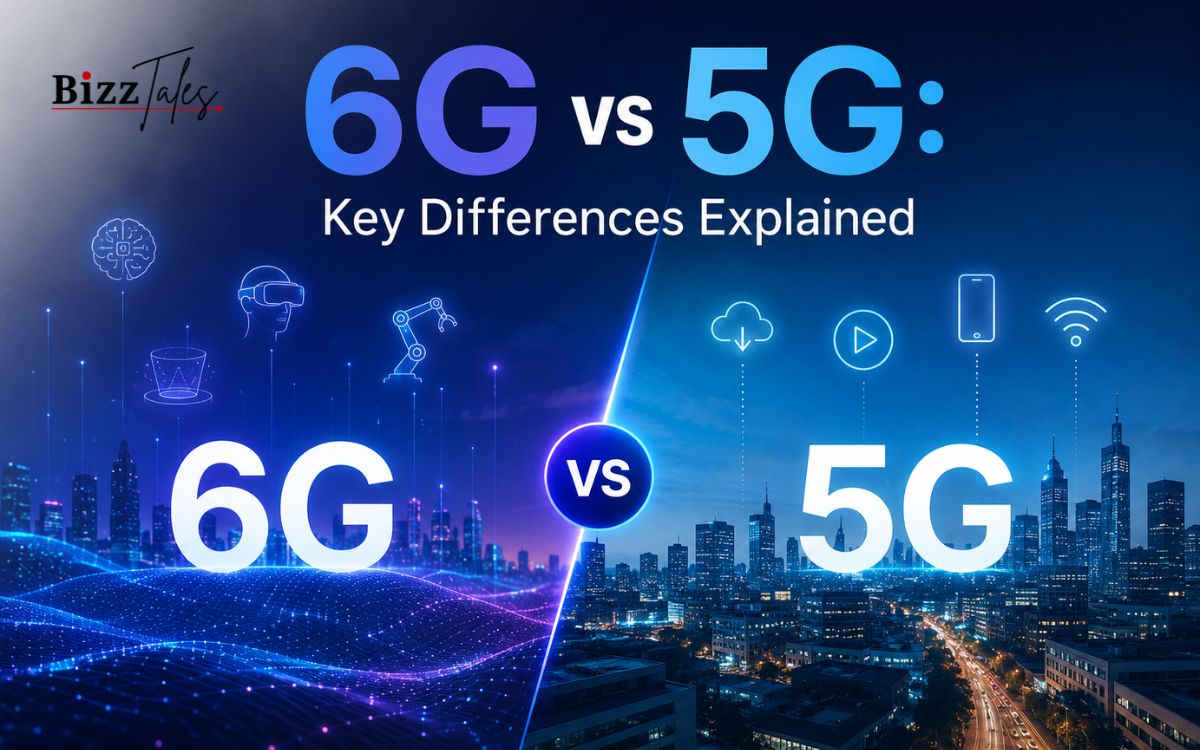
Today, the world is interconnected more than ever before and wireless communication technologies are pervasive as a core enabler in digital transformation. Be it mobile devices, smart homes, autonomous vehicles, or industry automation, mobile networks have seen rapid developments over the last few decades. Each generation of wireless technology has brought about faster speeds, increased reliability, and new capabilities that have forever transformed industries and lifestyles.
The deployment of 5G networks was a significant achievement in the history of telecommunications. Offering enhanced speed in data transfers and reduced latency, 5G technology also facilitates connectivity for countless devices worldwide. Despite the ongoing enhancement of 5G in numerous nations around the world, a new development was detected through extensive research, emphasizing the plan for the next decade to begin working on 6G, which might be roomed in the following years.
The move from 5G to 6 G will be a much larger leap than just increase in speeds. 6 G is anticipated by researchers to pave the way for a ‘smarter communications ecosystem where AI, automation, virtual experiences and IoT are streamlined at a new level.
It is important for companies, investors, governments and end users to be aware of the distinctions between 5G and 6G in order to gain insights into the future of connectivity and its impact on the world economy.
Understanding the Evolution of Mobile Networks
To understand the importance of 6 G, we need to get an idea of the progress in mobile communications.
First gen networks provided basic voice calls. 2nd gen systems provided digital voice services and messaging. 3rd gen networks provided mobile internet access whereas 4th gen changed the phone to a computer capable of providing video, social media and cloud based services.
With 5G, we moved from connecting people to connecting everything. 5G architecture and design was envisioned to accelerate smart cities, driving autonomous transportation, automating industries, enabling IoT-enabled devices and digital text.
6G will build on this progress, however, by intelligent networks that do not just connect devices but also learn from them, analyze their interactions, and make instantaneous adjustments to optimize communication. This next generation of connectivity will strengthen the bond between the physical and digital worlds.
What Is 5G Technology?
5G, a fifth-generation wireless technology, is the latest worldwide standard for mobile phone networks.
The main aims of 5G are significantly faster internet speeds, lower latency, increased network capacity and better support for connected devices. 5G achieves much more efficient data transmission than other generations, and provides live communication capabilities.
5G networks provide higher bandwidth speed 10Gbps, efficient internet transmission through the utilization of diversity of forward links & efficient use of the multiple access channels by integrating advanced technologies like network slicing, edge computing, massive MIMO antennas & millimeter-wave spectrum that enable businesses & business-holders enjoy the ease of fast downloads, streaming experiences, cloud gaming and also smart manufacturing & connected transportation.
Embrained has an impact at the enterprise level, currently power the digital transformation of the following industry: health care, logistics, manufacturing, retailing, education, entertainment.
Although 5G is an incredible achievement, researchers are aware that future application of 5 G will demand more than today’s networks offering.
What Is 6G Technology?
6G is the name given to the next generation of wireless technology being developed on a global scale.
It is anticipated that the commercial use of the 6G technology will not be introduced until the 2030s. Nevertheless, governments, research bodies, telecom firms and large technology firms were putting a lot of effort into 6G research.
The future of 6G is not just about accelerates internet speeds. Online networks built for 6G will likely incorporate AI directly into the communications framework itself, leading to self-optimizing networks.
It is anticipated that 6 G will include immersive technologies including but not limited to: Holographic Communications/ Mixed reality, Digital Twins, autonomous robotics, enhanced human-computer interactions, and much more.
Instead of just enhancing network capabilities, 6G endeavors to realize smarter connectivity to facilitate the upcoming advancements in digital culture.
Speed Comparison: 6G vs 5G
Speed is probably the most talked-about distinction: The degrees of 5G and6 G
Currently, 5G networks have the potential to provide hundreds of megabits per second to many gigabits of data per second, as the maximum obtainable speed in the best possible circumstances. This should allow for , for example, HD Video streaming, cloud gaming, video conferencing and some industrial uses.
6 G will increase dramatically the performance.
Researchers are even predicting theoretical speeds of 1 terabit per second or more. These would facilitate the transfer of large data sets in what seems like a blink of an eye, and would allow for capacity-hungry applications that wouldn’t be feasible in today’s bandwidth.
For industries, such speed boosts could speed up commercial cloud computing, enable real time artificial intelligence, and revolutionize data hungry fields like healthcare, scientific analysis and advanced manufacturing.
The gradual reduction in network lag will probably usher in entirely new categories of digital services and experiences.
Latency and Real-Time Communication
Latency is the amount of time it takes until the data you sent gets back to you.
A key advantage of 5G is the ability to achieve few m sec latency which turns out to be a significant enabler for applications such as remote surgery, driverless cars, industrial automation, etc.
6G is expected to bring the latency down to an even lower level.
Experts foresee sending and receiving information on the order of millennia, reaching microsecond or even nanosecond delays in some cases. Such achievement would facilitate highly reactive mechanisms that could sustain sophisticated real-time communications.
For instance, factory robots could work together without delay. Drilling operations and other medical operations could be performed on patients far away with greater safety and precision. Virtual reality and augmented reality applications could run smoothly at faster speeds.
Ultra-low latency will be critical for next-generation intelligent systems and robotics.
Artificial Intelligence Integration
Perhaps the most revolutionary feature of 6G will be its intention to mesh with artificial intelligence.
Though 5G networks can be used to run AI applications the AI applications are implemented outside and independent of the network infrastructure.
6G will have AI integrated into its fundamental structure. Smart systems will constantly monitor traffic flows, manage resources more efficiently, forecast network faults and enhance network operation on their own.
This feature will generate autonomous learning and self-governing communications systems to surpass the present networks] efficiency.
More reliable, lower operating costs and better service quality for companies. The AI-native network could potentially fast-track the growth of autonomous industries. That are sets of services suited for industries that optimize through decision making in real-time and adaptive communication networks.
Spectrum and Frequency Advancements
The 5G networks use mainly the sub-6 GHz bands and the millimeter-wave range.
Although these frequencies achieve significant improvements over the old technology, they still do not deliver the effectiveness required for capacity and performance.
For 6G the research is being carried out on the usage of teraherz which will support more than 10 giga bits per second.
Such higher frequency bands might offer enormous bandwidth enhancements suitable for next-generation uses such as hologram communication, intense virtual reality, and extensive device-to-device communications.
Though, there are engineering constraints associated with terahertz communication such as propagation of signal, types of infrastructures and the potential high power consumption.
The solutions to these issues continue to be a primary concern of 6G research worldwide.
The Role of 6G in Smart Cities
Smart cities are definitely one of the most promising applications of future wireless technologies.
Existing 5G networks already enable connected transportation, intelligent utilities, environmental monitoring, and smart infrastructure.
6G would push these possibilities even more.
In the not-too-distant future, smart cities might look like intelligent transportation systems, where driverless cars move efficiently through AI-optimized traffic; smart grids, providing dynamic interaction of renewable and conventional energy generation; next generation public safety; and digital twins providing a real-time map of a whole city.
The combination of all these capabilities allow improve efficiency, sustainability, quality of life and could help states better control urban resources.
Global intelligent city development will be one of the keys for 6G adoption.
Business Opportunities Created by 6G
The rise of 6G will open huge economic opportunities in many sectors.
Telecommunications companies will pour resources into network infrastructure, equipment and services. IT companies will create innovative applications, devices and software platforms for next generation connectivity.
Sectors including hospitals, manufacturing, logistics, entertainment, educational, and travel will witness improved functions catering to automation, AI, and Virtual reality.
As 6G ecosystems continue to develop, innovative opportunities in robotics, extended reality, digital twins, edge computing, and AI-enabled services could emerge for start-ups.
Indeed, it is forecast that over the coming decades 6G has the potential to contribute trillions of dollars to the global economy.
Challenges Facing 6G Development
6G has great potential, but there are some difficulties.
To establish new communication standards will take vast effort through research, collaborations of researchers worldwide and a high financial outlay to develop the needed infrastructure.
Efficiency is another key issue. Future networks should be providing higher performance without destroying of mankind.
Security and privacy. As more and more devices become connected to intelligent networks, the challenge will also be to secure private data and combat cyber attacks through sophisticated cybersecurity regime.
The combination of regulatory oversight between countries will be crucial in ensuring international interoperability and successful deployment.
Progressing these issues will greatly influence the rate of and success of 6G deployment.
How 6G Could Transform Industries
According to many experts, the greatest effect of 6G will be mainly the industrial and enterprise realm.
Some manufacturing plants might employ AI-enhanced robotics and digital twins to that scale. Some healthcare providers might take advantage of cutting edge telemedicine and remote diagnostics through ultra-low latency links.
Ed institutions might employ immersive learning spheres utilizing holographic questions and virtual learning. Logistics firms might operate driverless large trucks through smart networking.
Consumption may have as many as completely immersive digital worlds that seamlessly integrate physical and virtual features.
These examples show how 6G can become the enabler of the future digital transformation.
The Future Beyond Connectivity
Going from 5G to 6G is a paradigm shift.
While 5G is all about connecting devices and providing faster communication, 6 G will make networks smarter, able to think, adapt and improve interaction between humans, machinery and digital life.
Most significantly, this change could transform how our societies communicate, work, learn, move and do business.
6G is not just a communications upgrade. Its true significance is that this technology will be an enabling platform for innovation over almost every task of our economy.
Conclusion
Fundamentally, the comparison of 5G and 6 G acts as a reminder of the rapid development taking place in the field of wireless technology. As 5G continues to enhance lives by delivering connectivity to just about everything, 6 G embarks upon a new world of intelligent connectivity by harnessing the power of artificial intelligence, offering higher speeds, eliminating latency and creating an immersive experience.
Today, corporations, governments and technology leaders are starting to prepare for a future in which communication networks will become a critical part of decision making, automation and innovations. While the rollout of 6G networks around the world is still a way off, its effect on the global economy could be dramatic.
In many areas of technology and development it is introduced that 6 G will in the future be one of the most influential technologies of the following decade. Impacting all of the industries, societies and digital worlds across the world.
FAQs
How does 6G differ from 5 G?
The fundamental difference will be that 6G will deliver speeds far beyond 5G, have lower latency and deep AI integration.
What will be the speed of 6 G?
Researchers anticipate speeds of 5G to hit 20 gigabits per second but 6G could theoretically hit speeds of one terabit per second!
How soon can I get 6G?
The leading indicators and market research all suggest that most experts forecast the commercial release of 6G during the early 2030s.
Will 6 G totally replaces 5G?
The overwhelming trend of the current forecasters is that 6G would gradually heighten the complements and eventually replacements to 5G network along the chronological progression.
What area will 6G be most valuable in?
Significances are realized for the most part in some domains such as healthcare, manufacturing, transportation and its related issues, education, entertainment, logistics, and smart city projects.
What role does AI play in 6G?
Self-optimizing networks will be made possible by AI. It will also bring efficiency and security. AI will also help autonomous systems to make decisions on the fly.