
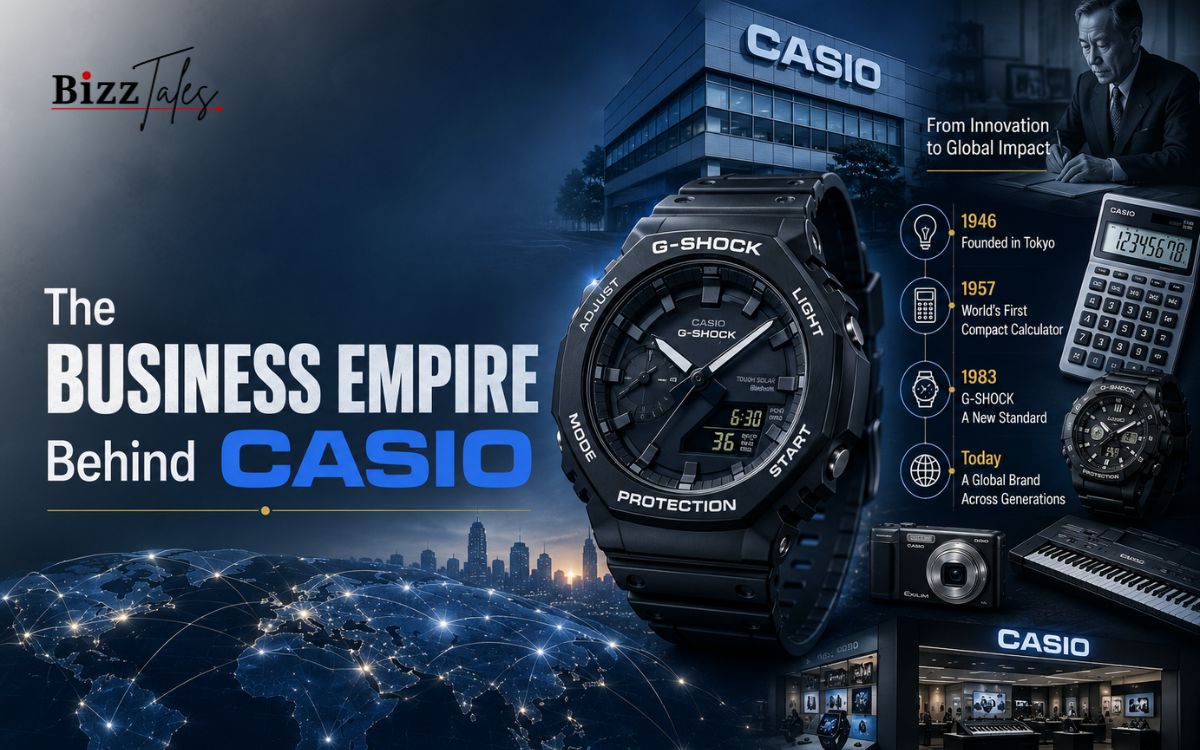
In a list of most popular watch brands globally, we tend to see luxury brand names like Rolex, Omega, Patek Philippe, among others. But what we don’t always see is Casio, a company that has quietly established some of the most successful and recognizable business empires, worldwide watch industry The reason for this is that Casio uses a completely different approach than luxury brand names. While the latter relies on luxury and immunity, Casio on bringing technology for everyman’s reach. The company’s evolution is one of the most astounding business stories of the modern world.
Over many years, Casio has been a global brand par excellence. From the timeless digital watches carried by students to the hardwearing G-shock ranges that have become a favorite among sportsmen and armies, or the calculator brands that will need to have been seen in every school in the country over the past half-century, the brand has been an ever-present name. This mixture of value, ingenuity, reliability and mass-market acceptance has created an empire that spreads way beyond wristwatches.
So Casio today is an example of a company that could dominate in those mass markets without having to be positioned as a luxury brand. Instead it has built its business on providing solutions to real problems, adopting technological change and providing customers with value.
The Humble Beginnings of Casio
The origins of the company go back to Japan after the war, when the country was reconstructing its economic structure and industries. Casio was established in 1946 by the talented engineer Tadao Kashio, The company initially did not produce watches or consumer electronic products. It developed and manufactured micro-mechanical parts and little gadgets and inventions meant to make life easier.
The Company’s first successful product was the ‘Yubiwa Pipe’; a clever way of holding a lit cigarette in order for the smoker to draw on it until the last joint of tobacco, without any risk of burning themselves. Although inconsequential in today’s world, it made some money and turned the course of future happy accidents.
What separate Casio from most other companies at the time was the fact that, the company invested heavily on research and development, ensuring their products were true solutions to consumers needs, not by copying revolutionary products. This factor would grow to be one of the main contributing factors of Casio’s worldwide success.
Revolutionizing the Electronics Industry
In the 1950s and 1960s, Casio turned its focus on electronics. It realized that they would be influential in the future and so the company started heavily investing in electronic products.
A key achievement for Casio was in calculators. When a calculator was a large, expensive, business-oriented electronic device, Casio launched affordable and portable electronic calculators. It revolutionized market and simplified calculation.
The triumph of the Casio calculators confirmed the company as a leading technology innovator. But more significantly, it also validated a way of thinking that the company would stick to for many years to come: using technology to help make ordinary people’s lives easier and more affordable.
Not only has the company been able to establish strong faith amongst its clients, but the ability to burst into new markets has been enabled by this strategy.
Entering the Watch Industry
The company started in the 1970’s time when the watch industry saw many disturbances and upheavals. Before, classic mechanical watches ruled the market and watching business became changed with advances in Quarts.
Most traditional watchmakers refused to adopt the electronic revolution. Fortunately, Casio did.
The company realized that customers were demanding a use for a watch other than just telling the time. So they started working on creating digital timepieces that had alarms, calendars, stopwatches and calculators.
Immediately these goods caused a stir as they offered something that conventional watches failed to do.
Casio watches were especially well received by students, competent workers, and technology geeks who valued their functional design and affordability.
Wholeheartedly devoting itself to innovation rather than tradition, Casio indeed sets itself apart from many others.
The Birth of G-Shock
Perhaps nothing has done more for Casio’s business empire than the G-Shock.
In 1983 Casio introduced the G-Shock, originally designed for a straightforward but tough objective: to create a watch that could withstand the harshest environments.
Back then, watches were pretty fragile products. If a watch was dropped, it typically broke. The engineers at Casio believed they could prove this wrong.
After much research and testing, the company released the first G-Shock model.
The crafted a shock resistant developed that could endure falls, shakes, great surroundings, and effects. At first it did seem just a little strange. Still, it was readily appreciated by customers.
The product gained traction among athletes, soldiers, explorers, construction workers and outdoor types.
For years, G-Shock became a worldwide phenomenon. What once was a tough tool watch grew into a fashion icon with a following in every corner of the world.
Today G-Shock is one of the most successful collections of watches ever designed-bring in a lot of income for Casio.
Why Casio Became a Global Brand
One of the biggest strengths of growth of Casio is that it has been successful in attracting a variety of consumer groups in different countries and cultures.
However, in contrast to luxury brands, which market to a relatively niche group, Casio was interested in making its products affordable to the general consumer.
The offering was low enough for students, dependable enough for professionals, and innovative enough to swing tech aficionados.
This led to a varied customer base. This product brand as well as cash inflow seeps into a broad customer base which has resulted in rapid expansion of the company into the global markets.
Casio realized that worldwide success could only be achieved by achieving the equilibrium between a price that consumers could afford and the quality that they expect
There is often a promise that the company made.
This made Casio one of the most recognizable brand of watches, and an electronics manufacturer.
Innovation Remained the Core Strategy
While many companies make it big with one product and then flounder, Casio kept on its toes and survived with a multitude of products for several decades.
Many of the other company products were similar to competitors’ ones, but they also launched products such as solar-powered watches, radio-control systems, GPS-enhanced equipment and digital high-end.
Casio, for instance, also responded to evolving consumer tastes by manufacturing products that furnished the useful and the visually pleasing.
Although the smartwatches came on stream, Casio kept innovating.
Rather of battling it out with technology giants, the company decided to build their unique advantage – the durability, reliability, battery power, and specialty features:
And such adaptation, without sacrificing the core essence of the brand, has been one of the keys to Casio’s long term success.
Building a Business Beyond Watches
But while watches still define a significant portion of who Casio is, it was in the diversification of their business that Casio really established its empire.
All of these things, along with calculators, musical equipment, projectors, camera’s, programs and electronics, have helped expand it.
In few other fields has there been such brand equality across categories.
It also diversified the sources of business, spreading the risk over more markets and giving more sources of income.
Taking this further, it wasn’t just families of students growing up that would have bought Casio calculators but generations of students using them. Casio can become associated with something and enter peoples’ minds as the thing to go to-for instance a trusted learning aid.
Also, there are many people who are introduced to music through Casio’s electronic keyboard.
Furthermore, by targeting several markets at the same time, it built a very flexible organization.
Challenges in the Digital Era
All big companies go through their problems and Casio is no exception.
The popularity of cell phones led to a dramatic decline in the market for items like calculators, digital cameras, or even just ordinary watches. A large number of experts forecasted that conventional watch factories would have a difficulty in the modern interlinked environment.
But Casio bounced back handily.
Rather than abandoning its core business, the firm concentrated on reinforcing strong product categories with competitive edges.
The positive factors such as the G-Shock’s growing popularity, increased use for educational purposes, and the strong reputation for hardwearing products of electronics distributed by Casio helped to counter some of these issues.
Casio’s concern to change without losing its public image exemplifies the significance of strategic flexibility.
Lessons Entrepreneurs Can Learn From Casio
There are many lessons to be learned from the Casio story for an entrepreneur and Business leader.
It’s important to remember and not to necessarily associate innovation and luxury. Innovation is about creating something new and writing about newbie answering the question “How do I do this today?” is not always about luxury products (here is an example of a successful innovation: Casio).
And secondly, the most successful product is more likely to meet a significant business/technological need rather than a fashionable trend. The best-selling products of Casio, for instance, are target at many consumers’ real needs.
Third, diversification leads to stability. Through diversification into different groups of products, Casio was able to mitigate the risks involved in running a business and took the opportunity for doing good growth.
Lastly, consistency is crucial. For decades, consumers linked Casio to value, quality and innovation. This remarkable brand image became one of the company’s most significant strengths.
Conclusion
The giant business network that lies behind the product axis of Casio powerfully demonstrates the importance of innovation, flexibility and innovative horizons-orientated thinking. Starting in post-war Japan, Casio has gone from state-of-the art to internationally acclaimed electronics and watch brand.
Though luxury watch brands tend to get more focus, Casio has undeniably touched the society. In fact, it has been influencing up in education, technology, fashion, and every household with its product for several generations.
The venture makes it clear that you don’t need exclusivity to build a successful business. The best solution can sometimes be providing customers with something that makes their lives easier, and making it financially viable too.
But even out of the ashes of the defunct Hattori, Casio still prospered and persisted – which demonstrates that a fusion of innovation and value can build a formidable business empire that will last.
FAQs
Why did it become « THE » manufacturer who made Casio famous all over the world?
MSI gained immediate public notoriety because of the production of innovative calculators, digital watches, G-Shock watches, and consumer electronics.
What makes G-Shock so well-liked?
G-shock Timepieces are renowned for their robust, highly shock resistant durability and overall long-lasting nature.
Casio is a company, which-generally speaking-effect more than just producing watches.
No. Casio-Electronic devices, calculators, musical instruments, learning-utilities and other consumer items.
What advantage gained Casio compared with other luxury watch brands?
Casio concentrated on affordability, innovation, practicality and reliability instead.
What take away from all this. We all have some lessons here. What’s the biggest one?
The major learning point that can be learnt from this case is that innovation and value creation for the customer can create a truly global brand even outside the luxury segment.