
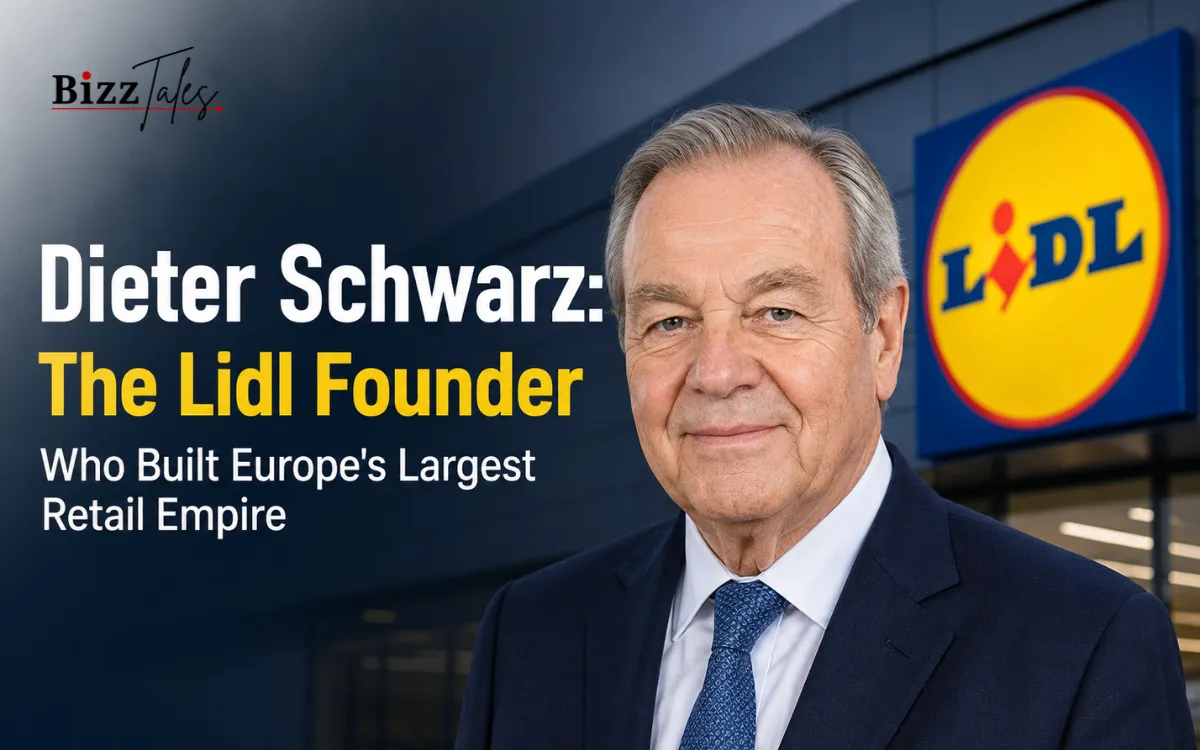
Dieter Schwarz, was one of the most successful retail entrepreneurs of modern times and was the force behind the two leading retail chains, Lidl and Kaufland. Built by the Schwarz Group, his empire turns over $200 billion a year worldwide. It contains thousands of stores, spread across Europe and the US. Yet despite this, he is one of the world’s most reclusive billionaires; rarely giving interviews or making appearances.
His excellent evolutionary path, from running a family business selling wholesale fruits to establishing the biggest retail group in Europe, demonstrates the power of an evolutionary long term vision, operational efficiency and prudent growth strategies. Today, millions of customers benefit from the services of Lidl and Kaufland, and the Schwarz Group is one of the largest retail chains.
While most richest people in the world made their money in technology or finance, Mr. J. C. Penney became established by dominating one of the most cutthroat businesses in the world: retailing.7
Forbes Ranking & Net Worth History
| Year | Forbes Global Rank | Net Worth |
| 2026 | Top 40 Global Billionaires | Approximately $66.4 Billion |
| 2025 | #37 | $41 Billion |
| 2024 | Germany’s Richest Person | Approximately €43.7 Billion |
According to Forbes and multiple wealth rankings, Dieter Schwarz remains among the wealthiest individuals in the world and consistently ranks as Germany’s richest businessman.
Early Life and Family Background
Dieter Schwarz was born on 24 September 1939 in Heilbronn, Germany.
His father, Josef Schwarz, was engaged in the fruit wholesale business, Brand der Lidl & Co. In its initial years, the family enterprise concentrated on food brokerages and distribution.
Since childhood I grew up in the business environment and was introduced to commerce, servicing and enterprise well before my tenth birthday.
Unlike many billionaire founders who began life from absolutely nothing, Schwarz was handed something to begin with. But turning that into a retail empire worth hundreds of billions required unprecedented leadership and drive.
Learning the Business
After completing his education, Dieter joined the family company.
He spent years learning different aspects of the business, including logistics, procurement, inventory management, and customer operations.
These experiences provided a deep understanding of retail economics.
Rather than immediately pursuing rapid expansion, Schwarz focused on mastering operational efficiency.
This disciplined approach would later become one of the defining characteristics of the Schwarz Group.
Many of the systems and management principles he developed during these years continue to influence the company’s operations today.
The Birth of Lidl
In 1973 the dawn of the economy was marked by the opening of the first Lidl branch by Dieter Schwarzkind.
The basic ideas behind each of the 3 countries were most directly applicable in this way, for at the time, discount retailing was still new in Germany.
Schwarz thought that consumers want quality items at lower prices without any extra costs.
It was concepted and it worked.
Lidl gained popularity by maximizing efficiency, private-label products, rapid execution, and sharp prices.
The growth of the company was becoming rapid across Germany and then spread outwards internationally.
Becoming CEO
After his father died in 1977, Dieter Schwarz took over asCEOof the company, ushering in an unprecedented period of growth. He dreamed big and expanded far beyond German borders, planning for a retail chain that would span all of Europe. He grew the company rapidly but controlled that expansion in a savvy manner, growing it from a regional business into the behemoth it is today.
Building Lidl into a Global Giant
Throughout the 1980s and 1990s, Lidl expanded rapidly.
The company entered multiple European markets and successfully replicated its low-cost operating model.
Its competitive advantages included:
- Efficient supply chains
- Private-label products
- Low operating costs
- Strategic store locations
- Strong purchasing power
Consumers responded positively to the combination of quality and affordability.
Today, Lidl operates approximately 12,000 stores worldwide, making it one of the largest discount supermarket chains on the planet.
The Creation of Kaufland
Although Lidl maintained its low-price strategy, the Schwarz group established a complementing business of supermarkets and hypermarkets. 1984 saw the opening of the first Kaufland supermarket. As compared to its sister Lidl, Kaufland is considerably larger and provides a larger variety of goods.
This dual approach enabled the group to cater to a variety of needs. Following expansion throughout Germany and then further into Central and Eastern Europe, there are now over 1,400 stores operated under the name Kaufland.
The Schwarz Group Empire
Over time, Lidl and Kaufland became part of the larger Schwarz Group.
The organization expanded beyond retail into:
- Food production
- Beverage manufacturing
- Logistics
- Recycling
- Environmental services
- Digital technology
- Cloud computing
This diversification strengthened the group’s competitive position and reduced reliance on traditional retail margins.
Today, Schwarz Group generates more than €175 billion in annual revenue and employs nearly 600,000 people worldwide.
International Expansion
One of Schwarz’s greatest achievements was international expansion.
Many retailers struggle when entering foreign markets.
Lidl succeeded across numerous countries by adapting to local consumer preferences while maintaining its core value proposition.
The company expanded into:
- France
- United Kingdom
- Spain
- Italy
- Poland
- United States
- Numerous other markets
Its ability to balance standardization with localization became a major competitive advantage.
Entering the United States
In the United States the grocery industry has been difficult because several competitors dominate the landscape. However, the company entered the market here as well and it continues to grow, although it has been at a slower pace then when Lidl made its foray into Europe.
It continues to put resources into U.S. Expansion, which proves that Schwarz isn’t afraid of playing in markets where competition is already fierce but believes it has long-term promise.
Innovation Beyond Retail
In recent years, Schwarz Group expanded into technology and digital infrastructure.
The company launched initiatives involving:
- Cloud services
- Cybersecurity
- Data management
- Digital transformation
These investments reflect recognition that the future of retail increasingly depends on technology.
The strategy positions Schwarz Group to compete not only as a retailer but also as a technology-driven enterprise.
This evolution demonstrates the organization’s ability to adapt to changing market conditions.
The Mystery Billionaire
Interestingly about Dieter Schwarz, the one that interests us is above all his will for confidentiality. In contrast to many businessmen of his status that we often find giving speeches or interviews in the media, Mr. Schwarz stays largely out of the spotlight.
Indeed, few photos of the businessman are even published in public, not much information about his personal life is available and he very rarely gives interviews or the occasion to meet him.
All this makes him known as the most discreet among all world billionaires.
Philanthropy and the Dieter Schwarz Foundation
Despite his private nature, Schwarz is widely respected for philanthropy.
Through the Dieter Schwarz Foundation, he supports:
- Education
- Universities
- Scientific research
- Innovation programs
- Child development
- Community projects
The foundation has invested heavily in transforming Heilbronn into a center for education, technology, and innovation.
Many observers consider these initiatives among the most significant philanthropic efforts in Germany.
Leadership Style
Dieter Schwarz is known for discipline, operational excellence, and long-term thinking.
His leadership philosophy emphasizes:
- Efficiency
- Cost control
- Customer value
- Continuous improvement
- Strategic expansion
Rather than pursuing rapid publicity-driven growth, he focused on building sustainable competitive advantages.
This approach helped Schwarz Group outperform numerous competitors over several decades.
Many retail executives study Lidl’s operating model as an example of successful retail management.
Personal Life
Dieter Schwarz married Franziska Weipert in 1963.
They have two daughters and are currently living in the city of Heilbronn, Germany. Despite being extraordinarily wealthy, Dieter Schwarz lives a very quiet life.
His private life is one of the most remarkable aspects of the entrepreneur.
Official Social Media Presence
Dieter Schwarz maintains no major public social media presence.
- Instagram: No verified personal account
- X (Twitter): No verified public account
- Facebook: No official public profile
- LinkedIn: No major personal public profile
Most information regarding Schwarz comes through Schwarz Group announcements, business publications, and financial media coverage.
Lessons Entrepreneurs Can Learn from Dieter Schwarz
The greatest lesson is operational excellenceSchwarz not always ran behind time, the value, but efficiency with customers. His success also teaches us important principles of long term view.
The group in Germany only reached its current state during decades, not just several years. These entrepreneurs can learn from careful approach to expansion, careful consideration of all cost aspects, approach to quality and optimization.
His career teaches us a lot of basics, from which great success can be built, rather than by constantly disruptive activities.
Conclusion
Dieter Schwarz’s transformation of a family wholesale business into Europe’s largest retail empire stands among the greatest entrepreneurial achievements in modern business history. Through Lidl, Kaufland, and the Schwarz Group, he created a global organization serving millions of customers while generating hundreds of billions in annual revenue.
His influence extends across retail, logistics, technology, manufacturing, and philanthropy.
Today, he remains Germany’s richest businessman and one of the most respected figures in global retail.
For entrepreneurs, business leaders, and aspiring founders, his journey offers powerful lessons about discipline, efficiency, strategic thinking, and the value of building sustainable businesses over the long term.
FAQs
Who is Dieter Schwarz?
Dieter Schwarz is the German billionaire entrepreneur behind Lidl, Kaufland, and the Schwarz Group.
What is Dieter Schwarz’s net worth in 2026?
His estimated net worth is approximately $66.4 billion, making him one of the richest people in Europe.
What companies does Dieter Schwarz own?
He owns the Schwarz Group, which operates Lidl and Kaufland.
When was Lidl founded?
The first Lidl store was opened by Dieter Schwarz in 1973.
What is Kaufland?
Kaufland is a European supermarket and hypermarket chain owned by the Schwarz Group.
Is Dieter Schwarz Germany’s richest person?
Yes, he has consistently ranked among the wealthiest individuals in Germany and often holds the top position.
How many stores does Lidl operate?
Lidl operates approximately 12,000 stores worldwide.
Why is Dieter Schwarz so private?
He is known as one of the world’s most reclusive billionaires and rarely appears in public or gives interviews.
Is Dieter Schwarz involved in philanthropy?
Yes. Through the Dieter Schwarz Foundation, he supports education, science, research, and community development.
What can entrepreneurs learn from Dieter Schwarz?
Entrepreneurs can learn operational excellence, efficiency, disciplined growth, customer focus, and long-term strategic thinking.