
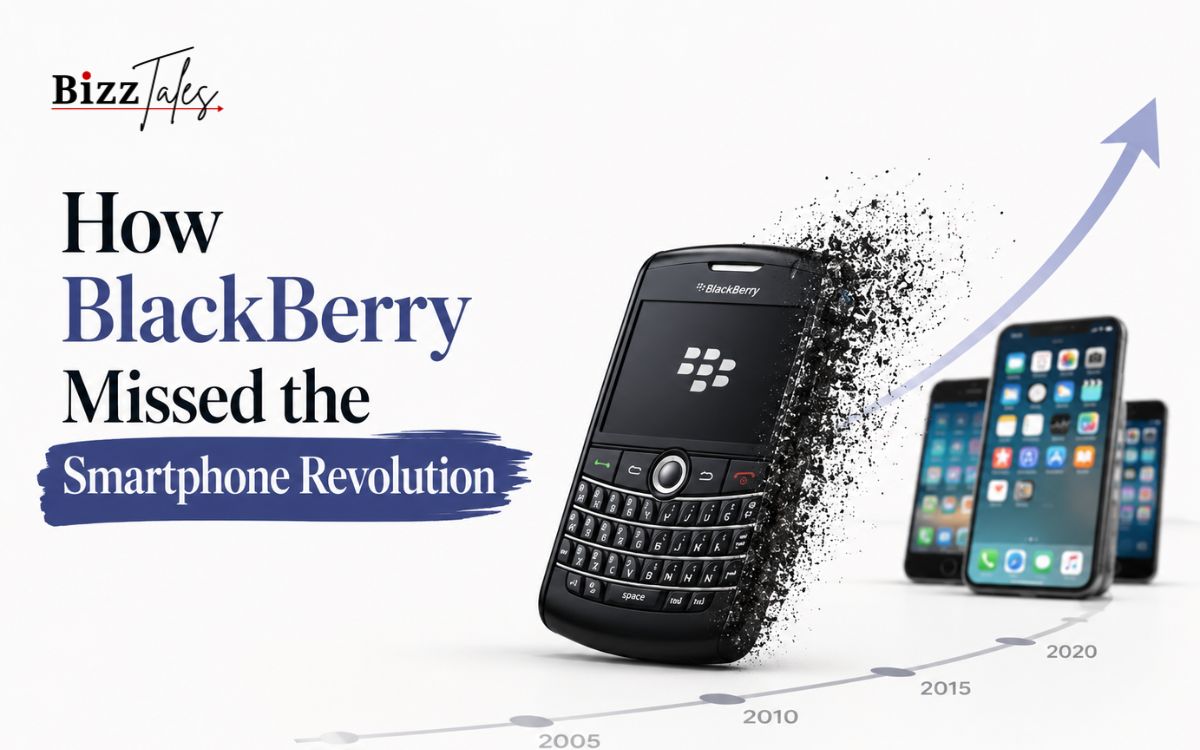
Today-everywhere in the world, everyone is talking about companies like Apple, Samsung, Google, Xiaomi, and other Android manufacturers. Hundreds of millions of people are using touchscreen smart devices running the world’s most advanced operating systems that are capable of a lot more-from video-streaming and chatting to AI, and even paying.
However there was a time when the phones looked very different. BlackBerry was king of mobile messaging long before the iPhone revolutionized the industry and Android became the world’s dominant mobile platform.
For business people, politicians, executives, small business owners, and even celebs, a BlackBerry was a sign of success. The devices were known for their keyboards, their safe email systems, and their business-oriented features. BlackBerry once had a huge percentage of the world’s phone market share. Almost everyone called their smartphone a “BlackBerry”.
I do not think there were many companies that seemed better placed for the future. But in just a few years time, the power of BlackBerry was gone. Reduced the mighty company that had defined mobile productivity. Today, the downfall of BlackBerry is always used as one of the most significant case studies of disruptive market change in modern business schools. It’s not just about a company losing market share.
It’s an example of how even people at the top of organizations will suffer when technology change is happening faster than they can cope.
The Rise of BlackBerry
Blackberry’s history started in Canada,where by a company named Research In Motion widely known as RIM,
Research In Motion (RIM) was established in 1984 by Mike Lazaridis and Douglas Fregin. Since its inception, the company has specialized in technologies related to wireless communications. RIM, over the years, came up with products that helped users to send and receive messages on the mobile phones.
It was far more useful for communication – as Companies were eager for advancements to be made easier.
Throughout the late 1990s and the early 2000s, BlackBerry gained popularity as they introduced new features which up until then were unheard of:
Enhanced email access from the mobile.
In 1999 no one could imagine receiving email on the go. Today, checking email on your phone seems second nature. A few years ago it was revolutionary.
Executives no longer needed to sit in front of a desktop computer to be connected. They could get messages any time, anywhere.
This convenience gained BlackBerry a necessity.
The company’s standing grew even faster as it received more and more adoptions.
Why Business Professionals Loved BlackBerry
There were a couple of main reasons for the strong success of BlackBerry in the beginning.
The most glaring being without a doubt the productivity of.
BlackBerry devices are also marketed as being enager-friendly. They were originally intended for use by the business consumer. The keyboard, for example, enabled quick and accurate input, and email-writing was easier than on many competing products.
Another benefit was security.
The authorities, businesses, banks and any entity responsible for classified data favored the encryption of BlackBerry communication.
Has the company’s reputation for security. Few rival companies could equal this credibility.
Battery life was yet another positive.
BlackBerry devices tended to have much longer battery life than other smart phones which was good for busy people.
Customers appreciated the honed mix of security, productivity, dependability and speed of communication.
BlackBerry a seemed to be invincible for years.
Market Dominance at Its Peak
As of mid-2000s, BlackBerry was one of world’s most successful technology companies.
It was in widespread use in North America, Europe, Asia and others.
Government officials were dependent on BlackBerry for communication.
Executives in the companies all believed it was an essential office tool.
Stars and public figures got behind the brand.
The firm made billions of dollars in revenue and had healthy profit margins.
Shareholders considered Blackberry to be a technological leader.
Several in the industry thought the company would be the king of the road for many years to come.
But driven by the success one heard of changes, beginning to showed up.
Consumers’ anticipations were slowly changing.
Technology was moving forward at a massive rate.
The smartphone world was set to be turned upside-down.
The Arrival of the iPhone
Arrived in 2007: the first do it all device: the revolutionary iPhone.
Initially, most people thought of it as a little-brand consumer product rather than a genuine commade BlackBerry.
It was a smart phone without a no keyboard.
It put a lot of emphasis on both entertainment and the user experience.
Most customer-oriented businesses were quick to judge it as being just another product for consumer use.
Among them was BlackBerry.
The company’s management held onto the view that keyboards were needed to remain productive.
They figured people would keep using email because it would be faster than using the touch screen.
This assumption has proved to be very costly.
The iPhone established a radically new mindset for mobile computing.
Instead of being mainly an device of communication, it made the cell phone a portable computer.
New application types, experiences, and interactions became possible thanks to the advent of touchscreen interfaces.
Customers were delighted.
Behind the scenes, the industry was starting to drift down a different path.
The Android Explosion
If the iPhone kick started smartphone revolution, then Android certainly turbo charged it.
The existence of the Android operating system from Google made entry into the cell phone world possible for several manufacturers.
Clinched buy utilizing myriad websites depicting increasingly mastery devices such as,
Increased rivalry.
Innovation was speeding up.
Consumers could afford a variety of smartphones. At all price rangs.
With the explosion of app ecosystems.
Mobile devices took on new roles such as, entertainment, maps, browsing and camera etc.
But BlackBerry simply was unable to adapt.
Its main strengths diminished in importance as consumer priorities changed.
The focus wasn’t just on email and instant messaging anymore.
There was a platform economy established for software applications.
The Fatal Underestimation of Apps
Software ecosystems were one of BlackBerry’s biggest mistakes.
The launching of the Apple App Store and the Google Play Store was a revolution in how people used smart phones.
Applications are now the dominant element driving engagement.
Consumers demanded social networking sites, games, productivity applications, streaming providers, navigations utilities, and a myriad of other digital services.
Developers concentrated on popular, high-growth platforms.
Apple and Android rapidly became the first choices.
Developer adoption didn’t really take off for BlackBerry.
Its ecosystem of application was still a whole lot smaller.
Due to consumers prioritizing app availability, the platform became less competitive.
We see that it increased as time went on.
Over time, BlackBerry devices became viewed by many as lacking compared to other options.
This advance was a key factor in the erosion of market share.
Leadership Missteps
Changes in technology in and of themselves do not account for the fall of the BlackBerry.
To a large extent, the relative importance of these was also decided by.
The company stayed firmly committed to its current customers.
Executives assumed that business users would still focus on the classic features.
They just didn’t recognize how fast consumer trends impact enterprise technology purchases.
Workers were more willing to access the Internet with personal equipment at work.
BlackBerry’s enterprise advantage was eroded by the bring your own device phenomenon.
At the same time, leadership on the whole seemed reluctant to support drastic reform;
Entrants aggressively pushed into touch screen devices, application ecosystems and consumer-focused innovation.
Lack of timely responses from BlackBerry.
When the company have more leading edge products, at the moment the competitors already held larg market shares.
Timing was crucial.
In technology markets, such delays are disastrous.
The BlackBerry Storm and Other Failed Responses
BlackBerry tried to compete.
The company launched touch screen devices like the BlackBerry Storm.
All three of these items were proven to be, well…crap.
UI refinement was obviously up to the same level that Apple’s and other top Android handsets were.
Added to which were the software constraints.
Consumers were no longer looking at BlackBerry on its own. Instead they were saying “how does this compare to…” and then citing their competition.
This comparison often pointed up the deficiencies.
Efficiency that could not recover momentum after later product launches.
Market share kept falling.
The company’s actions proved that merely identifying a threat is insufficient.
Execution counts just as much.
Sadly for BlackBerry, others kept moving ahead at a more rapid clip.
The Decline Accelerates
With the global rush to adopting smartphones, BlackBerry’s standing has badly declined.
There was a shift in consumer demand for touch screens, mobile apps, and multimedia experiences.
Gradually the enterprise customers followed.
Eventually, the company’s market share, which was previously huge, fell year after year.
Had a decline in revenue.
Investor confidence was reduced.
The value of the stock crashed.
Trade analysts were beginning to doubt the fate of BlackBerry.
The fall was especially dramatic given the company’s prior triumphs.
Hardly any technology leader had come crashing down with such speed from what once seemed like an invincible position.
The smartphone revolution had embedded itself into the rules of competition by:
BlackBerry was unable to adapt.
Reinvention and Survival
Although BlackBerry was defeated in the smartphone war, the fact remains that…
By then, the company started to divert toward the software, security, and enterprise direction.
Instead of competing head to head with the likes of phone manufacturers, it took its know-how in the domain of security and communications.
It certainly helped to stabilize the business.
Nowdays, without the BlackBerry smartphone, it is much more well-known for integrating vehicle and cyber security.
Although its no longer a leader in the consumer electronics market, the business continues to operate in these markets.
Its very continued existence speaks of resilience, even after losing a decisive battle to an industry.
Nevertheless, the brand change shows the huge opportunity that was missed.
Business Lessons from BlackBerry’s Fall
The story of BlackBerry has valuable lessons to teach entrepreneurs, executives, and investors.
The initial lesson is about customer behavior.
You need to know what customers want today, and how that will change in the future.
A further lesson is about interruption.
Even an extremely successful business finds it difficult to identify threats when they are initially weaker than current markets.
The new iPhone would not canabalize the BlackBerry in every sector.
Yet it brought about a different image of the future;
BlackBerry failed to see the significance of that vision.
The spirit of innovation also stretches to one’s readiness to question things taken for granted.
Businesses that cling too tightly to their ideas after success may be slow to adapt.
Finally, timing can make all the difference.
Moving too sluggishly may enable your challengers to create the advantages that are hard to dismantle.
The characteristics from these lessons are still true today across an industry.
Conclusion
The story of BlackBerry’s rise and decline is easily one of the most interesting narratives in the annals of technology.
The company changed mobile communication forever. It led the market in smartphones and became an indispensable business tool Worldwide.
However, the mounting success fostered a confidence that the company ultimately failed to sustain.
While Apple and Android brought new features with touchscreens, apps and software systems to the once sole mobile device in the world, BlackBerry just stuck to what had made it worth using,
The market advanced.
BlackBerry couldn’t keep up.
While the company managed to stay afloat through a pivot to a software and cybersecurity firm, it never returned to its prior heights in consumer tech.
Its story is a stark reminder that you can be a leader today and not be a leader tomorrow.
Much more companies that rely on innovation more than world market authorities.
BlackBerry started the era of smartphones.
It did not happen to forge what lay ahead for us.
FAQs
Why was BlackBerry so popular?
People loved BlackBerry for its strong security, physical keyboard, long battery life and attraction to corporate and government users.
What caused BlackBerry’s decline?
The company could not handle the new mindset caused by touchscreen smartphones, apps universe and new customer trends after the iPhone and Android [were] introduced,
Did BlackBerry ignore the iPhone?
Blackberry initially underestimated the threat of the iphone, and thought that keys on a physical keyboard as well as having business features and names of contacts and outlook would be the most significant priorities to users.
Does BlackBerry still exist?
Yes, BlackBerry is still a software and security company but the phones aren’t produced anymore.
What is the biggest lesson from BlackBerry’s failure?
One of the most important things to learn is the importance for market leaders to always stay abreast of technological shifts and changing customer needs regardless of the success of present products.