
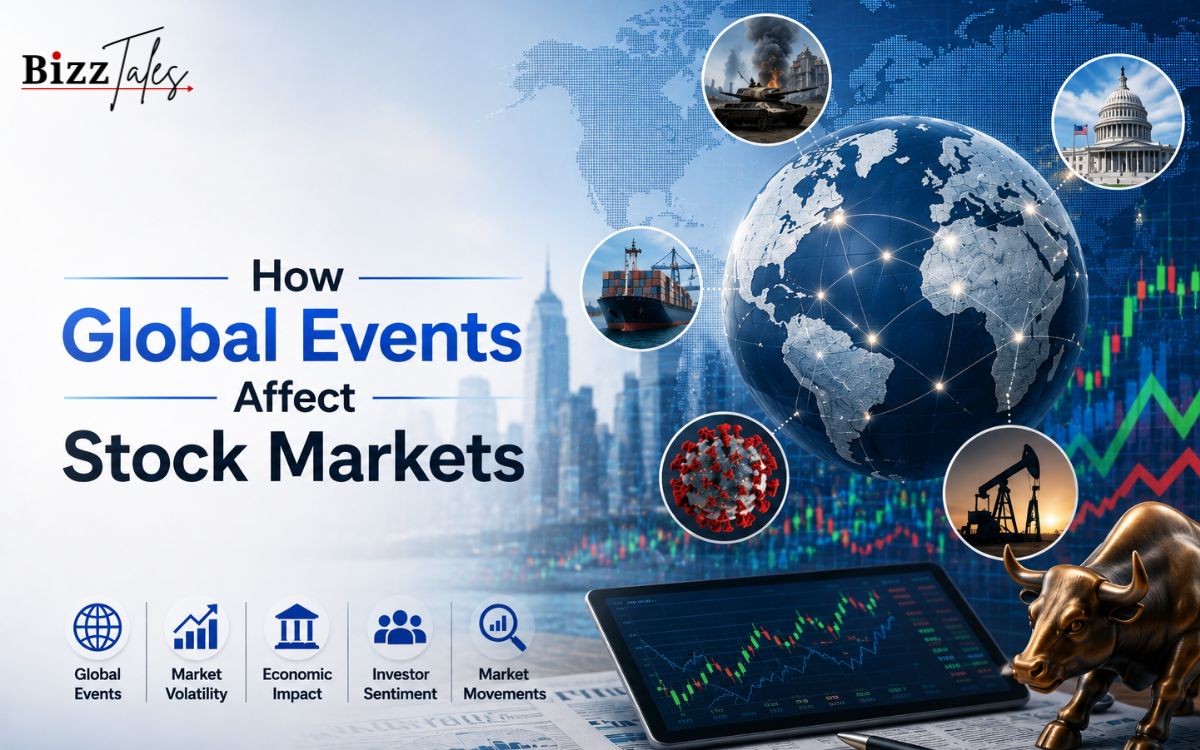
Stock markets are often thought to be a mirror image of the economy. As part of everyday life, investors are buying and selling shares with forward expectations. Though profits,company performance and economic conditions are crucial, stock markets are largely affected by international affairs.
A critical political development in one country, a war somewhere else, a dramatic spike in oil prices, a global health crisis, or even a message from the central bank can propel the stock market up or down within a matter of hours. Through integrated world economies, financial markets are now be way too sensitive to breaking news than ever before.
Thus, the study of the impact of worldwide events on stock markets is essential not only for investor but also for business owners, entrepreneurs and professionals. In fact, fluctuations in stock markets affect business activity, business optimism, flows of cash and investment availability.
There is actually very simple reality, no stock market can live alone. Indeed we can expect each market to be more sensitive to world events. And as all the events become more and more interconnected, so will their reaction.
Why Stock Markets React to Global Events
Expectations are what all stock markets are based on. Investors aim to forecast what the future of a business, country and company will look like.
That (any world upheaval) registers in investors’ minds as uncertainty. And right away you see what investors are going to ask themselves: Will companies make more or less money? Will consumer demand heat up or cool off? Will governments implement policies? Will economic growth pick up or slow down?
Since stock prices represent expectations for the future, not the present, the market may move in anticipation of an event and get the rise or fall of the event right before it actually reveals itself in the firms’ accounted earnings.
For example, investors may sell their stock if they think an international event would negatively impact profits of companies in the future. Stocks prices have declined even before businesses have suffered financial losses.
This common forward-looking characteristic of stock markets involves the reason for markets to move quickly due to global news.
Wars and Geopolitical Conflicts
2003.During 2003, one of the most powerful influences on stock markets was the impact of geopolitical conflict.
Wars generate uncertainty and most financial markets fear uncertainty. In addition, following armed conflicts between nations, investors worry about possible disruptions to trade, to supplies, to energy, and to growth.
An example if a recent one that impacts markets globally is the Russia-Ukrainian crisis. Prices in energy went up, commodity markets saw rises and falls, and investors were concerned about the effects on the economy. Stock markets around the world see sharp fluctuations as companies react to the crisis.
Mid to low boil over little things, no all out war. Investors also get affected by economic sanctions, wars, trade conflicts, diplomatic disagreements and other such issues.
With rising uncertainty, investors tend to shift funds to conservative assets, resulting in falls in stock markets.
Global Economic Crises and Market Reactions
Economic crises also play a significant role on the stock market.
During a recession revenues tend to decline for many companies, as consumers cut down on their spending. This in turn greatly impacts company earnings, and as stock prices are highly related to earnings, a recession would usually bring about a bear market correction.
The financial crisis of 2008 not only revealed the degree of integration in the financial markets, but also how problems in one part of the financial system can have a knock-on effect across nations and across industries.
All the world stock markets declined sharply because investors were afraid of a prolonged period of economic weakness.
Despite the above for the great world economy even to day the concerns of recession, inflation and economic growth are still playing a market game.
Investors are always watching the data to see if a country is growing or slowing down.
The Impact of Pandemics
The worldwide outbreak of COVID-19 was one of the most obvious examples of how an international incident impacts the stock-market.
As the pandemic first started to go global, in many ways uncertainty simply hit new levels: firms shut down, travel came to a halt, supply chains were thrown into disarray and consumer patterns changed overnight.
Markets around the world plunged as investors struggled to make sense of the possible economic ramifications.
However, the road to recovery also showed how markets react to good news. Measures like state bailout plans, vaccine development and economic reopens bolstered investor confidence.
This was a scare that has been compounded by the recent resumption of positivity in the global markets.
Oil Prices and Energy Markets
Oil is still the most important commodity in the world economy.
Stock markets tend to respond to fluctuations in the price of oil because energy costs impact on a wide range of businesses. An increase in the price of oil tends to push up costs for transportation, manufacturing, logistics, production.
As costs increase firms will have higher costs which reduce profits and give less scope to grow.
On the other hand, advantageous trends in oil prices can pass businesses and consumers savings.
Developments anywhere in the world, such as turmoil in oil producing countries, production reductions by key exporters, or supply interruptions, invariably impacts on oil prices, and thus on stock markets.
The energy markets and financial markets are interconnected.
Interest Rates and Central Bank Decisions
Stock market performance is predominantly influenced by the decisions made by central banks.
Government institutions like Reserve Bank of India, U.S. Federal Reserve, European Central Bank, etc., also affect the economic activity by altering the interest rates.
When interest rates are low, it means that borrowing is less expensive. Business people invest more, consumers use more of the goods and services and economies tend to do better.
Stock markets tend to welcome falling interest rates because they tend to be supportive of corporate profits.
Inversely, the higher interest rates make it hard for investors to borrow money, which can lead to a slow-down in the economy. When central banks hike up rates too fast investors tend to become wary.
Hence, if these two announcements have a significant impact onto the expectations of inflation trend and interest rate, then all monetary policy statement and major announcements in the financial market should be responsive to the market movement.
Elections and Political Decisions
Stock markets are to a large extent affected by political developments.
National elections, shifts in government policy, tax changes, trade agreements and regulation, etc. Effect business environments.
Investors sometimes wonder how political results will influence certain industries, company earnings and economic development.
Say, for instance, if a policy (e.g., increased infrastructure expenditure) stimulates the demand for a product or service-say, those provided by construction firms,-or alters regulations directly benefiting a specific set of industries, say, technological, healthcare or financial sectors-.
Markets tend to dislike uncertainties and uncertainties. Once the political uncertainty increases, relative changes in market distances tend to increase.
The Role of Investor Psychology
Economics matter and global events certainly matter, but we can’t overlook psychology.
Markets have less to do with facts and more to do with emotions.
Fear and greed are other forces at work in the financial world. Investors tend to sell stocks in a herd mentality in uncertain times, and the market falls.
In good times, excess confidence can lead to a buying frenzy that pushes prices up.
At times market reactions may appear ‘mush larger than the actual effect of the event as investors’ emotions exaggerate the increase/decrease in prices.
This is the mental factor which accounts for markets becoming extremely volatile in the occurrence of a grand scale event.
Technology and Faster Market Reactions
Today, information travels at the speed of the digital world.
Market responds within seconds to financial news and economic updates, to geopolitical incidents and corporate announcements. The rise of social media, financial websites and fast news services has increased the market velocity.
Therefore stock markets tend to react very quickly to events.
Technology’s done two things-mak [ing] markets more efficient and brough [ing] about a lot more short-term volatility.
Investors are in a new environment where news from the world of today can have a market moving impact on investors’ sentiment in a matter of minutes.
How Businesses Are Affected
The fluctuation of stock markets not only adjusts to investors.
Furthermore, businesses are affected to the extent that market environments affect capital availability, consumer confidence and investment decisions.
An effective stockmarket makes it easier for companies to raise capital, expand and grow.
Strong markets also boost consumer confidence, leading to increased spending and uplifting the economy.
Conversely, excessively long sustained downturns in the markets may weaken business confidence and hold back investment decisions.
Why leaders in business keep an eye on the financial markets].
Long-Term Investors and Global Events
Short term volatility is often a by-product of worldwide events, but the long term investor takes a more global outlook.
Markets have bounced back after wars, financial failures, epidemics, political awakening, and recession.
While short-term changes can often be volatile, market growth has tended to be driven by manufacturing, technolgy and economic progress on the longer term.
Typically a successful investor doesn’t overreact to every world event as they look at the longer term fundamentals.
An important thing to be aware of when investing is the distinction between short term mimicking behavior and long term fundamentals.
Conclusion
World events also greatly affect stock markets. Wars, financial crises, pandemics, fluctuations in the price of oil, political elections and decisions, central banks policies andeven investor reactions all has impact on financial markets.
As stock markets are a representation of expectations of the future, they tend to be a great proportion of time the market moderates the new information efficiently. Occasionally, the immediate short-lived fluctuations can be misinterpreted.
Real-world Knowledge of How the Global Environment Affects the Stock Market is very Important to Businesses, Investors, and Entrepreneurs The state of the stock market impacts investment decisions, business expansion, consumer purchasing patterns and overall economic activity.
We live in a borderless world, and whatever affects the global events will also affect the stock markets. Recognising this economic reality will empower individuals to efficiently cope with the uncertainty and take rational financial decisions.
FAQs
What are global events in relation to stock markets?
Global events include wars, economic crises, pandemics, elections, central bank decisions, trade disputes, and major geopolitical developments that can influence investor sentiment and stock prices.
Why do stock markets react so quickly to global events?
Stock markets are forward-looking. Investors try to predict future economic and business conditions, causing stock prices to react immediately when important news emerges.
How do wars affect stock markets?
Wars create uncertainty, disrupt trade and supply chains, increase energy prices, and often reduce investor confidence, leading to market volatility.
Why do oil prices influence stock markets?
Oil affects transportation, manufacturing, and business costs. Rising oil prices can reduce corporate profits and slow economic growth, impacting stock prices.
How do central bank decisions affect stock markets?
Central bank decisions influence interest rates, borrowing costs, inflation, and economic growth, all of which affect corporate earnings and investor sentiment.
Can elections impact stock markets?
Yes. Elections can lead to policy changes, tax reforms, and regulatory adjustments that affect businesses and industries, influencing stock market performance.
What role does investor psychology play in markets?
Investor emotions such as fear and greed can amplify market movements, causing stocks to rise or fall more sharply during major events.
How did COVID-19 affect global stock markets?
The pandemic created significant uncertainty, causing sharp market declines initially. Markets later recovered as governments introduced stimulus measures and economies reopened.
Do global events only affect large investors?
No. Global events affect everyone connected to financial markets, including individual investors, businesses, retirement funds, and consumers.
Should long-term investors worry about every global event?
Long-term investors typically focus on economic fundamentals and business growth rather than reacting to every short-term market fluctuation caused by global events.