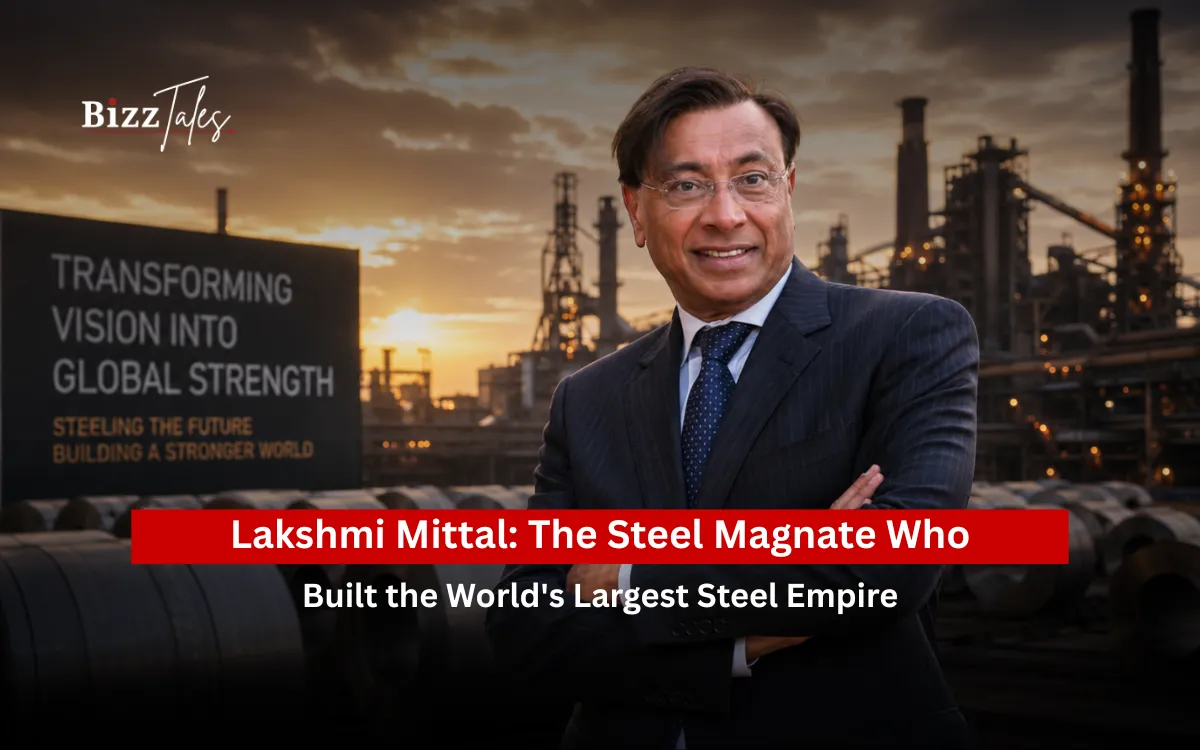
Lakshmi Niwas Mittal is one of the most successful industrialists in modern history and the man behind ArcelorMittal, the world’s largest steel manufacturing company. Over several decades, he transformed struggling steel mills across multiple countries into a global industrial empire that reshaped the steel industry. His rise from a small business family in Rajasthan, India, to becoming one of the richest people in the world is widely regarded as one of the greatest entrepreneurial success stories of the twentieth and twenty-first centuries.
Often referred to as the “Steel King,” Mittal built his fortune through strategic acquisitions, operational efficiency, and a global vision that few industrialists possessed at the time. Through ArcelorMittal, he established a presence across Europe, Asia, North America, South America, Africa, and the Middle East, creating one of the most influential industrial organizations in history.
Today, Lakshmi Mittal remains one of the most respected business leaders in the world and one of the wealthiest individuals of Indian origin.
Forbes Ranking & Net Worth History
| Year | Forbes Global Rank | Net Worth |
| 2026 | #107 | $25.7 Billion |
| 2025 | #97 | $27.2 Billion |
| 2024 | #101 | $18.8 Billion |
According to Forbes’ 2026 Billionaires List, Lakshmi Mittal ranked among the world’s richest individuals with an estimated net worth of approximately $25.7 billion. He continues to be one of the wealthiest industrial entrepreneurs globally and one of the richest business leaders of Indian origin.
Early Life and Family Background
Lakshmi Mittal was born on June 15, 1950, in Sadulpur, Rajasthan, India.
He grew up in a Marwari business family that later moved to Kolkata, where his father, Mohan Lal Mittal, operated a steel-related business.
From an early age, Lakshmi was exposed to entrepreneurship, manufacturing, and commerce.
Unlike many future billionaires who inherited large corporate empires, Mittal grew up in a modest business environment and witnessed firsthand the challenges of running industrial operations.
These early experiences helped develop the business instincts that would later define his career.
Education and Early Business Experience
Mittal attended St. Xavier’s College in Kolkata, where he earned a degree in commerce.
While studying, he became increasingly involved in the family’s steel business and learned about manufacturing, finance, operations, and international trade.
His education provided financial knowledge, but much of his business expertise came through practical experience.
By the early 1970s, he had already begun exploring opportunities beyond India.
This international outlook would become one of the key drivers of his success.
The First Major Opportunity
During the 1970s, India’s steel industry faced heavy regulation and government controls.
Recognizing the limitations of domestic expansion, Mittal looked overseas for growth opportunities.
His first major breakthrough came in Indonesia.
In 1976, he established PT Ispat Indo, a steel manufacturing company that became one of Southeast Asia’s leading steel producers.
The success of Ispat Indo proved that Mittal could build profitable operations outside India.
More importantly, it gave him confidence to pursue larger international ambitions.
Building the Ispat Empire
Throughout the 1980s and 1990s, Mittal aggressively expanded through acquisitions.
Rather than building new factories from scratch, he focused on purchasing underperforming steel plants and improving their efficiency.
This strategy became his trademark.
He acquired steel mills in countries including:
- Trinidad and Tobago
- Mexico
- Canada
- Germany
- Kazakhstan
- Romania
- United States
Many of these facilities were struggling financially when he purchased them.
However, Mittal’s operational expertise often transformed them into profitable businesses.
Becoming the Global Steel Leader
By the late 1990s, Mittal Steel had emerged as one of the largest steel producers in the world.
His strategy of consolidation allowed the company to achieve economies of scale that competitors found difficult to match.
The steel industry was traditionally fragmented.
Mittal believed consolidation would improve efficiency and profitability.
His vision proved correct.
The company continued expanding while strengthening its global market position.
The Historic Arcelor Acquisition
One of the defining moments of Mittal’s career came in 2006.
Mittal Steel launched a takeover bid for Arcelor, one of Europe’s largest steel companies.
The proposal initially faced significant resistance from management, politicians, and investors.
Many observers believed the acquisition would fail.
However, after months of negotiations, Mittal successfully completed the deal, creating ArcelorMittal.
The transaction became one of the largest and most significant mergers in industrial history.
The Creation of ArcelorMittal
Following the merger, ArcelorMittal became the world’s largest steel producer.
The company operates across dozens of countries and serves industries including:
- Automotive
- Construction
- Infrastructure
- Energy
- Manufacturing
- Transportation
At its peak, ArcelorMittal produced more steel than many national industries combined.
The company became a symbol of globalization and industrial scale.
This achievement cemented Mittal’s reputation as the world’s leading steel entrepreneur.
Challenges During the Global Financial Crisis
Like many industrial businesses, ArcelorMittal faced challenges during the 2008 global financial crisis.
Demand for steel declined sharply, affecting profitability and market valuations.
Mittal responded through restructuring, cost reductions, and strategic adjustments.
Despite difficult conditions, the company survived and remained the industry’s dominant player.
His ability to navigate economic downturns demonstrated resilience and long-term thinking.
Expansion Beyond Traditional Steel
In recent years, ArcelorMittal expanded its focus toward sustainability, innovation, and advanced manufacturing.
The company invested heavily in:
- Green steel technology
- Renewable energy solutions
- Carbon reduction initiatives
- Research and development
- Sustainable industrial processes
These efforts reflect the industry’s transition toward environmentally responsible production methods.
Mittal has consistently emphasized innovation as essential for long-term success.
Family Business and Succession
Lakshmi Mittal gradually involved the next generation in leadership roles.
His son, Aditya Mittal, became CEO of ArcelorMittal and plays a major role in the company’s strategic direction.
The leadership transition represents one of the most significant succession plans within global industry.
Together, the family continues guiding the organization through technological and market changes.
Investments and Other Businesses
Beyond steel, Mittal has invested in multiple sectors.
His interests include:
- Mining
- Energy
- Infrastructure
- Sports
- Real estate
- Financial investments
These diversified holdings provide additional sources of wealth and influence.
However, steel remains the foundation of his business empire.
Philanthropy and Social Impact
Lakshmi Mittal is widely recognized for philanthropy.
His charitable activities support:
- Education
- Healthcare
- Sports development
- Community initiatives
- Scientific research
One of his most notable contributions was establishing the Mittal Champions Trust, which supports Indian athletes competing internationally.
The initiative has helped numerous athletes achieve success on the global stage.
His philanthropic work reflects a commitment to creating opportunities beyond business.
Awards and Recognition
Throughout his career, Mittal has received numerous honors.
These include:
- Padma Vibhushan (India’s second-highest civilian award)
- International business awards
- Industry leadership recognitions
- Honorary degrees
His achievements have earned recognition from governments, universities, and business organizations worldwide.
Luxury Assets and Lifestyle
Lakshmi Mittal is known for owning several prestigious properties around the world.
One of the most famous is his mansion in Kensington Palace Gardens, London, often described as one of the most expensive residential streets globally.
Despite immense wealth, Mittal remains heavily involved in business operations and strategic decision-making.
Leadership Style
Mittal’s leadership philosophy emphasizes:
- Strategic acquisitions
- Operational efficiency
- Global thinking
- Long-term planning
- Financial discipline
Rather than focusing on short-term profits, he consistently pursued scale and sustainable growth.
His approach transformed the steel industry and created lasting competitive advantages.
Many business schools study his acquisition strategy as a model of successful consolidation.
Personal Life
Lakshmi Mittal is married to Usha Mittal and has two children, Aditya and Vanisha Mittal.
The family remains actively involved in business, philanthropy, and community initiatives.
Although he spends significant time in London, his influence continues across global markets.
Lessons Entrepreneurs Can Learn from Lakshmi Mittal
One of the most important lessons from Mittal’s journey is the value of thinking globally.
While many entrepreneurs focused on local markets, he pursued opportunities across continents.
His story also demonstrates the power of strategic acquisitions.
Rather than creating new businesses from scratch, he identified undervalued assets and improved them.
Entrepreneurs can learn from his persistence, operational excellence, and willingness to take calculated risks.
Most importantly, his career proves that vision combined with disciplined execution can transform entire industries.
Conclusion
Lakshmi Mittal’s rise from a young businessman in Kolkata to the creator of the world’s largest steel company is one of the most remarkable entrepreneurial stories in industrial history. Through ArcelorMittal, he transformed global steel manufacturing and built a business empire spanning dozens of countries.
Today, he remains one of the most respected industrial leaders in the world and one of the wealthiest individuals of Indian origin.
His influence extends across manufacturing, mining, infrastructure, sustainability, and philanthropy.
For entrepreneurs and business leaders, Lakshmi Mittal’s journey offers powerful lessons about ambition, globalization, resilience, and long-term value creation.
FAQs
1. Who is Lakshmi Mittal?
Lakshmi Mittal is the chairman of ArcelorMittal and one of the world’s most successful steel entrepreneurs.
2. What is Lakshmi Mittal’s net worth in 2026?
According to Forbes, his estimated net worth is approximately $25.7 billion.
3. What company made Lakshmi Mittal wealthy?
ArcelorMittal, the world’s largest steel producer, is the primary source of his wealth.
4. What is ArcelorMittal?
ArcelorMittal is the world’s largest steel manufacturing company operating across dozens of countries.
5. Where was Lakshmi Mittal born?
He was born in Sadulpur, Rajasthan, India, on June 15, 1950.
6. Who is Aditya Mittal?
Aditya Mittal is Lakshmi Mittal’s son and the CEO of ArcelorMittal.
7. What award has Lakshmi Mittal received from India?
He received the Padma Vibhushan, India’s second-highest civilian award.
8. Is Lakshmi Mittal involved in philanthropy?
Yes. He supports education, healthcare, sports, and community development initiatives.
9. Where does Lakshmi Mittal live?
He is primarily based in London, United Kingdom.
10. What can entrepreneurs learn from Lakshmi Mittal?
Entrepreneurs can learn global thinking, strategic acquisitions, operational excellence, resilience, and long-term planning.