
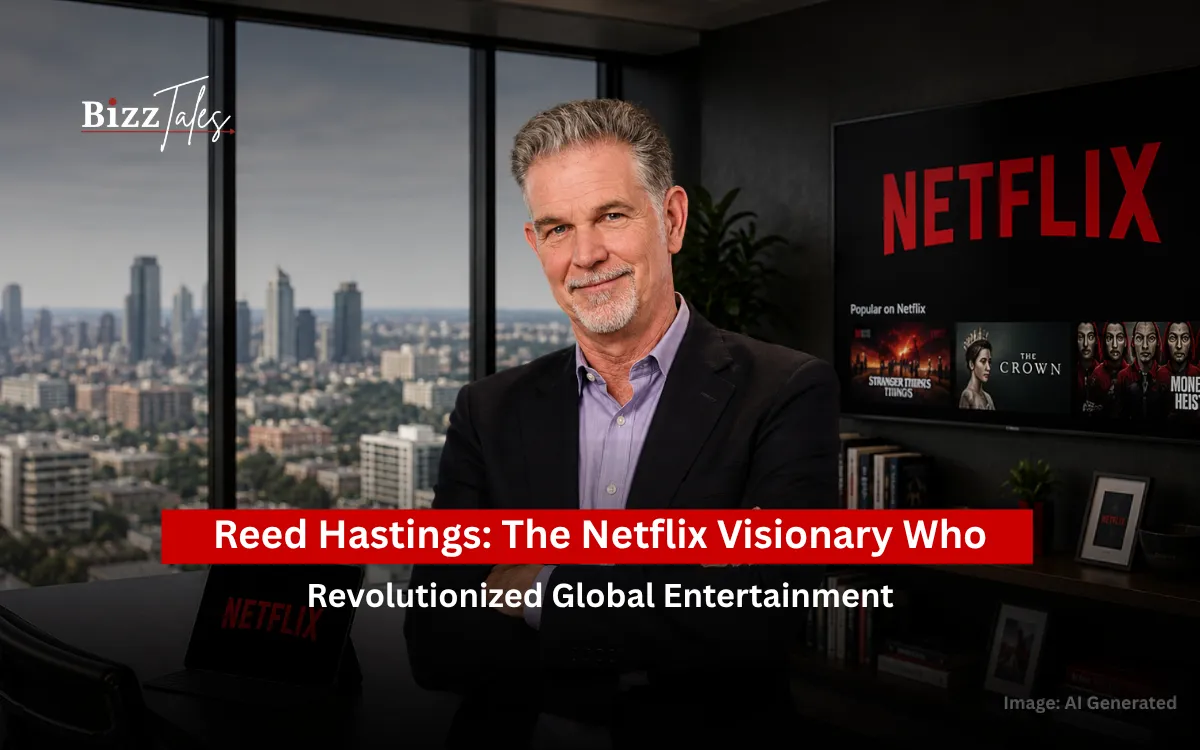
Reed Hastings is one of the most influential entrepreneurs in the history of digital entertainment. Best known as the co-founder of Netflix, Hastings transformed the way the world consumes movies, television shows, and streaming content. What began as a DVD-by-mail service evolved into a global entertainment giant serving hundreds of millions of subscribers across the world.
His journey is remarkable not only because of Netflix’s success but also because of his ability to anticipate technological change before most people recognized its potential. At a time when traditional television networks and video rental stores dominated entertainment, Hastings envisioned a future where content could be delivered instantly through the internet. That vision ultimately disrupted entire industries and reshaped global media consumption.
Today, Reed Hastings is recognised as one of the most successful entrepreneurs of the digital age. His career spans technology, education, philanthropy, and corporate leadership. This article explores his net worth, early life, career journey, business ventures, achievements, challenges, investments, leadership philosophy, personal life, and lasting legacy.
FORBES RANKINGS AND NET WORTH
| Year | Forbes Ranking | Net Worth |
| 2026 | #294 | $11.5 Billion |
| 2025 | #315 | $10.6 Billion |
| 2024 | #338 | $9.8 Billion |
EARLY LIFE AND EDUCATION
Wilmot Reed Hastings Jr. was born on October 8, 1960, in Boston, Massachusetts, United States. Raised in a family that valued education and discipline, he developed strong analytical and problem-solving skills from an early age.
As a young student, Hastings demonstrated an interest in mathematics, science, and engineering. His curiosity about technology and innovation would later become central to his career.
After completing high school, he attended Bowdoin College in Maine, where he earned a degree in Mathematics. The rigorous academic environment helped sharpen his logical thinking and quantitative abilities.
Following graduation, Hastings joined the Peace Corps and spent time teaching mathematics in Swaziland, now known as Eswatini. The experience proved transformative. Living and working in a developing nation taught him resilience, adaptability, and leadership skills that would later influence his management philosophy.
Upon returning to the United States, he pursued higher education at Stanford University, earning a master’s degree in Computer Science. This technical background provided the expertise needed to navigate the rapidly evolving technology industry.
His combination of analytical thinking, international experience, and technical education created a strong foundation for future entrepreneurial success.
CAREER JOURNEY
Reed Hastings began his professional career in the technology sector during the 1980s. After completing his studies, he worked in software development and gained valuable experience building technology products.
In 1991, he founded Pure Software, a company focused on creating software development tools. The business grew rapidly and eventually became one of the leading companies in its niche.
Pure Software went public and achieved significant success before being acquired through a series of mergers. Although the venture generated substantial financial rewards, Hastings later acknowledged that managing a rapidly growing company taught him important lessons about leadership and organizational culture.
The defining moment of his career came in 1997 when he co-founded Netflix alongside Marc Randolph. The company initially operated as a DVD rental service that allowed customers to order movies online and receive them by mail.
Netflix introduced an innovative subscription model that eliminated late fees, one of the biggest frustrations associated with traditional video rental stores. This customer-focused approach helped the company gain popularity.
As internet speeds improved and digital technology advanced, Hastings recognized that streaming would eventually replace physical media. Under his leadership, Netflix invested heavily in streaming infrastructure and shifted its business model accordingly.
The decision transformed Netflix into a global entertainment powerhouse. The company later expanded into original content production, creating award-winning films, documentaries, and television series.
Through strategic vision and bold decision-making, Hastings guided Netflix through multiple industry disruptions while maintaining strong growth and innovation.
BUSINESS VENTURES
Netflix remains Reed Hastings’ most important business venture and the primary source of his wealth. What started as a DVD rental company evolved into the world’s leading streaming entertainment platform.
One of Netflix’s most significant innovations was the introduction of subscription-based streaming. This model changed how consumers access entertainment and accelerated the decline of traditional video rental businesses.
The company’s expansion into original content production further strengthened its competitive position. Series such as House of Cards, Stranger Things, The Crown, and numerous other productions demonstrated Netflix’s ability to compete directly with established studios and television networks.
Beyond Netflix, Hastings has been involved in educational initiatives and technology investments. He has supported organizations focused on improving educational access, innovation, and digital learning.
He also served on the boards of several major companies and nonprofit organizations, contributing strategic guidance and leadership expertise.
While Netflix remains his most prominent achievement, his influence extends into education, philanthropy, and technology policy.
SUCCESS STORY AND MAJOR ACHIEVEMENTS
Reed Hasting’s success story is one of vision, persistence, and adaptability. Building Netflix into one of the world’s largest entertainment companies required anticipating technological shifts years before competitors.
One of his greatest achievements was recognizing the potential of streaming media. At a time when DVDs remained popular, he invested aggressively in digital distribution and positioned Netflix for the future.
Another major accomplishment was the creation of Netflix Originals. By producing exclusive content, the company reduced dependence on third-party studios and established itself as a major entertainment brand.
Under Hastings’ leadership, Netflix expanded into more than 190 countries, becoming one of the most globally recognized technology companies.
His influence extends beyond entertainment. Many business leaders study Netflix’s corporate culture, management practices, and innovation strategies as examples of effective organizational design.
The company’s impact on consumer behavior, media distribution, and content creation represents one of the most significant business transformations of the modern era.
CHALLENGES, FAILURES, AND SETBACKS
Despite his extraordinary success, Reed Hastings faced numerous challenges throughout his career. One of the earliest involved managing Pure Software during periods of rapid expansion. The experience exposed weaknesses in organizational structure and leadership practices.
Netflix also encountered major obstacles. During the early years, the company faced skepticism from investors who questioned whether consumers would embrace online DVD rentals.
The transition from DVDs to streaming involved significant risk. The company invested heavily in technology infrastructure before streaming became widely adopted.
One of Netflix’s most controversial moments occurred in 2011 when the company attempted to separate its DVD and streaming services. Customer backlash led to subscription cancellations and a sharp decline in stock value.
Competition intensified as major technology and media companies launched rival streaming platforms. Companies such as Disney, Amazon, Apple, and Warner Bros. Discovery entered the market, increasing pressure on Netflix.
The company also faced challenges related to content costs, subscriber growth, and changing consumer preferences. However, Hastings consistently demonstrated the ability to adapt and guide the organization through uncertainty.
His resilience and willingness to learn from mistakes became defining characteristics of his leadership.
INVESTMENTS AND ASSETS
The majority of Reed Hasting’s wealth comes from his ownership stake in Netflix. As the company’s co-founder and long-time leader, he benefited substantially from its growth and market success.
In addition to Netflix shares, Hastings maintains investments in technology ventures, educational initiatives, and diversified financial assets. His portfolio reflects a focus on innovation and long-term value creation.
Real estate holdings contribute to his overall asset base, providing diversification beyond public equity investments.
He has also supported philanthropic organizations through substantial financial commitments, particularly in education and social impact initiatives.
Unlike many investors who frequently pursue high-profile acquisitions, Hastings generally maintains a disciplined and relatively low-profile investment approach.
His financial strategy reflects a balance between entrepreneurship, diversification, and philanthropy.
LEADERSHIP STYLE AND BUSINESS PHILOSOPHY
Reed Hastings is known for a leadership style built on trust, accountability, and freedom. His management philosophy became famous through Netflix’s corporate culture framework.
One of his core principles is empowering employees. Rather than relying on excessive rules and bureaucracy, he believes talented individuals perform best when given autonomy and responsibility.
He also emphasizes transparency. Netflix encourages open communication, honest feedback, and direct discussion of challenges and opportunities.
Another defining characteristic is adaptability. Hastings believes organizations must continuously evolve in response to changing markets and technologies.
Innovation plays a central role in his philosophy. Throughout his career, he consistently challenged conventional industry assumptions and encouraged experimentation.
These principles helped create a corporate culture widely studied by executives and management experts around the world.
PERSONAL LIFE
Reed Hastings is married to Patty Quillin, and together they have built a family committed to education, philanthropy, and community engagement.
The couple has donated hundreds of millions of dollars to charitable causes, particularly those focused on education reform, social equity, and public service.
Hastings is passionate about improving educational opportunities and has supported numerous initiatives related to schools, universities, and digital learning.
Despite his immense wealth, he generally maintains a relatively private lifestyle. His public appearances often focus on business, education, and philanthropy rather than personal luxury.
Outside of work, he enjoys outdoor activities, travel, and spending time with family. These interests contribute to a balanced approach to life and leadership.
His reputation reflects intellectual curiosity, humility, and a commitment to creating positive societal impact.
SOCIAL MEDIA PRESENCE
LEGACY AND FUTURE OUTLOOK
Reed Hasting’s legacy is inseparable from the transformation of global entertainment. Through Netflix, he fundamentally changed how people watch movies, television shows, and digital content.
His influence extends beyond streaming. The management principles he developed continue to shape leadership practices across industries.
Netflix remains a dominant force in entertainment, and the company’s continued evolution will further strengthen Hastings’ long-term impact.
His philanthropic work in education also contributes to a broader legacy focused on opportunity, innovation, and social progress.
Future entrepreneurs will likely study his ability to recognize technological trends, challenge established industries, and build organizations capable of continuous reinvention.
The lessons from his career remain relevant far beyond the entertainment sector.
CONCLUSION
Reed Hastings’ journey from software entrepreneur to Netflix co-founder represents one of the most remarkable success stories in modern business. Through innovation, strategic thinking, and a willingness to embrace change, he transformed a small DVD rental company into a global entertainment powerhouse.
His achievements extend beyond financial success. By reshaping media consumption and introducing influential management philosophies, he changed how businesses operate and how consumers experience entertainment.
Despite facing intense competition, technological disruption, and organizational challenges, Hastings consistently demonstrated resilience and adaptability. These qualities enabled him to create lasting value and maintain industry leadership.
Today, Reed Hastings stands among the most influential entrepreneurs of the digital age, with a legacy that continues to shape entertainment, technology, and corporate culture around the world.
FAQS
1. What is Reed Hastings’ net worth in 2026?
Reed Hastings’ estimated net worth in 2026 is approximately $11.5 billion.
2. How did Reed Hastings become a billionaire?
He became a billionaire by co-founding Netflix and transforming it from a DVD rental service into the world’s leading streaming entertainment platform.
3. What companies does Reed Hastings own?
He is best known as the co-founder of Netflix and has also invested in technology, education, and philanthropic initiatives.
4. What is Reed Hastings’ leadership style?
His leadership style emphasizes freedom, responsibility, transparency, employee empowerment, and continuous innovation.
5. What is Reed Hastings’ biggest business achievement?
His biggest achievement is building Netflix into a global streaming and entertainment giant that transformed how people consume media worldwide.