For most entrepreneurs, especially startup entrepreneurs, making millions of dollars from investors is the mark of ultimate achievement. Startup entrepreneurs zealously dream of enormous rounds of funding, glamorous investors, and billion-dollar valuations for their startups.
Funding news nearly always hit the headlines in startup circles. Investors cheer, papers write the stories, and the founder became a business celebrity overnight.
But money by itself does not necessarily translate into success.
In last 10 Years business has seen various startups raising huge fundings and later struggling. Few of them has gone into a complete deadlock and even few has lost billions of dollar value of market value and investor confidence.
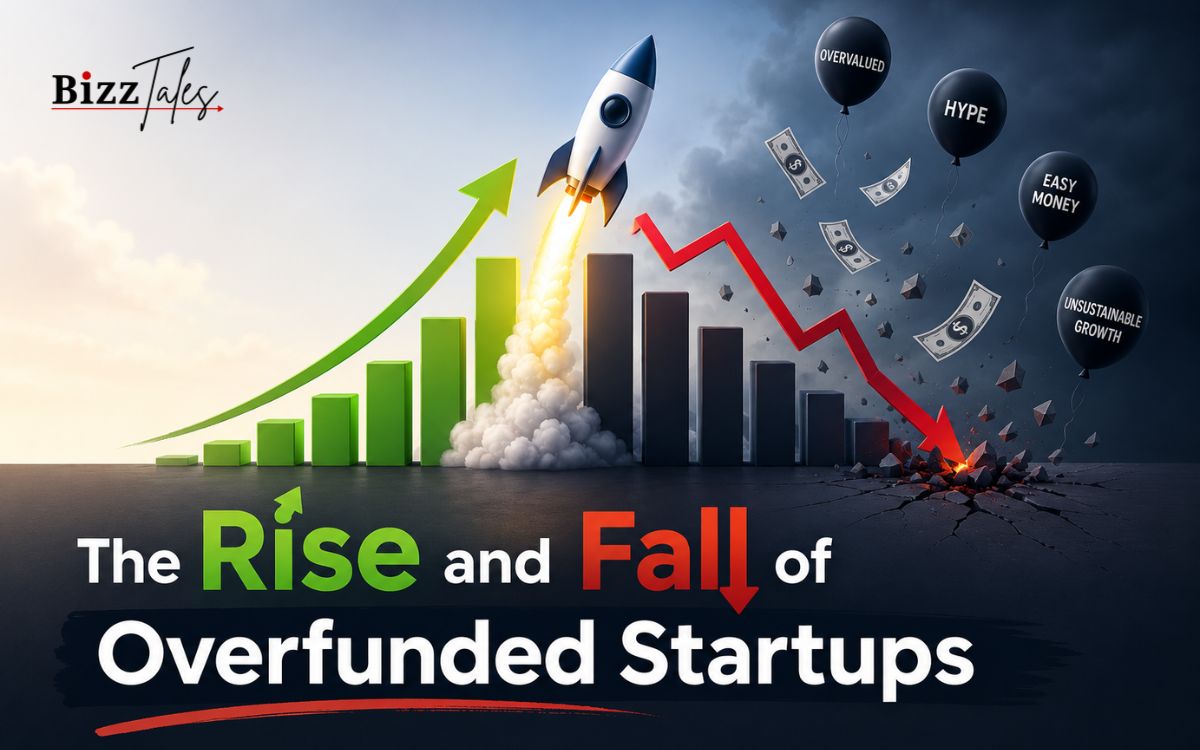
These firms became the poster child of what several experts have called overfunded start-up.
An overfunned startup is not inherently a bad business. The issue is when companies raise funding excessively and use the money to grow too aggressively-or become more concerned with cost-cutting than building a long-term, viable business.
Few entrepreneurs have learned more from the rise and fall of these startups than the entrepreneurs themselves.
The Startup Funding Boom
The startup ecosystem was flush with money throughout the past decade.
Interest rates were cheap. Venture capital firms had mountains of cash, and investors were out there looking for the next billion dollar idea.
Tech startups quickly became really hot too.
Investors flocked to fund start ups dealing in e-commerce, fintech, mobility, AI, food delivery, edu tech and SaaS.
However, as competition between investors continues to improve, valuations of startup companies increased still more rapidly.
Many companies were funded on the basis of expected future growth, rather than current profitability.
Started to move away from the profit making paradigm and settled for rapid growth.
After all, this first method seemed to be doing the trick.
Unfortunately, it also raised issues that would soon surface.
When Too Much Money Becomes Dangerous
Many people believe if you have more money for your new business, then it increases the happiness!
Ironically enough sometimes too much wealth can even be a curse.
When startups raise enormous amounts of funding, they tend to be expected to grow at insane speeds.
A scenario in which a company invests heavily in aggressive growth rather than placing greater emphasis on product quality, customer satisfaction and sustainable management.
Major rounds of capital can lend confidence.
Founders might think that they will always find the next round of funding and start spending money more heavily…more in the marketing campaign, office space, hiring people, and scaling plans.
Hundreds of millions of dollars can evaporate rapidly with out any financial discipline.
This is the point where many overfunded startups start to hit problems.
The WeWork Story
Perhaps the best known case of an overfunded startup might be WeWork.
Initially, the business was born on one simple idea: art business must have flexible office spaces for business needs and entrepreneurs.
Investors were drawn to the idea.
WeWork pulled in hundreds of billions of dollars in funding, reaching a peak valuation of almost $47 billion.
They have consolidated in a number of countries. This was leading to leasing a number of large offices and undertaking aggressive investment.
Nevertheless many more serious concerns are raised..
Some investors started to doubt the company’s financial outcomes, business model and overall management.
Once WeWork filed for an IPO, the following financial details were made publicly accessible:
These came as a jolt to investors.
The company is hemorrhaging money, yet valued at billions.
It (a company, a stock) fails to go public. Investors’ trust deceases. The company’s value goes down significantly.
It was WeWork that rapidly became one of the most analyzed startup failures in recent business history.
The Problem With Growth at Any Cost
Most overfunded startups go down the route of chasing growth without regard for profitability.
The concept appears reasonable initially.
Get customers fast, take the world, and make money first.
In 1 some cases this works.
However, most companies realize that it is not practical to attack customers with high discounts and expensive marketing campaigns.
One investor funding drops, business will then need profitable operation.
These companies are the most difficult to change if they never built up a sustainable business model “Breaking, once again, to the types of companies that have never developed sustainable business models-those will be hardest hit by the break.”
Repercussions can include layoffs, re-structuring, declines in valuations, or even bankruptcy.
We do care about growth. We do care about it happening at a good rate. It is more important for a growth to be “healthy” than that it happen quickly.
The Valuation Trap
These startup valuations can lead to false expectations
When investors give a young company a valuation in the billions, then public perception changes.
Industry celebrities, the media echo chamber, and pressure mounts to prove the valuation is justified.
The issue is that valuations can frequently be derived from future predictions than from actual/current information.
If a start-up does not attain those expectations, investor confidence can evaporate very quickly.
This is a dangerous circle.
Firms could continue to acquire capital at larger and larger valuation levels that are distant from the fundamentals of the company’s business.
In the end, the truth will be revealed.
Valuations can experience a sharp fall when growth slows or markets change.
Many over-funded startups have suffered through this very same example.
Investor Expectations Can Become a Burden
Funding is not “free money.”
Investors want a return.
Venture capital firms are investing millions upon millions of dollar expecting a significant return in the form of bankable after-growth profitability.
As the levels of funding go up, expectations are only bigger.
Founders are often pushed to grow by taking on new markets and launching new products, attracting new customers even if it means taking excessive risks.
Develops perspective-taking. Creates pressure to perform.439 An external source can be a compelling source of pressure and influence that may induce risky choices.430
Certain companies grow beyond their means.
Others venture into markets they know little about.
May bring about short-term expansion but tend to result into long-term problems.
One of the key problems startup founders face is how to satisfy investors while ensuring sustainable business growth.
Why Some Overfunded Startups Survive
Not all overly funded startups go bankrupt.
Others are not so successful at leveraging large ventures to establish terrific businesses.
Basically, it’s a matter of leadership, disciplined financial management, and implementation:
Fundraising is a means to an end. Successful founders recognize that raising money is just one of many tools they need.
They believe in sustainability and are more interested in creating sustainable business models. Not headlines.
They are strategic in their wise investments toward product development, customer experience, and longer term business objectives.
They have effective budget control and do not overspend.
While funding can facilitate growth, having sound fundamentals is key.
Market Conditions Can Change Quickly
Startups are heavily affected by the current state of economics.
In the turn of the markets mid-’01 in the the M-cash/Oz investment climate, a lot of start-ups which did well in the era of cheap start-up capital, had trouble.
Higher interest rates, macroeconomic uncertainties, and risk-averse investors can all hinder the flow of capital.
When external funding is difficult to get, startups have to be more dependent on its own financial condition.
However, companies that solely rely on constant fundraising can struggle during such times.
This state of affairs became particularly apparent at a time when venture capital investment was slowing down in many markets.
The firms that ‘weathered the storm’ have in general out performed the ‘come what may’ funding assumption in general.
Lessons for Entrepreneurs
Some lessons to be learned from the rise and fall of overfunded startups.
Fundraising should never be the ultimate goal.
In larger terms, creating a sustainable business beats raising lots of capital-by a long shot.
Secondly, profitability continues to be important.
All industries, even high-growth industries, will come to face healthy finance structures in the end.
Growth must be aligned to the operational discipline.
Over-expanding is full of potential dangers.
Lastly, founders should keep their attention on customers instead of valuations.
Where businesses will make long term success by solving problems and providing valuable services.
Media and investor attention are fleeting.
Robust businesses withstand.
The Future of Startup Funding
The startup world keeps changing.
Investors now need to be more selective and focus on sustained growth rather than rapid growth alone.
While thewhere big round capital raises will stay strong, there also should be more focus on profits, efficiencies and business.
Success in future startups might hinge less on the amount of money raised and more on the wise deployment of resources.
The entrepreneurs who comprehend this change should be capable of creating more robust and tougher companies.
The lessons from failed startups with too much capital are passing on to how founders and investors continue to pursue growth now.
Conclusion
Overall, the saga of the successes and failures of overfunded startups is arguably the single most important story in recent entrepreneurship.
Firms like WeWork proved that even staggering investments with billion dollar valuations cannot ensure success.
Investment alone cannot compensate for weak leadership, poor financial discipline, lack of customer orientation and unsustainable business models. However, if used appropriately, investment can speed up the rate of growth.
While the startup community may cheer each funding round, the final indicator is how much value can be built.
Entrepreneurs who focus on core drivers rather than emotions have a higher chance of building companies that operate through the winds of change and go on to flourish over a sustained period.
At the end of the day, though, it just doesn’t matter how big a funding round is, if it’s not smartly executed.
How would you define an overfunded startup?
An overfunded startup is a startup that is raising huge sums of investment capital but is unable to make effective use of this.
Why do startups that are overfunded fall flat?
Unfortunately many fail with high levels of spend, unrealistic growth expectations, weak business models and poor discipline with finances.
Is increasing the funding always good?
Not necessarily. Although it is true that when it possesses sufficient financial resources it is more manageable for an enterprise to grow, having excessive funds can prove to be a rather negative aspect as well.
How is WeWork an overfunded startup?
WeWork obtained billions of capital and reached a huge valuation, however, doubts on profitability and the fundamentals of the business finally resulted in a collapse of valuation.
Is there hope for startups with huge funding?
Yes. Numerous prosperous companies around the world have been considered to be good at funding with strategies mainly rooted out from focus on Sustainable growth, good leadership and customer value.
What lessons can we learn from overfunded startups?
The most important is that money alone isn’t the answer, solid business principles and financial discipline are a lot more significant.