
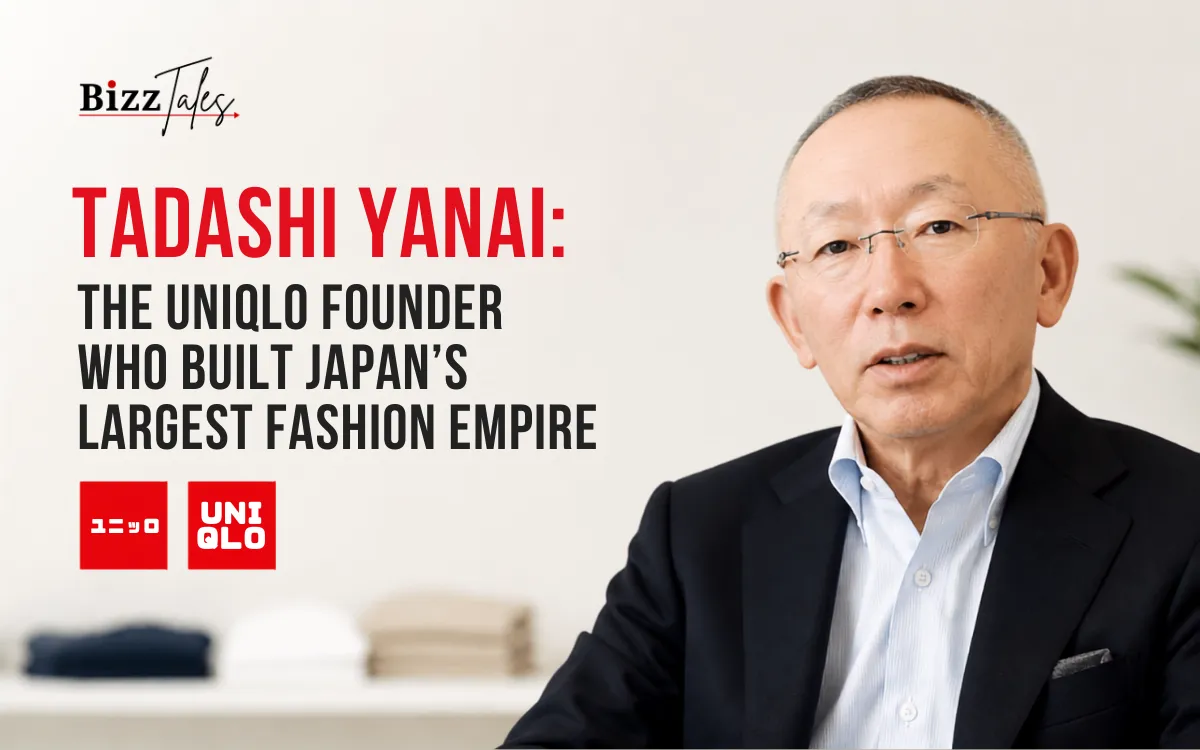
Tadashi Yanai is one of the most successful retail entrepreneurs in modern history and the founder of Fast Retailing, the parent company behind the global fashion brand Uniqlo. Over several decades, he transformed a small family clothing business in Japan into one of the largest apparel empires in the world. Today, Uniqlo stores operate across Asia, Europe, North America, and other international markets, serving millions of customers every day.
Known for his focus on simplicity, quality, affordability, and innovation, Yanai built a business model that challenged traditional fashion retailing. Unlike luxury brands that target premium customers or fast-fashion companies focused purely on trends, Uniqlo positioned itself as a brand offering high-quality everyday essentials for everyone.
His journey from working in his father’s tailoring business to becoming Japan’s richest businessman is one of the most inspiring entrepreneurial stories in the global retail industry. Today, Tadashi Yanai is widely recognized as the architect of Japan’s most successful fashion company and one of the most influential retail leaders of the 21st century.
Forbes Ranking & Net Worth History
| Year | Forbes Global Rank | Net Worth |
| 2026 | #32 | $61.8 Billion |
| 2025 | Japan’s Richest Person | $48.2 Billion |
| 2024 | Japan’s Richest Person | $38 Billion |
According to Forbes’ 2026 Billionaires List, Tadashi Yanai & family ranked #32 globally with an estimated net worth of $61.8 billion, making him the richest person in Japan.
Early Life and Family Background
Tadashi Yanai was born on February 7, 1949, in Ube, Yamaguchi Prefecture, Japan.
He was raised in a business-oriented family. His father operated a small tailoring and clothing business that served local customers.
Unlike many future billionaires who started with massive corporations, Yanai’s early exposure to business came through a modest family enterprise.
Growing up around retail operations helped him understand customer behavior, inventory management, and entrepreneurship from a young age.
These experiences laid the foundation for what would later become one of the largest fashion businesses in the world.
Education and Academic Journey
Yanai attended Waseda University, one of Japan’s most prestigious institutions.
He graduated in 1971 with a degree in economics and political science.
His education helped him develop a broader understanding of business, economics, and management.
However, his most valuable lessons would come through practical experience rather than academics.
After graduation, he briefly explored traditional employment before eventually returning to the family business.
This decision changed the course of his life.
Early Career and Joining the Family Business
Following university, Yanai worked at a retail company before deciding that corporate employment was not the right fit.
After approximately one year, he left and joined his father’s clothing business.
At the time, the company was relatively small and operated primarily as a local retailer.
Many entrepreneurs would have been satisfied maintaining a stable family business.
Yanai, however, envisioned something much larger.
He believed clothing retail could be transformed through scale, efficiency, and innovation.
His ambition soon began reshaping the company’s future.
The Birth of Uniqlo
One of the most important moments in Yanai’s career occurred in 1984 when he opened the first Uniqlo store in Hiroshima.
The store introduced a different retail concept.
Instead of focusing on expensive fashion trends, Uniqlo emphasized affordable, high-quality, practical clothing.
The strategy resonated with consumers.
Customers appreciated the combination of quality products and reasonable prices.
The success of the first store encouraged further expansion.
What began as a single retail location would eventually grow into a global fashion phenomenon.
Creating Fast Retailing
In 1991, Yanai renamed the family company Fast Retailing.
The new name reflected his vision for rapid growth and modern retail operations.
Fast Retailing became the parent company overseeing Uniqlo and future business ventures.
Under Yanai’s leadership, the company adopted advanced supply-chain management, efficient inventory systems, and innovative merchandising strategies.
These improvements helped increase profitability and scalability.
The company was positioning itself for national and eventually global expansion.
The Uniqlo Revolution
During the 1990s, Uniqlo experienced explosive growth throughout Japan.
Its success was driven by a simple but powerful formula:
- High-quality products.
- Affordable pricing.
- Consistent customer experience.
- Efficient operations.
Unlike fashion brands dependent on seasonal trends, Uniqlo focused on timeless essentials that consumers could wear every day.
This approach created broad market appeal.
Products such as fleece jackets, HeatTech apparel, and lightweight basics became extremely popular.
The brand established itself as a household name across Japan.
Expanding Beyond Japan
After dominating the Japanese market, Yanai set his sights on international expansion.
Entering foreign markets proved more challenging than expected.
Some early ventures struggled.
The company’s first expansion efforts in the United Kingdom and United States experienced significant difficulties.
Several stores closed, and growth was slower than anticipated.
Many entrepreneurs would have retreated after these setbacks.
Yanai chose a different path.
He viewed failure as a learning opportunity.
His willingness to adapt ultimately became one of his greatest strengths.
Learning from Failure
Yanai has often spoken openly about failure.
One of his most famous philosophies is that success comes from repeated experimentation and learning.
He once noted that people take failure too seriously and must continue believing in future success.
His approach became especially important during Uniqlo’s early international struggles.
Rather than abandoning global ambitions, he refined the company’s strategy.
The lessons learned helped create stronger operations and better market positioning.
These adjustments eventually paved the way for worldwide success.
Building a Global Fashion Empire
Over time, Uniqlo expanded across Asia, Europe, North America, and other international markets.
Flagship stores opened in major cities including New York, London, Paris, Milan, and Shanghai.
The company developed partnerships with designers, artists, museums, and global ambassadors.
Today, Fast Retailing operates thousands of stores worldwide and competes directly with major global retailers such as Zara and H&M.
Its international growth transformed Yanai into one of the richest businessmen in the world.
Other Brands and Business Interests
Fast Retailing’s business extends beyond Uniqlo.
The company owns or has owned several fashion brands, including:
- GU
- Theory
- Helmut Lang
- J Brand
- Comptoir des Cotonniers
- Princesse tam.tam
These brands provide diversification across different customer segments and geographic markets.
The broader portfolio strengthened Fast Retailing’s position within the global apparel industry.
Innovation and Technology
Yanai believes technology plays a critical role in retail success.
Fast Retailing invests heavily in supply-chain optimization, digital commerce, artificial intelligence, and customer analytics.
The company continuously seeks ways to improve product quality while maintaining affordability.
This focus on innovation has helped Uniqlo remain competitive despite changing consumer preferences and increasing competition.
Technology remains central to the company’s future growth strategy.
Philanthropy and Social Impact
Beyond business, Tadashi Yanai is known for his philanthropic efforts.
Following the 2011 Tōhoku earthquake and tsunami, he donated substantial funds to support recovery efforts.
In 2015, he established the Yanai Tadashi Foundation, which provides scholarships to Japanese students pursuing education at leading universities in the United States and United Kingdom.
He has also donated millions of dollars to educational and cultural initiatives, including programs supporting Japanese studies and research.
Leadership Style
Yanai is known for demanding high standards and maintaining a long-term perspective.
He emphasizes continuous improvement, accountability, and innovation.
Employees often describe him as ambitious, disciplined, and deeply involved in strategic decision-making.
His leadership philosophy encourages learning from mistakes rather than fearing them.
This mindset helped Fast Retailing navigate challenges and achieve sustained growth.
Many retail executives consider him one of the most influential business leaders in modern fashion.
Personal Life
Despite his enormous wealth, Yanai maintains a relatively private lifestyle.
He is married and has two sons.
Much of his public attention centers on business, education, and philanthropy rather than personal celebrity.
His preference for focusing on operations rather than publicity has contributed to his reputation as a disciplined entrepreneur.
Even after decades of success, he remains actively involved in guiding Fast Retailing’s future.
Lessons Entrepreneurs Can Learn from Tadashi Yanai
One of the most important lessons from Yanai’s journey is the value of persistence.
His early international expansion efforts failed, but he continued improving and adapting.
His story also demonstrates the importance of focusing on customer needs rather than short-term trends.
Entrepreneurs can learn from his commitment to quality, efficiency, innovation, and long-term thinking.
Most importantly, his career shows that global success often requires embracing failure as part of the learning process.
Conclusion
Tadashi Yanai’s transformation of a small family clothing business into the global fashion giant Uniqlo is one of the most impressive retail success stories in modern history. Through vision, persistence, and innovation, he built Fast Retailing into a multinational corporation serving millions of customers around the world.
His influence extends beyond fashion into education, philanthropy, and global business leadership.
Today, as Japan’s richest businessman and one of the world’s wealthiest entrepreneurs, Yanai continues shaping the future of retail through technology, innovation, and customer-focused thinking.
For entrepreneurs, business leaders, and aspiring founders, his journey offers powerful lessons about resilience, adaptation, and the importance of never allowing failure to define the future.
FAQs
1. Who is Tadashi Yanai?
Tadashi Yanai is the founder, chairman, and CEO of Fast Retailing, the parent company of Uniqlo.
2. What is Tadashi Yanai’s net worth in 2026?
According to Forbes, his estimated net worth is approximately $61.8 billion.
3. Is Tadashi Yanai the richest person in Japan?
Yes. He is currently recognized as the richest individual in Japan.
4. What company did Tadashi Yanai found?
He founded and built Fast Retailing, which owns Uniqlo and several other fashion brands.
5. When was Uniqlo founded?
The first Uniqlo store opened in 1984 in Hiroshima, Japan.
6. What is Fast Retailing?
Fast Retailing is the parent company of Uniqlo and one of the world’s largest apparel retailers.
7. Is Tadashi Yanai active on social media?
No. He maintains a very limited public social media presence.
8. What is Yanai’s leadership philosophy?
He emphasizes innovation, learning from failure, continuous improvement, and long-term growth.
9. What philanthropic work does he support?
He supports education, scholarships, disaster relief, and cultural initiatives through the Yanai Tadashi Foundation.
10. What can entrepreneurs learn from Tadashi Yanai?
Entrepreneurs can learn persistence, customer focus, innovation, adaptability, and long-term strategic thinking.