
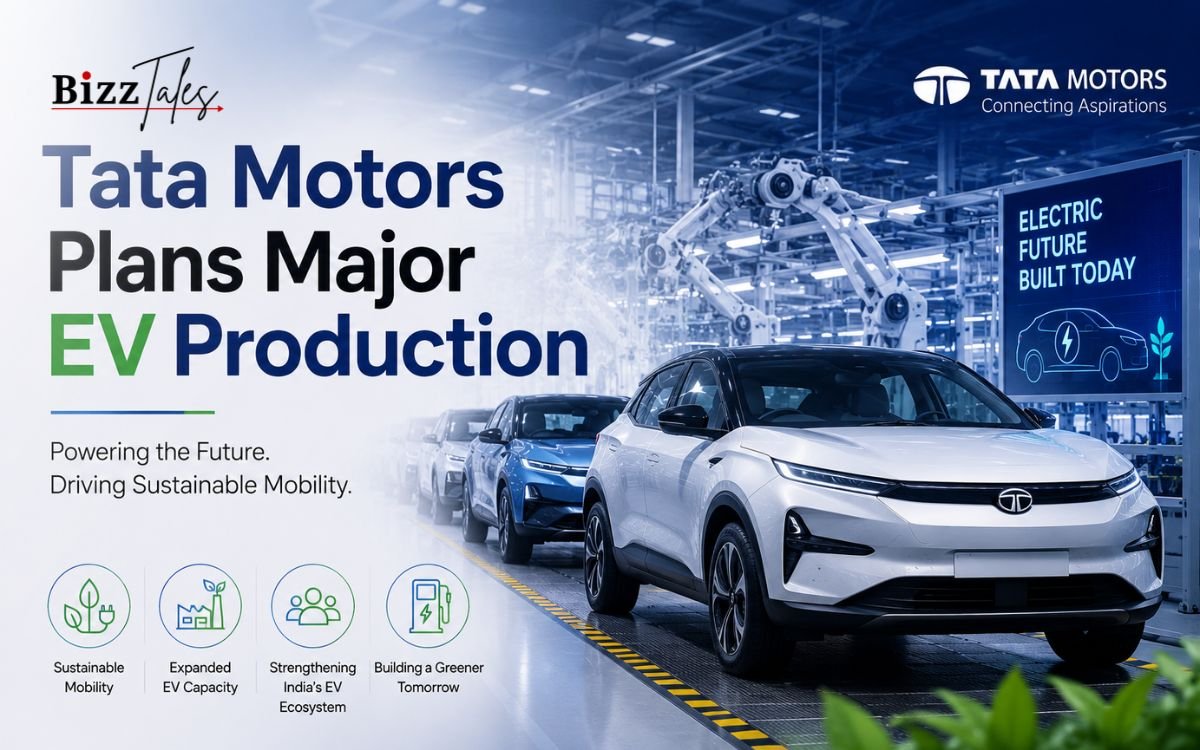
India is seemingly on the cusp of a new chapter as regards its electric vehicle revolution and Tata Motors is attempting to stake a claim to the center of that shift. The country’s biggest maker of electric passenger vehicles seems to be gearing up for a huge ramp-up in its production capacity for electric vehicles as markets in India and the rest of the world are seeing a growth in demand for eco-friendly travel solutions.
However, this must be viewed in the context of the national and international trend of Governments, consumers and companies using, introducing and spreading cleaner forms of transport. As the costs of fuel increase, more environmental concern emerges and battery technology develops,along with Government support, the demand for electric vehicles (EVs) grows. Tata has therefore begun to increase its production volume, develop its technology and enhance its supply chain to stay competitive.
Recently Tata Motors has emerged as one of the top-leading companies in the EV segment in the country. Almost a decade after the first launch Tata Motors has the electric cars like the Nexon EV, Tiago EV, Punch EV & Tigor EV doing the rounds of the country helping there look further in to the electric mobility boom in India. Now with the plan to expand the production they seem to be convinced that the country will have more and more demand for the electric vehicles in the future.
Some in the industry argue that Tata Motors’ push to grow aggressively may help to transform the Indian auto industry as well as cement a major position for the country as a leading electric vehicle manufacturer.
India’s Electric Vehicle Market Is Growing Rapidly
The Indian automotive industry is witnessing the most momentous change in its history. Even though the traditional internal combustion engine vehicles still lead the sale books.
Various factors have led to this. Increased awareness of climate change has led to consumers thinking about the use of greener modes of transport, while financial incentives from the government has made EV ownership more affordable.
Better charging infrastructure, too, help tackledon of the prominent worries for prospective buyers. The public and private investment in charging stations and networks is making EV more usable.
With consumer-confidence increasing, there will be great demand for EVs in the near future, especially within the next ten years. Tata Motors’ expansion indicates their optimism in the potential EV market.
Why Tata Motors Is Expanding EV Production
The motivation behind expanding manufacturing capacity for electric vehicles is a combination of present and foreseeable market demand.
Tata Motors has always had stronghold in the passenger EV market in India. The firm has been able to create a daunting product line that caters to every segment of the population-from first-time EV buyers to tech-conscious masses.
Nevertheless, as demand continues to grow, the production capacity needs to match the market needs. Increasing production facilities will enable the company to shorten lead times and delivery times and to launch new electric models.
The capacity expansion also fits into the larger strategy of Tata motors becoming a truly global viable mobility solution provider. As the Competition increases, expanding production capacity give the scale advantage needed to stay competitive and benefit from high efficiency levels.
In investing early Tata Motors intends to position itself as an established player in the market before electric vehicles become commercially mainstream.
Tata Motors’ Journey in Electric Mobility
Tata Motors’ early advantage in the EV market in India did not happen overnight. It invested in electric mobility prior to the popularity of EVs.
The early focus of R& D approaches and priority investments helped Tata Motors accumulate expertise, such as those related to Battery related systems, electric power train, complete vehicle integration and charging systems. These have helped lay down a strong foundation for future growth.
The launch of the Nexon EV was a milestone. It instantly emerged as one of India’s top-selling EVs, proving they could deliver real-world performance at an affordable price.
By launching additional new models, Tata Motors was able to further expand the reach of the product. The introduction of models targeted at specific segments allowed the firm to develop a diversified portfolio of electric vehicles.
The company is now considered a pioneer of India electric passenger vehicles market.
The Importance of Manufacturing Scale
Industry of the car… Among other branches, the automotive… With a lifetime market be producing large volumes, a time the fixed cost in the outputs is been spread over a larger number of outputs.
For electric vehicles, the amount of manufacturing is crucial because a big amount of production is the battery sysmtem. So, higher mass production can help in having better deal with suppliers and benefit from economics of scale.
With scales of economy increasing, the production volume will be enhanced. So, the costs of developing are reduced and the new products are more affordable to the customers.
Improved manufacturing capabilities may also enable future export opportunities.
Although still early, there will be many considerations that will determine the leaders and followers in the EV Market 6. One of those may be scale.
Government Policies Supporting EV Growth
Government schemes have been instrumental in driving the adoption of electric vehicles in India.
Numerous initiatives have been implemented to incentive EV adoption, foster development of charging infrastructure, and promote domestic manufacturing. Such initiatives aim at reducing reliance on fossil fuels and achieving other sustainability goals.
The measures to support manufacturers have also served as an incentive to invest in EC ecosystem. Manufacturers who increase the production and are willing to localize components are eligible to benefit from policy support that focus on the development of domestic capabilities.
The scope of Tata Motors’ production growth is fully integrated with national goals for clean energy, manufacturing growth and technological progress.
A favorable environment exists for EV industry long term development where in policy support and increases of end-user demand interact synergistically.
Battery Technology Is Driving Change
One of the crucial determinants of the future of electric vehicles is the battery technology.
The improvements in battery performance are enduring their benefits to driving range, improved charging speed and vehicle safety and efficiencies while reductions in manufacturing costs are being achieved gradually with improvements in cost reduction.
These innovations will make electric cars a viable choice for the majority of drivers. Better range will soothe usability doubts, lower prices will make them financially more accessible.
Tata Motors. Will also maintain large investments into battery research and development going forward. Improvements in future fast charging and energy density are likely to result from upcoming innovations in battery technology.
Battery technology is set to stay a major point of competition in the world EV industry.
Competition in India’s EV Market Is Intensifying
While Tata Motors has a currently good holding in the market, the market is becoming more competitive.
Top domestic manufacturers and world popular auto brands are pouring more models into the market. Various levels of products have been launched and more are to come.
This is also great news for industry’s toward innovation. Product competition is driving the industry to a truly global destination, manufacturers are competing in the areas of technology, market, design and performance and so on.
Tata Motors, however, having to increase production capacity is not just a matter of order filling but a desire to stay a step ahead of stiffening competition.
A good manufacturing base will give flexibility to introduce new products and to respond rapidly to market changes.
Impact on India’s Automotive Industry
The EV profile of Tata Motors can have an impact far beyond that of Tata Motors;
Investments in electric vehicles production at a significant scale generate a boost along the entire automotive ecosystem. Suppliers of the automotive industry, component manufactures, technology developers, logistics corporations or service firms all gain from a growing market.
Job creation is significant as well. New production plants tend to need more skilled workers, engineers, technicians, and administrative staff.
The growth of homegrown EV manufacturing capacity may further enhance India’s standing in international automotive supply chains.
With more and more businesses embracing electric mobility, India’s might become a key global destination for EV manufacturing.
The Role of Charging Infrastructure
Charging infrastructure is still one of the most important factors affecting the price of EV adoption.
Consumers must have the confidence to be able to charge easily at home, work and also on the move. Indeed the charging network has grown significantly, but further investment is required if demand is to increase.
Tata Motors, through its partnerships and infrastructure development initiatives, has facilitated the development of charging ecosystem.To cope with this rise in vehicle volumes, access to reliable charging will pose a bigger challenge.
The growth of the company’s production shows that there is reasons to believe that the development of charging schemes in the country will proceeds.
A strong charging network is an absolute requirement for mass electric vehicle adoption.
Sustainability and Environmental Benefits
The sole point to be considered here is the one concerned with ecology. In this case, the electric transportation system is very important!
Transport also has a significant impact on the emission of greenhouse gases and contribute to urban air pollution. Electric vehicles could be used as a means of significant reduction of those, especially with the use of renewable energy.
Tata Motors has identified sustainability as a part of the company’s 20 year vision. Further production at the plant further offsets the existing production numbers by helping to reduce overall carbon emissions through alternative forms of transportation.
As global environmental regulations grow more strict, manufacturers that make investments in environmentally sound technologies are protected by strategic advantages.
The company’s expansion represents an increasing awareness that sustainability and business development go hand in hand.
Challenges Ahead
While strong momentum is palpable across the electric vehicle industry, several obstacles still remain.
The cost of the battery is a quite obvious and large aspect affecting a cost of a vehicle. The costs are going down, and this is important for the possibility of the vehicles to be produced in a large extent.
Expansion of the charging infrastructure is also necessary to keep up with growing vehicle counts. Improving consumer knowledge of electric vehicle characteristics, maintenance requirements and usability will be needed to rebut common misconceptions.
Supply chain resilience is also an issue. As the global, digital demand for battery materials increases there will be increasing strain on the supply for raw material access and costs.
Tata Motors need to be extremely cautious while fulfilling the said expansion strategy.
But the company’s knowledge and market position give a solid background for future development.
Looking Toward the Future
The automotive market in India is gradually shifting towards electric vehicles. The factors leading to this change include consumer needs, technological improvements, the focus on the environment and recent step taken by the government.
By moving into this area, Tata Motors has shown its faith in the overall market trend. The company is gearing up for both the present and the future.
As batteries become more advanced and charging points are placed in more locations EV shares will continue to grow. A manufacturer that can produce fleet quantities at a reasonable price will be most successful.
Tata Motors aspires to be one of those leaders.
Conclusion
If Tata Motors successfully ramp up electric vehicle manufacturing as announced, it would be a major step forward for the world of Indian green mobility.
The market conditions for electrification are at unprecedented levels of support, favorable government policies, technologies and charging infrastructure with consumption rising rapidly. To capitalize on this opportunity, by deploying the production capacity, Tata Motors is progressing towards the next stage of the EV revolution in India.
Overall, this expansion has been a positive move for Tata Motors and could enhance India’s automotive ecosystem, bring fresh economically beneficial activities and help speed up India’s transition to cleaner Mobility. Tata Motor’s approach will have a major influence on the future of India’s driving needs as the EV market progresses.
What is prompting Tata Motors to increase EV manufacturing?
The business is expanding its production to meet demand for the increase sales of electric vehicles and Ensures the business remains leading and innovative within the EV industry.
What are the most sought after Tata Motors EVs?
Popular models include the Nexon EV, Tiago EV, Punch EV, and Tigor EV.
In what way will more production improve the lives of consumers?
Adds to increased production capacity (less waiting time, more availability, and prepare for future product launches)
How essential is the battery technology in the development of EVs?
More improved batteries will result in extended range, faster recharging times, increased efficiency and lower costs.
In what way does this proliferation aid India’s EV objectives?
Which falls in line with the regimes government program of clean mobility, investment in home grown manufacturing, and emission reductions.
Will the competition threaten Tata Motors’ SUV/EV leader position?
The market competition is heating up; however Tata Motors biggest advantage in the emerging battle is that it is the most efficient as it offers the biggest portfolio, enjoys the highest manufacturing scale and takes investments early.