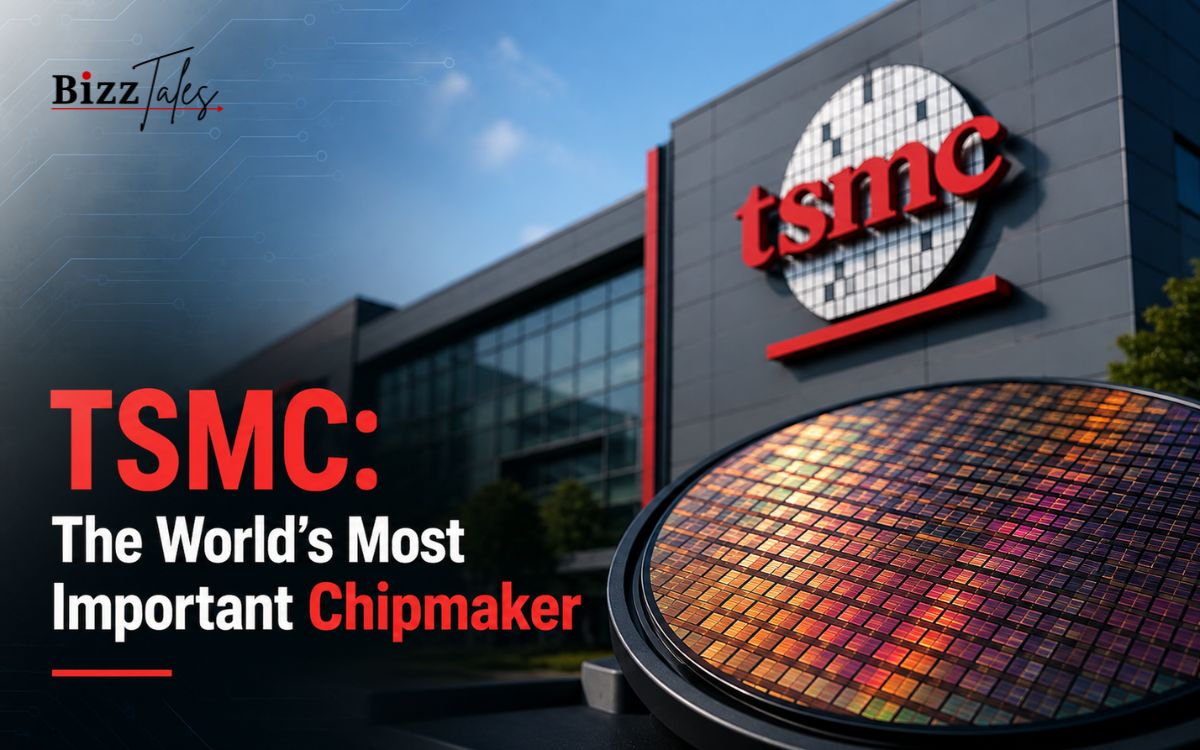
For most people, TSMC is not even a household name. Unlike famous consumer brands like Apple, Samsung, Microsoft, or Google, so far they are few ways to market Taiwan Semiconductor Manufacturing Company (TSMC). They don’t have social media feeds, direct to consumer handset lines, or even own electronics like household appliances.
Despite its low profile, TSMC is perhaps the most significant technology corporation anywhere.
Anytime an iPhone is used, a video is played, an AI is run, a modern car drives, a video game is played or a cloud service is accessed a chip by TSMC is likely to have been used. They are embedded deep within the global technology agglomerate.
Any future like this would have been impossible without TSMC. The company’s manufacturing processes have allowed the development of computers, smartphones, data centers, AI programs, hospital machinery and research tools, and advanced military technology.
Today, TSMC is manufacturing the vast majority of the world’s most sophisticated semiconductor chips and is one of the most strategically significant firms on the planet. This is a story not just of technology, but of innovation, globalization, competitive dynamics, geopolitics and the future of the digital economy.
The Origins of TSMC
TSMC’s story starts with a visionary leader, Morris Chang.
Chinese-born and US-educated and after a long career in the semiconductor industry, Chang saw potential markets others had not.
The majority of semiconductor companies during the 1970s and 1980s operated their own chip design and fabrication plants. However, in order to set up the fabrication plants, the cost involved was too high for most businesses and therefore only the biggest companies could afford it.
Chang thought there was a higher model.
He wanted to build (a company) that designed chips, and then sent them to be built elsewhere. At that point this seemed a very risky thing because there just hadn’t been a lot of chip companies that had built a fab.
However, Chang realized that as chip designs grew more complex then many businesses would choose to outsource manufacturing to a specialist.
A decade in the making, in 1987, with the approval of the Taiwan government and a close close group of private investors, TSMC was established.
What at first glance seemed to be a niche market approach would later bring a complete transformation of the semiconductor industry.
Creating a New Business Model
Perhaps the most remarkable innovation in TSMC was not technology. It was strategy.
Rather than compete with chip designers, TSMC became a part of their supply chain.
This approach fostered trust across the industry. Companies could produce high performance chips without fearing that the manufacturing partner would turn into a rival.
The model mean that companies could just concentrate on product development and let TSMC in charge of fabrication.
As a result, this concept gradually became popular among customers.
Startups and large companies both recognized the benefits of outsourcing chip production. With the increasing adoption of fabless companies, TSMC gained more and more customers.
This business would go on to be one of the most successful models in technology history.
The Rise of the Semiconductor Industry
First, what is a semiconductor and what makes a chip essential?
Semiconductor chips are the central processing units of today’s electronic devices. They carry out logical functions, store information, and facilitate communication between parts of the electronic system.
Any high technology product will a technology based on the semiconductor technology.
Smartphones, laptops, game consoles, cars, medical equipment, industrial robots, cloud server, AI and communication networks-all need high-end chips.
With computers becoming more advanced, the demand for semiconductors surged.
The problem was that the high-end chips were going to be expensive to manufacture and difficult to develop.
It can cost as much as billions to construct a manufacturing plant and needs periodic upgrade so as to stay in the race.
Very few companies could afford these kind of investments.
This is where TSMC took the stage and became the manufacturing giant that allowed the flow of technological innovation to thrive across the globe.
Becoming the Manufacturing Partner of Technology Giants
A major contributing factor to the success of TSMC was its capacity to draw in world leading technology companies.
Instead of entering product development under the company’s own name, the company’s were completely engaged in transforming itself into the world’s best semiconductor manufacturer.
The strategy brought to the company clients that varied from small startup companies, to international conglomerates.
In today’s technology-driven world, today’s companies, including Apple, NVIDIA, AMD, Qualcomm and countless others, depend heavily on TSMC’s manufacturing capacity.
For these cases, TSMC is no longer just the vendors. As a matter of fact, TSMC is finally a strategic partner.
Many success of certain products of modern technology is directly depending on how TSMC is capable of producing chips that are greater in power and efficiency.
This relationship has only grown over the years giving TSMC more influence in the worldwide technology supply chain.
The Race for Smaller and More Powerful Chips
It’s always been about accomplishing one thing in the chip industry.
Something that takes a very high level of engineering skill to successfully introduce is:
Semiconductor manufacturing today involves putting billions of transistors on very small silicon wafers with incredible precision. The dimensions involved in a lot of the most recent manufacturing processes are measured in nanometers-not even visible to the human eye.
Never lagging behind in this race of technology,TSMC has always been on the top of it.
The companies spends on several billions of dollars a year for R&D, and manufacturing infrastructure.
By being able to manufacture state of the art chips, the customer has been able to produce quicker smartphones, more powerful computers, hugely intelligent AI systems, and ever more complex electronics.
This technological leadership has developed as one of TSMC’s greatest competitive advantage.
How TSMC Powers the AI Revolution
AI has been one of the major technologies.17 The development of advanced machine learning and deep learning techniques has revolutionized the field.
All of these demand huge amounts of computing power: large language models, generative AI, cars, robots, analytics.
This demand has opened up unforeseen opportunities for growth for the semiconductor manufacturer.
However, to run such an AI system, you need chips that are extremely specialized to run the numbers-especially considering the huge volumes of data that will be flowing through.
Most of these super processors are manufactured by TSMC.
The more rising in AI leads to the much growing demand for the company capacity of production as the AI is used greatly for all over the world practicing-investing heavily in the AI.
With the AI boom, the company has further strengthened its role as a key enabler for technological innovation.
Why Apple Depends on TSMC
A significant company of TSMC is its cooperation with Apple.
Following the introduction of the iPhone, Apple’s iPad and Mac computer lines have adopted custom-designed processors designed by Apple. They are a key factor in the ability of the Apple product line to stand out with respect to performance, battery life, and integrated design.
Yet designing chips and actually manufacturing them are a totally different matter.
Apple depends on TSMC to manufacture its cutting-edge chips on a huge scale but to very high quality standards.
This partnership has turned into one of the most significant technological alliances.
Every iterations of Apple devices benefits from the modern semiconductor processes and reminds that TSMC’s important role behind the scene.
Instead of taking a number of years, without access to TSMC facilities some of Apple’s innovations would take so much longer to develop.
The Strategic Importance of Taiwan
The fact that TSMC is based in Taiwan has serious geopolitical consequences.
The firms on this tiny island turn out a large share of the world’s leading semiconductors.
The increasing worldwide reliance on semiconductors has amplified Taiwan’s unique role.
Most governments have noted the potential for disruptions to the semiconductor industry to affect the economy.
The COVID-19 crisis revealed how delicate the world’s supply chains are, when so many sectors-everything from car production to consumer electronics-were compromised by a lack of chips.
These events put the dependence of the world’s economy on TSMC and the whole semiconductor industry into sharp focus.
As a consequence, many nations are heavily investing in local chip fabrication facilities while trying to develop tighter relationships with chip suppliers.
Expanding Beyond Taiwan
Aware of the need to increase supply chain resilience, TSMC has started to establish manufacturing facilities outside Taiwan.
The company has built, or has invested in, new facilities in the US and Japan.
These expansions are intended to diversify the geographic risk exposure while satisfying the increasing demand of clients.
It is very difficult to build the silicon fabrication facilities outside Taiwan, because of many factors such as high costs, extensive human resource, and finicky technology.
However, the trend for diversification has become more pronounced as both governments and firms look for increased supply chain security.
These international deployments are indicative of TSMC’s shifting position as a key enabler infrastructure provisioner of the digital world.
Challenges Facing TSMC
However, TSMC faces a wide variety of obstacles now and in the future.
The competition still is fierce. Companies like Samsung Electronics and Intel still keep investing in high-end manufacturing technologies.
Global supply chains have become highly sensitive to geopolitical upheavals. An unstable political climate which includes political malfeasance or terrorism, introduces more questions than answers with respect to geopolitical risk, which is growing increasingly difficult to forecast due to changes in:
On top of this, retaining technological leadership demands extraordinary investments.
Every fresh generation of semiconductor fabrication is more costly and more complex from a technical perspective.
To maintain advantage over the competitors, TSMC need to always keep moving forward and satisfy customer needs.
Such problems necessitate strategic long term planning and meticulous handling.
Leadership and Corporate Culture
One of the key reasons for TSMC’s achievement has been consistently following a disciplined culture of innovation and operational excellence.
The company has always taken a long-term view in its strategy, whether it was under Morris Chang or the current leadership.
The TSMC management team specializes in execution, quality, research, and customer relations.
This dedication has gained the confidence of several of the world’s leading technology companies.
Being not a consumer-driven business, but a manufacturer, TSMC’s brand image is mainly founded on stable, accurate and advanced technology.
Its culture bears a stamp of these priorities.
The Future of TSMC
Things are looking up for TSMC.
Alot of those new technological advances such as artificial intelligence, cloud computing, 5G networks, self driving cars, robotics, and advanced health care technology are anticipated to grow thesemands for semiconductors to a large extend.
The demand for superior chips will still increase day by day, as digital transformation is gaining momentum.
TSMC can be expected to capitalise on these trends thanks to its process manufacturing skills and customer relationships.
The company is also exploring the latest technologies of the future.
If current trends persist, The role of TSMC in global economy will likely be even more important in the next ten years.
Lessons Entrepreneurs Can Learn from TSMC
There are a lot of lessons to learn from the story of TSMC for entrepreneurs and business leaders.
One lesson is the importance of BIFURCATION. Instead of attempting to compete in every part of the semiconductor industry, TSMC chose to specialize in being the best manufacturer..
Another takeaway is how powerful long-term thinking can be. The company continued spending on areas like research, infrastructure and building customer relationships long before these actions yielded any financial benefits.
As we represent, businesses can also create great value by collaborating. TSMC’s strategy of assisting others in achieving success enabled it to establish one of the world’s most powerful enterprises.
Most significantly, its tale emphasizes the need to recognize neglected opportunities.
Conclusion
TSMC is not a household name, although its products are used in everything from… To.
The company makes the technologies that are transforming our world-from mobile phones and artificial intelligence to the cloud and advanced electronic devices.
Its business model, technological leadership and strategic position have made it one of the world’s most valuable and powerful companies.
With the demand for high-end semiconductors always increasing, TSMC will probably play an even more important role.
TSMC aren’t just in the business of fabrication. Their story is about powering innovation, helping technology company giants around the globe stay ahead, and doing the work that is silently shaping humanity’s digital tomorrow.
FAQs
Can you tell what TSMC does?
This Malaysian company produces semiconductor chips that are used by high tech organizations worldwide like Dell, Apple, NVIDIA, AMD, and Qualcomm to name but a few.
Believe in TSMC. Get a clear idea of the company.
Founded in 1987 by Morris Chang as the architect of the semiconductor foundry industry, TSMC.
What makes TSMC so significant?
TSMC manufactures a significant amount of the world’s leading chips, therefore is vital to numerous sectors including Smartphone, Al, Cloud and Automotive.
TSMC itself is not designing any chips.
No. TSMC does not design chips by itself; it specializes in making other company’s designs.
In what ways does TSMC affect artificial intelligence?
The bottleneck left by American FDIs in high tech can largely be replaced by TSMC, to be the enablement of global AI industry from data centers to ML systems.