Shopping in India has undergone a sea change over the past few years. Consumers in India have been used to waiting a handful of days for their goods to be shipped. E-commerce sites were offering convenience, variety of products and value for money and consumers were willing to wait.
But today we are having very different uses.
Today’s customers expect just-in-time delivery.21GOODS shopping is no longer just about the end product, it is also about accessing the goods and receiving it quickly. This means groceries, pharmacy supplies, home care, snacks. So every variety of product now expects to reach customers in merely minutes rather than days.
As a result of this rising demand, India is witnessing the emergence of one of the country’s fastest growing business segments- Quick Commerce.
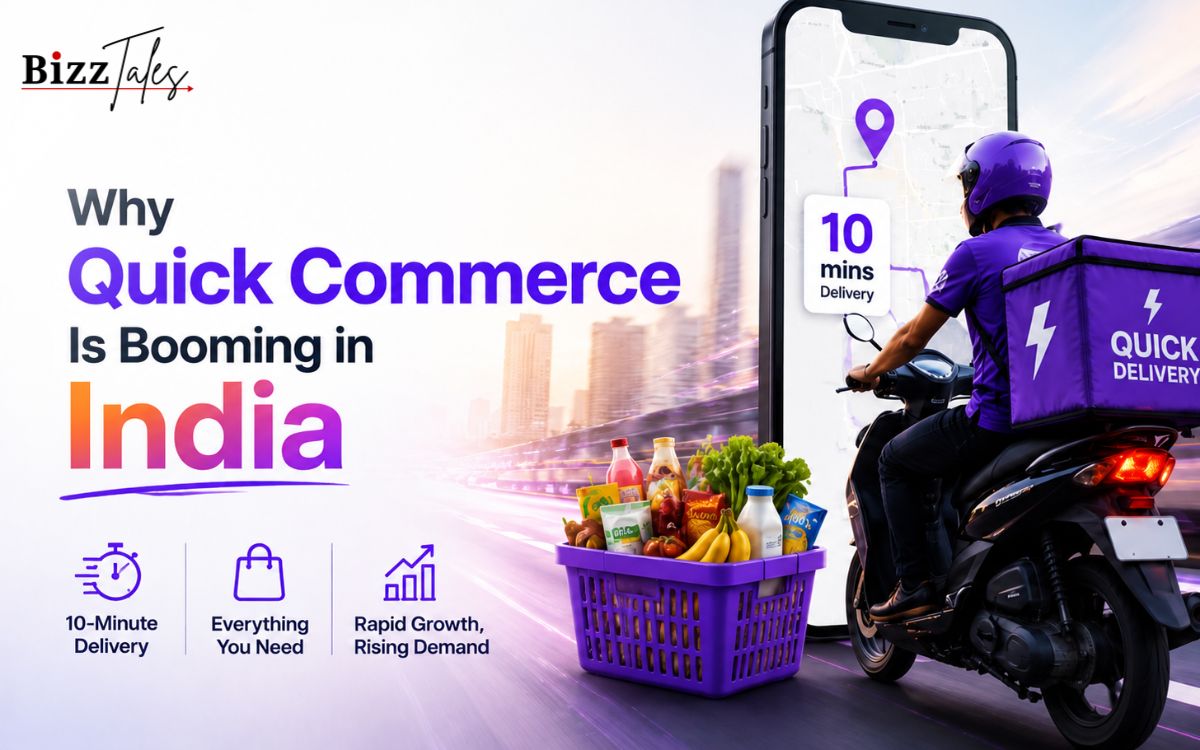
Derived from quick, quick commerce (also known as Q-commerce) is a business model that is dependent on super-fast deliveries-everything generally gets delivered within 10 to 30 minutes. Business players in this industry are re-shaping the landscape of customers shopping for everyday necessities.
In cities all over India, speed-e-commerce has been a common thing for the consumers. Consumers by just a tap on their phone can get the product delivered to them immediately.
What was once deemed impossible, has now become commonplace.
The fast-paced escalation of quick commerce business is grabbing investors, leading competition, instigating employment and revolutionizing the retail industry of India. To view the progression of quick commerce business of India, it is important to analyze on why this industry is booming.
What Is Quick Commerce?
Q-commerce is a delivery framework established to deliver goods to consumers as quickly as possible.
Quick commerce companies do it much quicker. While most e-commerce companies take a day or two to deliver ordered products, quick commerce companies deliver to your doorstep in a matter of minutes.
This model depends on the existence of warehouses / dark stores that are located at specific points.
The small fulfillment centres are a necessity in maintaining the supply of Business products that are bought often, to be kept close to residential areas.
Orders are being placed by the customers an products are being picked, packed and delivered on the spot through nearby delivery partners.
Everything is centered on convenience and speed.
These operational efficiencies are among the major factors driving the industry forward.
Changing Consumer Expectations
Changing consumer behavior is also another key factor for the growth of quick commerce.
Today’s consumers emphasize the importance of convenience.
With modern hectic lifestyles and work pressures, in addition to the rapid urbanization, the time spent shopping in…
. Do not cater to today’s fast paced lifestyle, have a longer life (and higher quality lifestyle) with more flowing easy movement: by investing in HABA®-SENSA treatment!
Now customers lean more toward shopping through their smart phones.
Being able to get groceries, snacks, drinks and many other regular shopping items in just a few minutes offers a hugely compelling customer experience.
When consumers enjoy this comfort, it’s challenging for them to go back to browsing in a store.
Smartphone and Internet Growth
THE DIGITAL REVOLUTION HAS SPURRED QUICK COMMERCE IN INDIA.
Buying online has become more popular due to cheaper mobile phones and internet access that is more affordable.
Millions of consumers now use mobile applications for:
- payments
- shopping
- food delivery
- transportation
- banking
These quick commerce platforms feel very much at home in this world.
With the upgrade of smartphone infiltration, the user pool for Q-Commerce is also enlarged.
Urban Lifestyle Is Driving Demand
Indian cities are speeding up.
People often work many hours and don’t have time to grocery shop. Or run errands.
Quick commerce tackles this head-on.
Customers don’t have to spend time traveling to buy things; they can make their order from home, office, or just about anywhere.
This advantage holds significant value considering the size of major metropolitan centers like Mumbai, Delhi, Bengaluru, Hyderabad, Pune and Ahmedabad.
Time matters more than any minor price disparity.
The Success of Instant Gratification
SomePsychologically it is pleased that the consumers who will enjoy immediate satisfaction.
Consumers are generally impatient in the sense that they prefer to buy now rather than to buy later.
Quick commerce responds to this tendency.
The convenience of getting products to us within a matter of minutes facilitates the level of satisfaction that normal retail and slash typical online shopping cannot provide.
Quicker companies tend to have higher customer loyalty.
Investor Confidence in the Sector
The quick commerce industry has gained the interest of many investors.
Investors believe there’s significant growth opportunity as consumer demand is on a marked uptrend.
Large investments have helped companies:
- expand dark store networks
- improve logistics
- strengthen technology platforms
- increase operational efficiency
Funding has driven that rapid growth and also created more competition with other industry players.
It is currently regarded as one of the most monitored areas in the Indian startup landscape.
Technology Is Powering Growth
Technology is the core driver of fast commerce operations.
Advanced software helps companies manage:
- inventory
- route optimization
- order processing
- demand forecasting
- delivery management
AI & DATA analysis are systematically reviewed and making use of the technology used to predict shopping patterns.
If not for the miracle of technology, thousands of orders would never get to the door-step, let alone in a matter of minutes.
The Rise of Dark Stores
Dark stores are a key characteristic of the rapid commerce.
Dark stores are different from normal retail stores in the sense that they are meant solely for orders
Placed near residential areas so that deliveries can be made quickly.
This model enables transport companies to keep their operation at high speed and reducing transportation delays.
The increased demand has led to an increase in dark stores opening in and other towns.
Competition Is Fueling Innovation
The rapid commerce market exist in a very competitive environment.
Companies are always trying to make delivery faster, enhance customer experience or provide better product availability.
Competition is advantageous for consumers because it forces businesses to constantly strive to gain and keep customers through innovation.
The latest functionalities, loyalty schemes, tailored offers, as well as quick delivery systems are on the rise.
The fierce competitiveness would enhance the industry.
Employment Opportunities
Furthermore, quick commerce also generates millions of new jobs.
The industry generates jobs for:
- delivery partners
- warehouse staff
- operations teams
- technology professionals
- customer support teams
More and more jobs are opening up, as other companies ease into a new city.
This economic contribution is boosting the overall significance of the industry.
Impact on Traditional Retail
Traditional retail businesses are being affected by the rise of fast commerce.
A lot of local stores are also making changes and providing home delivery services or collaborating with food delivery services.
Corporations more and more under-estimate the customer survey as a new key to competitive advantage.:
Firms that cannot respond may find that they cannot compete with the evolving consumer demand.
Challenges Facing Quick Commerce
However, this fast-growing sector, known as quick commerce, also for all.
Payback has always been the major concern.
In order to deliver within minutes,a heavy investment must be done in infrastructure, technology, and logistics.
Concerned with time and money.
Other challenges include:
- rising operational costs
- intense competition
- inventory management
- delivery partner availability
Ultimately, the question of how well businesses adapt to these will measure their long-term success.
Why Consumers Continue Choosing Quick Commerce
Despite likely difficulties, consumers are still choosing to use the quick-commerce option as they are solving real issues.
We value the ease, the speed and the flexibility.
Being able to buy day-to-day essentials forgotten groceries, critical medicines etc. Instantly, is where the real value lies in.
Quick commerce is no longer just a convenience service.
For many of urban consumers, it has become a part of daily life.
The Future of Quick Commerce in India
Industry experts argue that the rapid growth of quick commerce is set to continue in the near future.
Growth is expected to come from:
- deeper penetration into existing cities
- expansion into smaller cities
- broader product categories
- improved technology
- stronger logistics networks
As operations become more efficient, profitability for firms can…
Profitability at the Company Level:
The future is probably about faster deliveries, more personalized products, and a larger scope of inventory.
Impact on Consumer Behavior
Fast commerce is a complete rewind in the evolutionary history of shopping27.
Consumers are shopping more often and doing less bulk shopping (weekly shops) their purchasing patterns are becoming more frequent but smaller shopping trips.
This change in behaviors is impacting the managing of stock, the supply chain and the plans in the retail.
However, one must not forget that these changes are being watched over by businesses of all industries.
Conclusion
Of late, quick commerce has become the most happening business space in India as it tap into today’s consumer aspirations in the most effective manner.
Convenience, fast and simple is what people want and fast commerce is right there to fulfill this desire.
Boasting “mobiles on the street, heart in the city, eyes on the future, stomachs full of technology” and fueled by the growth of the Smartphone and the move to city life, industry is booming along with investor optimism.
Looking in more detail at some indicators, and despite ongoing difficulties, the long term picture looks more positive:
Quick commerce is no longer only about delivery. It is rebooting consumers, the retail industry, and shopping as we know it in India.
All entrepreneurs, investors and business executives should recognize the importance of this phenomenon since rapid commerce is simply one of the most disruptive trends we see in Indian retail today.
FAQs
What is quick commerce?
Quick commerce is a delivery model that provides products to customers within a short time frame, typically 10 to 30 minutes.
Why is quick commerce growing in India?
The growth is driven by convenience, smartphone adoption, urban lifestyles, and increasing consumer demand for faster deliveries.
What products are commonly sold through quick commerce?
Groceries, snacks, beverages, medicines, household items, and personal care products are among the most popular categories.
What are dark stores?
Dark stores are small warehouses designed specifically for fulfilling online orders quickly rather than serving walk-in customers.
Is quick commerce profitable?
Profitability remains a challenge for many companies, but improving technology and operational efficiency may help businesses achieve sustainable growth in the future.