The Reserve Bank of India (RBI) is unquestionably the most powerful and important institution in the entire Indian economy. If one were asked to define the RBI, most people would associate it with banks and interest rates, but policy of RBI affects the whole world of business in just about every way possible.
From an end user perspective, starting from a new startup fund raising business, building new manufacturing or distribution facilities, running retail outlets, making investment plans for a large corporation or a small business, business performance can be impacted directly by the RBI policies.
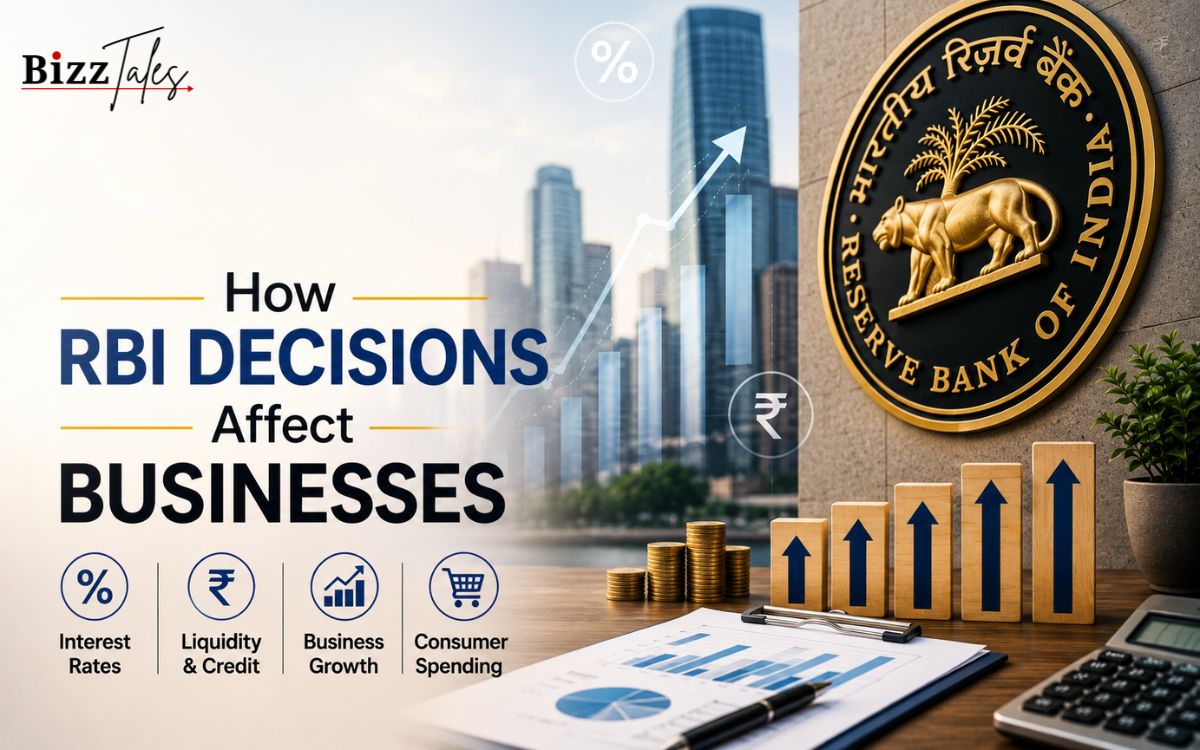
The ripple effects of Central Bank’s decisions related to interest rate 7, monetary policy 8, inflation target, liquidity management and Banking regulations are felt across all sectors in India. Not only the retail and corporate customers of banks, business and individual but entire economy is affected.
Most business owners are unaware of the impact that RBI policy has on their business. If you want to understand how your business is affected by the policies of the RBI you will be able to make more informed business and financial decisions.
In an expanding economy like India, the RBI plays a very significant role in balancing growth and stability. Its behavior affects the financial markets as well as the everyday cash flows of firms and individuals..
What Is the RBI?
The Reserve Bank of India is the banking institution of India.
The Reserve Bank of India (RBI) was founded in 1935 and today directs the country’s monetary policy, supervises banks, preserves financial stability, keeps inflation under control and aids development.
In 2004 05, the RBI was no commercial bank (though it acts as one in a certain way).
Rather than, it becomes the skeleton of India’s financial system, which is undeniable.
The decisions taken by the bank means the banker for the economy. The RBI is one of the most powerful institution of the country:
Why Businesses Follow RBI Announcements
When RBI releases a monetary policy decision, businessmen, investors, banks and financial experts all sit up and analyze the result.
This is because RBI policies often determine:
- borrowing costs
- lending rates
- business investments
- consumer demand
- inflation levels
- economic growth
Minor policy adjustments may have massive impacts in various sectors.
Business perspective on RBI actions is approximately same as interpretation of weather forecasts before a journey.
The more quickly businesses catch the economic signals,the better they prepare.
The Importance of Interest Rates
Important decision of RBI that may affect the markets is interest rate.
The indicator utilized by the RBI is the re po rate.
The rate at which commercial banks of lend money from the RBI is called as the repo rate.
Once the RBI alters this rate, the entire economy feels its results.
If the RBI raises rates, it will cost more to borrow.
In the event that the RBI decreases rates, the subsequent effect will be that credit will cost less.
Consequently this have direct impacts on companies and consumers.
How Lower Interest Rates Help Businesses
If the RBI were to reduce the interest rates, then it becomes easier for banks to borrow money in the financial markets.
Therefore, banks do sometimes lower loan interest rates for businesses and individuals.
This enables a number of advantages for businesses to be gained.
Companies may find it easier to:
- expand operations
- buy machinery
- hire employees
- invest in technology
- open new branches
Financeer’s say has faith in business growth, and hence lower borrowings.
Specially advantageous to startups, as access to cheap capital is facilitated.
How Higher Interest Rates Affect Businesses
In the event of rising inflation or economic conditions needing to be drained of excess cash, the RBI can set the rates to a higher level.
The net effect of the two will therefore be: This pushes the price of loans up.
Companies borrowing money have to carry a heavier credit burden.
Some firms may slow down expansion projects or put new investment on hold altogether, as the debt service burden grows.
This may even be felt more acutely by small businesses. They often lack the financial resources to deal with this.
De an increase in interest that can be detrimental to the sales of several industries.
Impact on Consumer Spending
The decisions made by RBI also affects the consumers as well as the business world.
Low interest rates tend to encourage consumers to borrow more.
Home Loans Car Loans Personal Loans…are using sensex the opportunities areargham.
As consumers get richer, companies have developed a much higher demand.
They all find the best environment when the interest rates are low: retailers, car makers, property developers, consumer brands.
However, higher interest rates might cut spending.
Inflation and Business Operations
The core duty of the RBI is to keep inflation under check.
Inflation can be defined as; the increase in the general level of prices over a period of time.
In a growing economy,moderate inflation is a normal.
But when inflation gets so high that it is out of control it can be a serious problem for businesses and consumers.
When prices rise rapidly:
- raw material costs increase
- transportation expenses rise
- wages may increase
- profit margins become smaller
High inflation periods present various challenges for businesses, leading to profitability concerns.
How RBI Controls Inflation
The RBI implements a range of monetary policy instruments to control inflation.
One strategy is to raise the interest rates.
Higher interest rates mean consumers borrow and spend less. And this can dampen inflation.
Although this may have an impact on short run growth(though we should not over expect), it is important as it helps long run stability of economy.
Firms generally favor stable inflation over volatile prices, that is:
Impact on Investments
Investment activity is significantly affected by RBI decisions.
Therefore, when the interest rate is low, firms will increase their investment.
Motivated by the pursuit of higher returns, investors could also reallocate funds into stocks and corporate enterprises.
On the other hand, increased interest rates may lead investors to allocate funds to fixed-income securities than to riskier assets.
However, this could have an impact on sources of funding for a startup and growth plans for a business.
Effect on Startups
Startups are very sensitive to RBI regulatiion.
Most startups need to get external fundings and takes debt to develop.
Lower interest rates create a favorable environment for:
- fundraising
- expansion
- hiring
- innovation
Loans are likely to be harder and more costly at these level rates.
However, risks may appear more risk-averse, what can influence a startup ecosystem.
Impact on the Real Estate Sector
The real estate is one of the field most influenced by transactions at the Reserve Bank of India.
Many homebuyers are very dependent on housing loans.
Lower interest rates-home loans are cheaper.
All of these typically stimulate more demand for place of residence.
Higher sales and more project activity also work in favor of the developers.
Demand may slow in the case of rising rates due to the higher cost of borrowing.
Influence on Manufacturing
Manufacturing businesses often demands large investments.
Factories, machinery, infrastructure, equipment, etc., are generally big investments.
Lower costs of borrowing away from or elsewhere abroad provide incentives for producers to increase output and invest in modernization.
Increment in rates may postpone capital projects and lessen investment.
Stock Market Reactions
The stock market also keenly follows RBI decisions.
Investors typically react as soon as the interest rate and monetary policy signals change.
In general, lower rates are seen as a good thing as increasing rates will encourage profits and growth.
Higher rates may lead to fears of a slower pace of growth and business activity.
Therefore, any news by RBI can often have an impact on the market sentiments.
Impact on Banking Sector
The RBI policies not only influence other financial institutions directly, but also directly impact the banks themselves.
Alterations in the rates of interest impact profitability of lending, deposit rate and other banking activities.
Due to the fact that banks are the pillar for the whole financing of a business performance of banks has an impact on the economy more generally.
A healthy banking system enables businesses to grow and helps maintain a stable economy.
RBI and Economic Growth
The RBI constantly balances two important objectives:
controlling inflation
supporting economic growth
If inflation gets out of hand, then steps must be taken to counteract it.
If the economic growth shall turn into a stagnation, the measures of the stabilization could no longer suffice.
Maintaining the correct balance is undoubtedly one of a central bank’s most difficult functions.
Global Factors Also Matter
RBI announcements do not occur in isolation.
Policy when global economic factors are present.
Factors such as:
- oil prices
- international trade
- geopolitical tensions
- foreign investment flows
- global interest rates
May also have an impact on India’s economy.
The Reserve Bank of India takes these factors into consideration for taking its decisions.
Why Business Owners Should Pay Attention
For many entrepreneurs, customers, products and operations tend to be at the center of their attention.
Although they are important, RBI policies offers useful business insights.
Knowledge of interest rates, inflation trends, and monetary policy helps businesses:
- plan investments
- manage borrowing
- forecast demand
- reduce financial risks
Economic literacy tends to result in improved choices.
The Future Outlook
India continues to be one of the world ‘s most rapidly expanding large economies.
RBI policies will keep having an impact on business sectors over a diverse range of industries, since they will have a dynamic character as the economy adjusts itself to changing circumstances.
Firms that keep track of monetary policy will be more able to adjust and expand.
The RBI-business relationship will continue to be vital to India’s economic journey.
Conclusion
The Reserve Bank of India holds an important position in the business climate of India.
Interest rates, inflation control, liquidity management and monetary policy decisions made by the RBI determine the cost of borrowing, consumer expenditure, investments and the economy.
No matter if the company is a start up, a small business or large corporate it would be impacted by any RBI policies.
Learning about the operation of these decisions gives business owners the knowledge to make intelligent financial decisions and to avoid poor decisions in strained and fluctuating markets
In our fast-changing economy, RBI actions are increasingly important to be aware of in the present day.
FAQs
What is the role of the RBI?
The RBI is India’s central bank responsible for managing monetary policy, regulating banks, controlling inflation, and maintaining financial stability.
How do RBI interest rate changes affect businesses?
Lower interest rates make borrowing cheaper and encourage business expansion, while higher rates increase borrowing costs and may slow growth.
Why does the RBI increase interest rates?
The RBI often increases interest rates to control inflation and maintain economic stability.
How do RBI decisions affect consumers?
RBI decisions influence loan rates, spending power, savings returns, and overall economic activity.
Why should entrepreneurs follow RBI announcements?
RBI policies affect borrowing costs, investments, customer demand, and economic conditions, making them important for business planning.