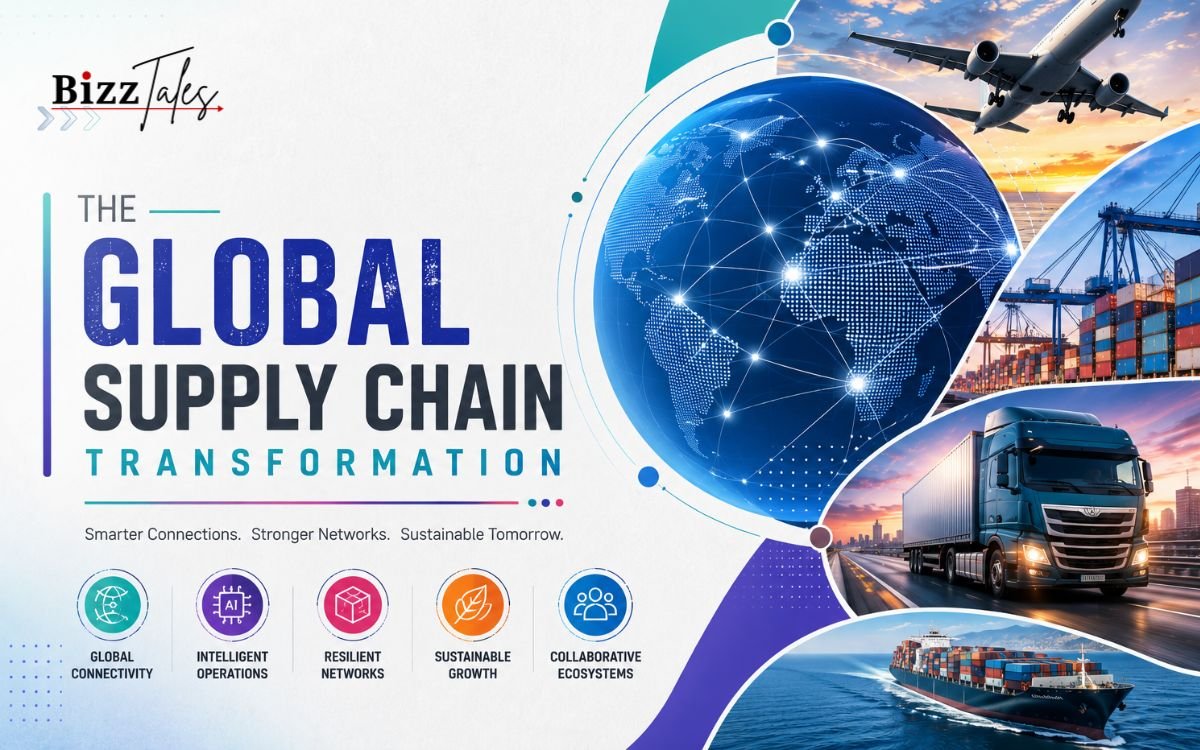
Throughout the world, the economy is experiencing one of the biggest changes since the industrial revolution and it’s all revolving around how supply chains is evolving. From being regarded as the most hidden of all business functions, supply chains are now a strategic concern for governments, companies, and investors around the world. With everything including AI, automation, geopolitics and sustainability, supply chains are changing.
In the last few decades, globalization led to companies creating complex global supply chains in order to capitalize on the lowest costs available. Raw materials were purchased in one continent, assembled in another, and shipped off to sales markets which were often located thousands of miles away. This was profitable and created global corporations.
Nevertheless, recent instances unveiled weak points in those complicated structures. The world-wide supply systems had to face a variety of problems such as the coronavirus pandemics, international conflicts, trading rules and facing trades and ships, lack of work-force or inflation. Consequently, firms are shifting their priorities from classic approaches to more robust, flexible and high-Tech supply chains.
What is happening now is not a fleeting change but a permanent shift in the operate of the economy. Those that make the right changes will develop competitive advantages, those that don’t may find it difficult to succeed in increasingly volatile world.
Understanding the Traditional Global Supply Chain Model
Historically, supply chains were focused on efficiency. Companies put pressure on minimizing the cost of production by establishing manufacturing plants in countries where the cost of labor and equipment was lower.
This resulted in very complex international networks of production and trade. For example, from one product to another, the locations of the various stages – extraction, processing, assembly and consumption – could be widely dispersed-say, extraction in Africa, parts fabricated in Asia, assembled in Europe and sold in North America.
The idea was supported by globalization opened the border of world trade where the tariff duties fallen, so that state of the infrastructure transportation and the foreign trade was expanded. It increased the profit gained for the dist.
Although the system functioned smoothly in stable times, it tended to favor low cost over being resilient. Companies found that complex supply chains could become very sensitive to shocks.
The recent years have demonstrated the necessity for considering the balance between efficiency and re liability.
The Pandemic Changed Everything
The effects of the COVID-19 pandemic on the global supply chain are unprecedented.
Nothing like you’re experiencing today has ever happened before to businesses so abruptly: factory closing, border closed, lack labor, disruption in transportation of goods. Goods that people considered as commodities got out of reach.
COVID-19 revealed flaws in inventory management approaches as well, of which the most outstanding was the common implementation of the so-called “just-in-time” manufacturing systems. As their purpose is to reduce inventory costs, they are often very lean and do not have enough buffers if faced with severe disruption.
Suppliers struggled with critical shortages of materials, components, and finished goods across all business industries from electronics to automotive manufacturing to health care and retail.
The ahead lessons learned during the pandemic still affect decisions made by the corporation. More and more companies are looking at robustness, risk management and diversification as they build new supply networks in the future.
The Rise of Supply Chain Resilience
Certainly, resilience is one of the most important terms of present supply chain management.
One reason for this shift, which has been relatively uniform across industries, is a recognition that firms need to spread their risk, not cut costs at the expense of their ability to respond to shock.
Firms are also diversifying suppliers, adding inventories, regionalizing manufacturing and improving total visibility.
The resilience of a supply chain entails suspecting weak points before a crisis arises and preparing alternate plans for the damages.
A supply network or supply chain comprising of resilient network is important during the building of ‘s’ as it ensures the continuity of the operations, customers services and profitability.
Artificial Intelligence Is Transforming Supply Chains
AI is quickly being recognized as one of the most important technologies for supply chains.
AI allows businesses to process huge levels of data, identify relationships and correlations, forecast demand, optimize stock levels and increase operational efficiency. All of these aspects lead to businesses gaining an advantage by making quicker and more insightful decisions.
One of the areas where AI is providing benefits is in demand fore casting. It is a well known fact that fore casting methods used to be less efficient in the dynamic environments. AI systems can digest current time information and convey reliable predications.
In addition, machine learning can give early indications of potential issues. For example, using weather data, transportation networks, supplier performance, and market trends, AI can pick up early signals of potential failure.
With advancements in technology, it is likely that AI will be come more dominant within the supply chain
Automation Is Reshaping Logistics
I want to move on to talk about part of the reason why supply chains are changing. This is something else that is highly a contributing factor.
Warehouses, distribution centers, and factories are all moving towards automation. Automated equipment and process contribute significantly to operational cost savings and efficiency gains. Automated robots are being used for a variety of activities including stock keeping, ordering, conveying, packing, etc.
Automation can be used to run 24X7, does not cause any errors, minimize manual intervention and is useful in removing dependence on manpower.
Innovations in robotics, computer vision, and autonomous technology are driving the adoption of automation within supply chains.
Automation may change employment profile but will also enable such higher skilled occupation based on automation, such as management of the technology, analysis of the systematic output..
The inclusion of automation is anticipated to keep growing, as enterprises look for increased efficiency and scalability.
Digital Supply Chains Are Becoming the New Standard
The digital revolution is radically transforming supply chains.
Contemporary companies are adopting digital solutions that enable throughout tracking to improve control and administration. Such solutions give visibility to organizations, enabling them to be aware of the available stock, the shipping process and performances.
Cloud computing allows for the development of digital supply chains. Through cloud computing, businesses can connect suppliers, manufacturers, logistics providers and customers via a unified platform.
Data is accessible in real time. Furnishings of real-time data minimizes risk and increases decision making.
Digitalization enables collaborative working even across intricate supply networks and supports flow of information among participating entities.
As technology becomes more affordable and easily accessible, the shift to digital supply chains will likely pick up speed.
Geopolitics Is Redefining Global Trade
Developments relating to geopolitics are becoming a more significant factor in the strategy concerning supply chains.
Trade wars, economic embargoes, regional conflicts and national security issues have made firms reconsider their international strategies.
Most of the organizations are trying to eliminate their reliance on single country sourcing strategy and find for the alternate locations of manufacturers. Supply chain diversification can be used to describe this growing phenomenon.
Similarly, nations are also developing local production base to keep its economy resilient.
Decisions around production sourcing, transportation and investment is increasingly on the basis of geopolitics.
Companies today face an ever more complex environment in which the economic and political are more and more intertwined.
The Shift Toward Regionalization
Of the many trends resulting from recent supply chain disruption, one of the most prominent is regionalization:
Bringing some manufacturing operations closer to the end markets. Global distribution networks are often disabled due to the high transportation risks and increased responsiveness8 of the production.
However, regionalisation is not necessarily a retreat from the globalization process. On the contrary, it is a way for them to further balance and diversify their supply networks;
Nearshoring and friend-shoring have become two of the more popular options. Firms are creating operations in geographically closer and/or politically aligned nations to mitigate risk.
This transition is dramatically changing the global trade flows opening up a wide range of business opportunities to developing manufacturing economies.
Sustainability Is Becoming a Strategic Priority
Sustainability in the environment is becoming a key focus for supply chain.
Consumers, investors and regulators are increasing pressure on companies for accountability of impact on environment. Companies are responding by lowering emissions, enhancing energy efficiency and implementing sustainable sourcing practices.
Transport emissions contribute a major share to the ecologic footprints of many organizations. Most companies are working on employing greener transportation systems and streamlining logistic chains for better overall fuel efficiency.
The emphasis on sustainable packaging, and using renewable energy and sourcing responsibly is also increasing.
Adapting supply chain strategy to incorporate sustainability can provide companies with competitive advantage by elevating public perception, ensuring compliance to regulation, reducing efficiency costs over time.
The Future of Global Logistics
The logistics industry is rapidly changing to meet the shifting needs of the supply chain.
Transformative technologies including autonomous vehicles, drone delivery systems, advanced analytics and intelligent infrastructure can revolutionize the transportation network.
Facilities such as ports, airports, warehouses, and distribution centers are being linked together through new digital technology. This helps streamline and facilitate processes, increase spend visibility and integration throughout the supply chain.
With real-time tracking, consumers and businesses get more information about where the shipment is and when will delivery take place.
The future logistics ecosystem will be smarter, more automated, and more adaptive.
Challenges That Still Remain
Even with the improvement, the transformation of supply chain faces some problems as below:
The costs of technology adoption can be high and the process complicated. Company will need to purchase new infrastructure, new training and increased security expenditure.
Supply chain disruptions from natural disasters, conflicts, cyber-attacks and economic shocks still pose a threat.
Another aspect to think about is workforce development. Companies require knowledgeable workers to operate more complex systems and technologies.
Achieving an optimal compromise between efficiency, resilience, sustainability and profitability is a matter of planning and implementation.
Managing these difficulties will enable companies to successfully adapt to the changing economy.
What Businesses Must Do Next
Any organizations that want to survive in the future supply chain must be continually innovating.
Strengthen your approach to technology procurement,IT, supply chain, strengthen your supplier relationships and improvement of transparency, building more solid strategies for risk management should.
Collaboration will be more critical than ever. Companies will need to co-operate more closely than they ever had before, with consumers, suppliers, logistics company, technology providers and any other strategic partners, including governments.
Agility will continue to be an important competitive advantage. Flexible organizations will gain an advantage over their competition.
The change continues. Corporations cannot always be reactive.
Conclusion
The Transformation of the Global Supply Chain ranks among the greatest business innovations of the 21st Century. Organizations are reimagining the movement of goods as technological breakthroughs, geopolitical developments, commitments to sustainability and experience of recent shocks compel us to reevaluate supply chain practices.
The game is changing. Actually, since the expansion of digital technologies, AI, Automation, Digitalization and Regionalisation are enterprizng new rules to traditional supply chain models, offering new opportunities and posing new challenges. Companies who adapt themselves to this new environment will efficiently face up environmental changes, and efficiently serve customer needs.
As international trade grows and evolves, supply chains will be central to the prosperity of the economy and the success of businesses. Those organizations which commit resources today to innovation, flexibility and good management will be best equipped to succeed within the supply chain networks of tomorrow.
What is the root of the worldwide supply chain revolution?
Top drivers of the future include the following Artificial intelligence, Automation, Digitalisation, Geopolitical shifts, The sustainability agenda, Experience of recent disruptions.
How does AI benefit supply chains?
Demand forecasting with the help of AI. Streamlining of inventory systems. Detection of various risks. Enhancing operational efficiency and quality of decisions.
How do we define supply chain resilience?
Supply chain resilience is the capacity of a supply network to persist, adapt and recover from disturbances.
Why do companies pursue regionalization?
Regionalization reduces transit risk, enhances responsiveness and improves overall supply chain reliability.
What impact does sustainability have on the supply chains?
Companies are decreasing emissions, becoming more energy efficient, switching to more responsible buying methods and taking sustainable logistics solutions.
How will supply chains operate in the future?
The future supply chains will be more digital, automated, smarter, sustainable, and resilient as there will be advanced technologies and technologies and real-time data.