
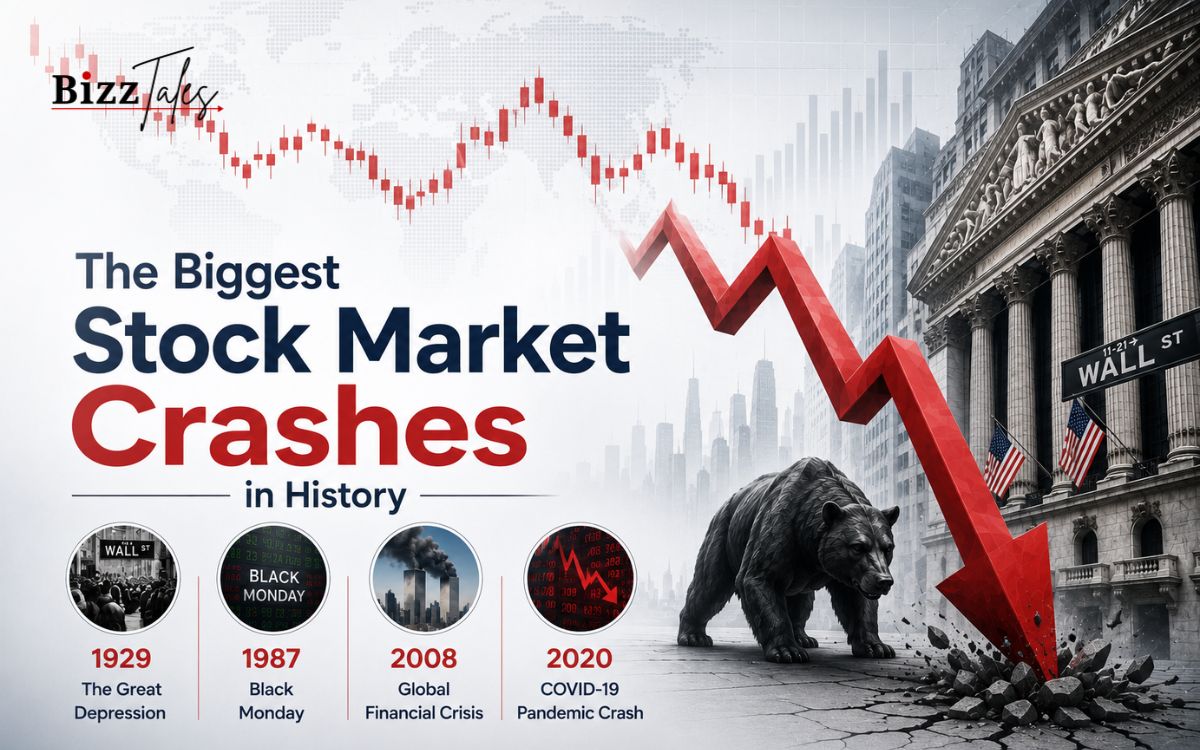
The stock market is generally regarded as one of the best instruments available for creating long-term prosperity. Over long periods, worldwide stock markets has been a powerful vehicle for investors to generate investment capital, fund for retirement and share in the wealth of corporations. The history has, unfortunately, not always been smooth sailing. Generations of investors have enjoyed extraordinary gains at time while the markets have at other point suffered from catastrophic stock market crashes that have contributed 100 of billion or even trillions of dollars in value within a matter of days, week or months.
When markets are going up, investors often have an infinite time horizon and are convinced the good times will last forever. Euphoria sets in, risk appetite escalates, investors become relaxed about high Stock Market prices. But financial markets have proved time-and-again to be very volatile and prone to sharp corrections. Financial crises, asset bubbles, geopolitical shocks and international crises can all cause abrupt downturns in the market.
To the novice thefts of shares can seem frightening, with headlines screaming most of the world’s shares are crashing. Pictures of shares crashing, traders panicking, and headlines such as 3-0 puts the fear of God into even the hardened investor. But the history is very different. Short-Term pain, Long-Term gain. Each crash always has been followed by much innovation (and some then a sustained recovery).
Knowing the biggest stock market crashes in history is more than just about knowing what went down. It is about understanding the investor’s mind set, recognizing clues and finding out why patience trumps everything else in most cases. The lessons learnt is the basis for the investment lessons learned in the aforementioned tragedies and hopefully will continue to be relevant in the future.
Why Stock Market Crashes Happen
First we need to understand, even before we look at specific crashes, why do stock markets crash in the first place, and contrary to popular opinion, crashes are not caused merely by one event, they develop over time as an accumulation of economic, financial, and psychological reasons.
Another reason is markets speculation. When investors are too optimistic about the market, a phenomenon called a bubble occurs. Stock prices can increase to irrational levels far beyond any true fundamental value of the company. Investors buy simply because prices go up. With a downward correction, the bubble burst.
Recessions are also crashes in waiting. As profits fall, unemployment climbs, and consumers spend less, investors become alarmed about future earnings potential. This causes panic selling. Market crashes are often sped by financial crises, bank failures, inflation, increasing interest rates, war, and world crises.
Almost every crash may have different reasons, but in most of them there is one common factor: fear. When greed can push markets up high in good boom times, fear can take them down in crashes downward very quickly.
The Wall Street Crash of 1929: The Beginning of the Great Depression
The infamous stock market crash of 1929 is perhaps the greatest benchmark in history in terms of measuring every other crash to date. During the 1920’s, America was experiencing a period of rapid economic growth. Markets were thriving, industries were excelling, and stock prices were rising; leading many to believe it would never end.
Customers and investors heavily borrowed money to speculte on stocks. This led to a frotitan bubble. The higher the prices went the more investors wanted to speculte. The result was a disconnect berween stock value and the economy.
Then the bubble finally burst in October 1929. Investors started to sell off their stocks panic stricken, the prices of shares went crashing. The greatest drop was faced on 29 th October also called as the Black Tuesday. Millions of shares were sold off as the investors desperately tried to cut their losses.
The effects reached beyond the stock market. Businesses went bankrupt, banks crashed, unemployment soared, and the world sunk into the Great Depression. The economic hardships persisted for years and millions of people suffered.
The 1929 crash will always stand as one of the most crucial warning about the perils of speculation and over optimism.
Black Monday 1987: The Largest Single-Day Crash
Almost half a century after the Great Depression, financial markets faced yet another unprecedented shock. On 19 October 1987, Black Monday as it was also called, stock markets globally recorded one of the largest falling single day’s gains ever.
The Dow Jones Industrial Average (DJIA) dropped more than 22 percent in one trading day. How rapidly the market plunged took investors, economists and regulators by surprise. As opposed to what happened during the stock market crash of 1929, this time there was no recession right before the crash. Rather, the crisis was triggered by a mix of market mispricing, investor fear and automated trading.
Something which was highlighted as one of the biggest issues of the crash was program trading, where computers places massive sell orders once certain levels was hit. The market then starts falling and the programmed sell sells it further down causing a ‘domino’ panic effect.
Even so, the crash was a serious blow, but the overall economy was still healthy. Eventually, the markets picked up and proved that it wasn’t always the end of the world.
The Dot-Com Crash of 2000
The tail end of the 1990s was the most exciting time of technological innovation in history. The internet was revolutionizing business, creating new opportunities and inspiring the worlds investors. Firms with no revenues and no profits were being given astronomical valuations based solely on having an internet business model.
Many investors thought the internet would revolutionize things, and they were right. However, they failed to realize the significance of profit and what makes a sustainable business model so, they let the stocks of IT companies reach irrational heights.
It all collapsed in 2000. Investors started to doubt whether many of the internet companies would ever make a profit. People lost faith, technology stocks plummeted.
In a few years, trillions of dollars of market value disappeared. Hundreds of web companies went bankrupt, and thousands of investors were burned. But the crash was a valuable lesson. The internet was not the trouble. It was the over-speculation.
Ironically, some of the biggest firms of today came through the crash more powerful than ever. The message was: revolutionary technology can transform industries but you do still need to examine the fundamentals of a business.
The Global Financial Crisis of 2008
Hardly any other event has had as profound an influence on modern financial markets than the Global Financial Crisis of 2008. The crisis originated in the U. S. Housing market, where one bubble of cheap borrowing and appreciating homes-built by a long period of expansion-quickly collapsed:
Financial institutions were marketing mortgages to many who could not bear them. These were delivered as a wide range of complex financial products to all corners of global capital markets. With house prices soaring, many institutions thought the risks were low.
But as housing prices started declining, everything quickly fell apart. People were defaulting on their mortgages en masse, financial institutions took massive write-downs, and not a bank in the world was trusted for years.
The failure of the major financial institutions sent shockwaves through global markets. Stock markets tumbled, and trillions of dollars of wealth evaporated. The governments and central banks had to introduce record-breaking rescue packages to prevent a collapse in the financial system.
The crisis reaffirmed the risks associated with over-indebtedness, poor risk management and interconnected financial systems.
The COVID-19 Market Crash of 2020
2010: The most significant global event of our timeOccurred in early 2020 when a novel virus called COVID-19 spread at an unprecedented level across multiple countries at an alarming speed. It was faster than anything before seen and resulted in a significant global health crisis impacting economies, businesses and personal lives.
With countries announcing lockdowns and shut-downs and restrictions on movement and travel, it became difficult for investors to gauge the impact on the economy. Companies were shutting down, and supply chains were breaking down, and millions of employees were worrying about their future.
The stock markets responded remarkably quickly. Within a matter of a few weeks, the big indexes have seen some of the most severe drops in history. Investors across the world traded in fear and confusion at trying to comprehend the extent of this crisis.
What Set the COVID-19 crash apart was the rapidity of the recovery. Enormous safety nets by governments, initiatives and intervention by central banks, and adaption to new innovations by the technology sector revived sentiment. Markets recovered astronomically quicker than anyone could have predicted.
The pandemic revealed the speed with which the markets are able to react to unknown events but at the same time highlighted the innate resilience of the financial systems when backed by innovation and policy measures.
Common Patterns Seen in Every Market Crash
While these crashes happened in different contexts, there are uncanny parallels between them. Virtually all of them had excessive optimism as a factor well before the market started tumbling. Investors convinced themselves that prices would rise forever many to dismiss any concerns.
Another frequent phenomenon is panic. As soon as the markets slide, the fear seems to gallop quicker than rational thinking. Premature bullish investors become hysteric sellers. That certainly increases the slide of their losses and the market jitters.
Crashes end the discussion on the importance of liquidity. Liquidity can be the major concern when investors face uncertain times. When investors become aware of risks, they fly to cash and safe investments. The more they sell off, the faster the game falls.
All of the severe declines have eventually been reversed. The period of time for each of the reversal has been different, but the empirical record repeatedly demonstrates our resilience.
What Investors Can Learn from Historic Crashes
If a person had to learn one thing from the history of the stock market, it is that markets crash temporarily but wealth is permanent. Investors who panic and sell their holdings lose after the market has hit a sharp bottom. On the other hand, those who stuck to their strategy and did not give in to the short term depression would of course make the maximum gains.
Another key lesson is diversification. Holding too many assets, whether a single stock, a particular sector of stocks, or an asset class, increases risk. Reducing unsystematic risk by having a diversified portfolio is essential.
Looking at the crashes of the past also shows that it is essential not to speculate. Investment driven merely by excitement can result in bad investing. Good businesses, healthy balance sheets, and long-term thinking are timeless.
Lastly, investors need to be aware that volatility is an integral part of investing. Markets, in fact, are expected to suffer future market crashes in exactly the same way that they have done for the past three centuries. The distinction is not between volatility and no volatility but between good and bad handling of it.
Are We Likely to See Another Stock Market Crash?
History indicates that there will be more crashes to come. The financial markets are cyclical and there is usually a correction / crash following any period of growth. Neither individuals, governments nor investors can reliably predict the timing of the next crash.
What is important to know is if you understand all investments that have crashed in the past, then you will be in a strong position to prepare yourself mentally for those, as well as financially for those in the future. Wise investors don’t fear crashed markets but seek to have overspilled out portfolios, a reserve fund and realize the importance of long term strategies.
We will face future new challenges-whatever they are economic, technological, geo-political, environmental. History too teaches us that innovation, entrepreneurship and growth may happen again in spite of a number of external setbacks.
Conclusion
History of Stock Market Crashes will always be a roller coaster saga of panic and resilience. Through the hefty plummet on 1929 to the crack of the COVID-19 meltdown in 2020, the stock markets experienced mind-blowing temper tantrums in between, which push investor mood swings to new heights while whipping up the economies, and the entire global economy into chaos. There are always various reasons behind each crash but all share the commonality of revealing human irrationality, speculation and ambiguity.
All the anguish given in these crises has also taught its own valuable lessons. Markets will rebound, companies will learn from their mistakes and even the most difficult times bring forth opportunities. Investors who are familiar with history tend to make rational decisions when the next panic comes around.
In fact, market crashes should not deter us from investing but should remind us to have patience, diversify, and think long term. Remember that the biggest winners in market history have seldom been those who handled the crises optimally. They are those who played on and have maintained perspective.
FAQs
When was the worst stock market crash?
The most significant stock market crash in my opinion was the Wall Street Crash of 1929 because..they helped bring about the Great Depression and this created massive economic damages throughout the world.
How did the 2008 financial crisis come about?
The great recession was triggered by a bubble in the housing market, a crisis in mortgage lending, too much debt and banking problems.
What is the typical duration of stock market collapses?
Time frame? The time frame ranges from a few months for some crashes to a few years for others, depending on the economic climate and the level of investor confidence.
Is it possible for investors to profit while markets are collapsing?
Yes. Many time investors take advantage of downturns to buy good securities at lower prices, can advance in the long-term.
Has the stock market always popped back up after a fall?
In the past all of the major stock indexes has pulled itself out of any large crash, though the time it took to do so varied depending on the crash.
What is an important lesson we could learn from stock-market crashes?
What I have learned most from all of this is to stay disciplined, not to panic and sell, and to think about the long-term rather than market fluctuations.