
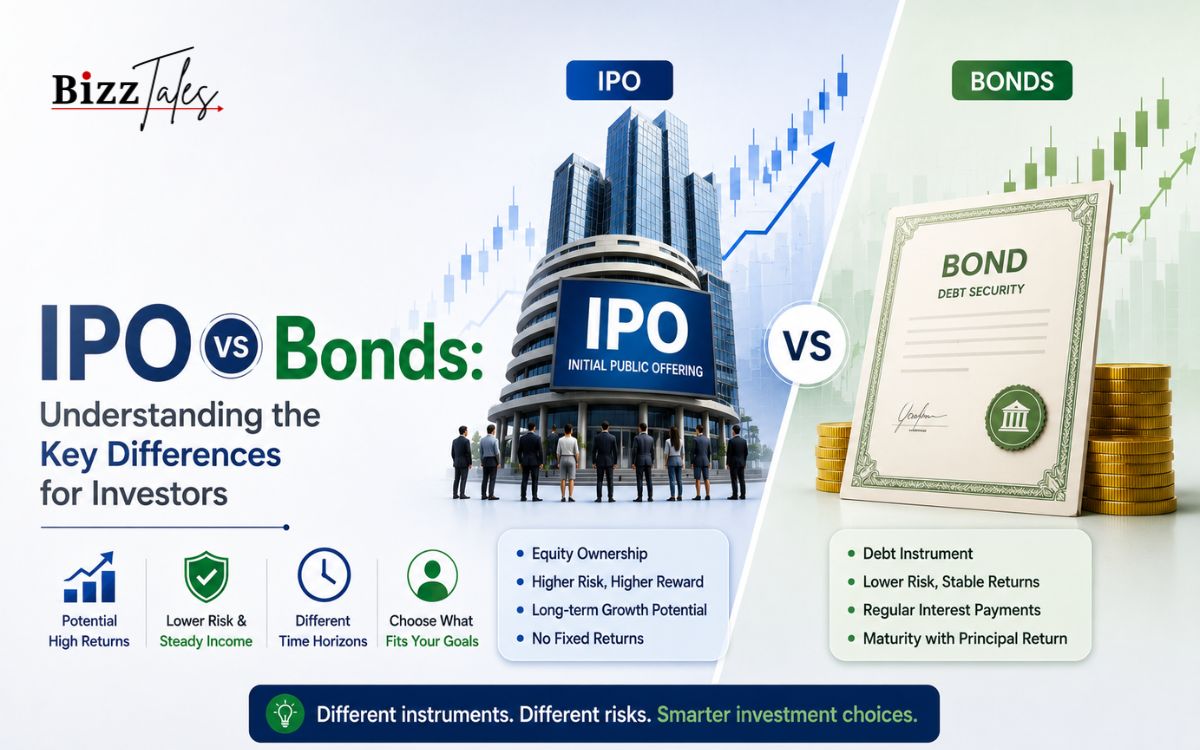
The first thing that someone trying to look for good investments will see is the two commonly misused phrases IPO and Bond. Both are used for companies and governments to raise monies but are very different. Sadly new investors tend to think of both of them as an investment product because both deal with the depositing of cash into a business. They are not.
In recent years, IPOs have been in the spotlight very much in India and worldwide. Whenever an established company announces its public offering, investors eagerly rush to subscribe to it, wagering on its future growth. And at the same time, bonds continue to appeal to investors looking for less risk, steadiness and assured returns. Advisors often suggest a blend of these two, depending on a client’s objectives, age and risk appetite.
It is important to know what the difference is between an IPO and a bond as misjudging this could end up in the investor being disappointed. For an investor that is worried about the stability of returns, then an IPO may not be suitable, whereas for an investor happy taking high risks that go along with High-growth bonds, then bonds may be seen as dull. By understanding the facts behind both, investors can plan and implement an appropriate strategy for their funds.
This is a simple guide to IPOs and bonds in plain English, to give you a very basic understanding of the key differences between them, the benefits and risks involved, and when each investment might be appropriate.
What Is an IPO?
IPO (Initial Public Offering): An IPO is the process by which a private company becomes a public company by offering its shares to the general public. Prior to an IPO, the company is owned by founders and individual investors, the employees and venture capitalists. After, the public can buy shares, becoming owners of the business.
Why do companies bring out IPOs? ‘Companies do it for a whole range of reasons. They might be looking to raise capital for the company to expand its operations or fund new investments in technology, to pay off existing debt, acquire competitors or invest in new markets, or put themselves in a stronger financial position.’
For investors IPO enables them to have a stake in the company’s growth from an early stage. Investors can reap the benefits in the form of stock price increases and dividends if the company’s performance after listing is good. IPOs carry no promise of profits though. Some companies flourish after listing while some fail to meet investors’ expectations.
IPOs can be very popular in the media. Investors hear of stories that certain stocks doubled or tripled since issues and think that buying IPOs is an easy way to make money. IPO investing however, needs research, patience and knowledge regarding company’s business model and financial viability.
What Is a Bond?
As mentioned, bonds are a financial tool to get investors to provide money on a fixed term (e.g., 10 years) to a government, company or institution. When an investor buys shares in a company through an initial public offering (IPO), they are purchasing ownership in the company. However, with bonds they are simply providing a loan.
When an organization sells bonds, it is essentially saying, “we will return (the principal) to you (the investor) in (X date),” with investors then instead receiving periodic interests payments.
As an example, if an investor invests 10,000 in a bond which pays interest of 8 percent per year, he/she will receive 800 annually for the duration of the bond until its maturity. At maturity, the issuer repays the initial principal amount of 10,000.
GOVERNMENT utilize bonds to generate money for infrastructure, social welfare and other development projects. Companies use bonds as a means of source for funding for their acquisition plans or operations or expansion plans. Since bonds are stable and secure sources of income, they are appealing to conservative investors because of the stability of the security compared to stocks.
Ownership vs Lending: The Fundamental Difference
The key distinction between IPOs and bonds is the relationship:
Owning shares in an IPO means you own a part of a company. How much profit you make is determined by how well the business does in the years ahead. Should the business prosper the value of your shares increases. Conversely if the business does poorly your profit decreases.
Buying a bond does not mean acquiring ownership. You just lend money to the issuer. The main profit is not due to business prosper, but to interest. Whatever the company growth is aggressive or slow, the investors will get normally proceeds directly related to the bond definition.
This is one of the most fundamental ideas-that of ownership-as well as the most critical division to grasp for all investors.
Risk Levels: Which Is Safer?
The importance of Risk, is one of the key driving factors determining investment decision-making. Risks between IPOs and Bonds, can vary greatly.
IPO investments tend to be more risker as stock prices can vary greatly. This is because of the uncertainty attached to a company’s future performance and the fact that the general public’s view on the market influences the share price greatly. Investors can benefit from large earnings but they can also make losses.
Bonds are considered more secure investments since they provide steady income streams and offer predictable repayment schedules. Typically, bonds issued by the government are thought of as among the safest investments because they are obligation of the nation’s government, which has the ability to tax its citizens and therefore generate sufficient revenue.
But bonds are not entirely risk-free. There is default risk inherent with corporate bonds if the issuer is subject to financial distress. Inflation can also erode the purchasing power of bond income stream.
As a general guideline, most investors are willing to accept the risk of an IPO in return for the reward.
Return Potential: Growth vs Stability
A key attraction for investors in the IPO is the chance of huge capital gains. If a company can scale the heights after listing then investors who entered the bandwagon early will reap the rewards. Many of the biggest companies in the world have created huge fortunes for their early investors who held onto their shares.
Of course, that such high return outcomes are possible, they also would have to be accompanied by greater uncertainty. Even not every IPO turns out to be a winner. It may well be that some companies do not produce the expected growth, thus not generating the anticipated returns.
Bonds are looking for stability not the explosion. It is possible to determine in advance how much interest will be received and when it will be received. Returns will be lower than those in the stock market but also often more predictable.
This differential provides the appeal of IPOs to growth investors and bonds to investors seeking income and preservation of capital.
How Market Conditions Affect IPOs and Bonds
Market conditions impact both an IPO and a bond but in a differentfashions.
In bull markets, investors feel more optimistic and confident about investing in IPOs. Companies prefer to issue new shares when markets are buoyantas they are able to command higher prices, and investors are more prepared to take the risk in a rising market.
IPO’s in a bear market may face difficulties. Investors are less willing to buy risky assets, prices drop and as a consequence the demand for new issues may decrease. Therefore some companies delayed their plans about new IPOs and waited for a more stable market situation.
Bonds frequently act differently. When there is economic instability investors often sell their stocks and buy bonds as they are considered much safer. This demand can make bonds exceptionally desirable in an economic downturn.
Knowing that which tool to use at the right time can decide the prosperity of investor. Credit facility being one among them can help invest in various asset classes in the right time.
Who Should Consider Investing in IPOs?
However IPOs might be apt for investors who are gambling takers and long term investors. Frequent investors who want to create wealth by expanding the business will be inclined towards IPOs, as they give you the chance to participate in companies caught in a key phase of growth.
For investors who like to dig into companies, study financial statements and understand industry cycles, IPO investing might be just as exciting but caution should be exercised in investing just because it gets a lot of talk in the media.
A key to successful IPO investing is patience: be willing to accept some short-term fluctuations and hold for the long-term perspective.
Who Should Consider Investing in Bonds?
Fixed income investments are often appropriate for investors that value stability, regular income and low volatility. Those at a crucial financial stage such as retirees, conservative investors and pre-realization investors tend to lean toward bonds.
Bonds. If preservation of investment capital is more crucial than maximizing growth, then investors may choose to invest a portion of their portfolio in bonds. They also offer diversification benefits, which may help investors balance out portfolio risk.
Among financial advisorsit is often advised to have bonds included in a balanced investmentportolio, particularly as you near retirement.
Can Investors Own Both IPOs and Bonds?
A common misconception concerning investing is feeling like one must pick between stocks and bonds. In fact, the biggest investors own both.
A diverse portfolio with more stable investments like bonds and more aggressive ventures like stocks and IPO investment.
As an illustration, the proportion of portfolios invested in equities and IPOs may be higher among young investors due to their relatively longer investment time horizon. Older investors may gradually increase the proportion of fixed income investments to preserve capital and generate income.
The perfect blend varies based on one’s financial objectives, comfort with risks, and investment timeframe.
The Future of IPOs and Bonds in Modern Investing
Despite the evolving financial markets, both IPOs and bonds still attractive investments. With technology, investing has been made simple, buy retail investors can now get involved in buying IPOs and bonds via their online system.
Similarly, new scenarios created by the general atmosphere of global economic uncertainty, an inflation concerns, a changing interest rate environments still impact the investments decision. While innovative companies will still go for IPOS to fund their profitable projects, bonds will persist to be indispensable tools to those investors who seek out non speculative sources of revenues with a less painful and risky investment.
Investors should not look at IPOs and bonds as rivals but as part of a larger strategy.
Conclusion
While both IPOs and bonds can provide corporations with funds, they are very different investments. With an IPO, investors have an ownership stake and can benefit from the company’s future growth. Bonds give the owner no stake in the company’s growth but simply serve as a source of debt for the company.
Ultimately, the decision to go with IPOs or bonds depends on the investor’s objectives, risk appetite, and overall financial situation. Some investors who are comfortable with higher volatility may incline toward IPOs, whereas more conservative investors might prefer bonds for their steadiness and assured returns.
By knowing the pros and cons of each, investors are able to make more educated investment decisions, which ultimately can lead to a more diversified, efficient portfolio. The best investment plan does not entail picking a single asset, but rather balancing one’s holdings to maximize potential long-term results.
FAQs
Give me the principal difference between an IPO and a bond?
To be an owner of a company, investors need a share. To be a lender to a company, investors need bonds.
Are IPOs or bonds riskier?
Initial public offerings (IPOs) tend to be less secure because of the volatility of stock prices. Bonds tend to be more secure, namely government bonds.
Can bonds give the investor a bigger return than IPO?
Usually IPOs grow more and bonds give more reliable returns.
Is investing in IPOs profitable?
No. IPO investments can result in losses or profits based on the circumstances of the given firm and the market.
Why would a government want to sell bonds?
Bonds are issued by governments to generate funds for other development focuses like infrastructure projects and public services.
Is it advisable for beginners to buy IPO or bonds?
What should I keep in my portfolio? The answer is entirely relative to your investment objectives and your risk appetite. As a rule of thumb, most novice investors should have a balanced portfolio of (growth) stocks and stable (low risk) instruments.