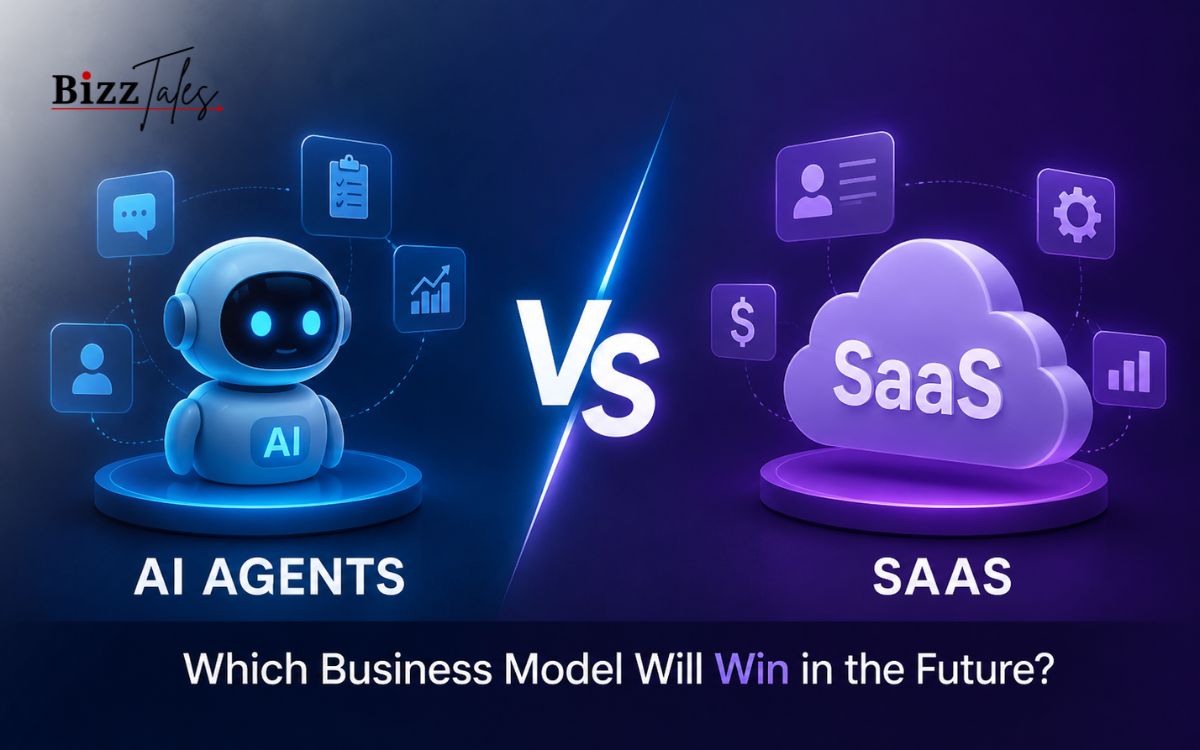
In the last few decades, the software industry has gone through a number of successful business model shifts, it was the transition from licensed software to the rise of software vendors selling on a subscription basis. In the last 10 years, it was the rise of cloud SaaS based model, shifting the revenue paradigm to a monthly subscription model. Today, there is a very exciting and promising new model by AI Agents that many believe could completely change the way the software industry operates.
AI is growing at a breakneck pace and has evolved from being merely a supporting technology to an innovation driver. Companies are increasingly turning to AI-enabled solutions for automation, delivering better CX and informed better decisions.However, increasing prevalence of AI Agents has flagged a critical industry-wide debate – Will AI Agents outsmart SaaS or will SaaS be here to stay?
This question has come into focus as billion dollar budgets are being committed to AI and startups are bringing to market agent-based applications to do jobs that used to encompass a number of different applications of software. Entrepreneurship, investing, technology leadership and business owners all want to prepare.
Understanding the SaaS Business Model
Software as Service or SaaS replaced traditional software programs by allowing application to run on the “cloud” rather than on locally installed computers.
Prior to the rise of SaaS, the traditional way of acquiring a program was to buy licenses, install the application on each computer that needed it, and then pay for any subsequent upgrades and support. This often required large initial investments and sophisticated wide-scale deployments.
SaaS, one of the most disruptive innovations, brought the subscription model to application delivery. Businesses could now utilize internet-based applications, subscribe to them on a monthly or an annual basis, and enjoy regular updates without having to take care of hardware.
An increasing number of popular SaaS solutions are fulfilling most business functions. Game planning, accounting, communication, human resource management, marketing automation, and e-commerce are just a few.
The SaaS model was so successful because it created predictable recurring revenue for software companies while it was inexpensive, scalable, and easy for customers.
What Are AI Agents?
Intelligent Agents (also called AI Agents) are a new way of delivering the power of software intelligence.
Instead of traditional software where a user has to perform a series of tasks through interfaces and workflows, AI Agents are built to grasp tasks, make decisions and act with near no human input.
An AI Agent can be set a goal around a task such as scheduling meetings, answering customer questions, analyzing data, building reports, managing workflows or conducting research. Rather than giving them a bunch of tools they just do the work:
AI Agents:Current AI Agents integrate LLMs, machine learning algorithms, automation frameworks, APIs, memory systems and reasoning engines. This integrate with software applications to gather information, converse and perform tasks.
The main difference is traditional software assists users to perform work, AI Agents is more and more performing the work.
Why AI Agents Are Generating So Much Attention
The palpable enthusiasm for AI Agents owes to a) the seemingly boundless productivity increase they (could) bring and b) the enthusiasm within the AI community brewing already.
There are always concerns from the organization about how to cut costs, how to become more efficient, how to do the same job with fewer people, and how to remove repetitive tasks. Power comes when it is possible to automate the whole process by AI Agents, instead of task by task.
One example is a marketer who used traditional SaaS products, often requiring and managing several platforms for things like:
1) content creation
2) email marketing
3) analytics
4) social media publishing
5) CRM
The user has to keep track of campaign lifecycle activity across many different systems.
It is scalable, then, and can be ‘automated’ (ie, produces content, schedules, launches the campaign, checks results, makes suggestions on improvements, etc., all without user time invested).
What more and more technology companies are investing heavily and V.Cs around the world.
The Strengths of the SaaS Business Model
While the excitement around AI Agents continues to build, SaaS has continually proven to be one of the best business models ever.
Reliability. SaaS applications generally do particular things very well-they are highly reliable and consistent. As a result, most companies rely on these applications to carry out essential-and often mission-critical-functions.
SaaS provides best-in-class security, compliance, and governance capabilities. Many industries including financial services, healthcare, and government require tight regulation and control that can take years to build, but SaaS providers have…
Another area of strength is customization. Most SaaS solutions enable companies to set up workflows, permissions, integration points and reporting capabilities to match their individual business needs.
Additionally, SaaS businesses have well-established pricing models, customer support and implementation processes, allowing for an easy uptake regardless of the business size.
This adds up to why the SaaS global industry continues to generate a couple of hundred billion dollars each year.
The Strengths of AI Agents
AI Agents bring in features that even the most advanced SaaS platforms cannot.
Automation is one of the biggest benefits of AI Agents-rather than forcing its users to learn and interact with difficult interfaces and workflows, AI Agents can be given input and goals and put to work.
They also increased flexibility. Old software programs usually fixed work-flow for your tasks and laid down setting structures. AI Agents are more flexible.
Another positive aspect is the personalization factor. AI Agents have the ability to identify user preferences, recall history and provide personalized recommendations.
Cost effectiveness could also turn out to be a key strength. At this stage companies pay for numerous SaaS applications from every department. Having a sophisticated AI Agent offering several software functionalities will bring down costs and increase business fluency.
With the advancement of AI technology, the agents are more and more able to perform a complex business function that lead to the use of powerful agents to supplant dedicated applications.
AI Agents vs SaaS: Key Differences
While each technology’s goal is to increase business efficiency, they work in quite a different manner.
SaaS platforms equip the user with tools that they then work at. The emphasis is on the tools supporting the work in question, within a framework of sorts.
AI Agents care about the results. Rather than needing the user to perform each step, they seek to accomplish a goal on their own.
SaaS stresses on control and predictability. All processes are well defined and businesses know how things will work in between and are under control all along.
AI Agents–are fluid and dynamic. They adapt in response to changing circumstances and show themselves autonomous by making decisions and navigating gameplay situations.
Another distinction has to do with customer experience. SaaS solutions usually demand the user to go through a training and onboarding phase, while AI Agents interact with the user through a simple, human-like chatting experience.
These differences imply that the roles played by AI Agents and SaaS may be quite different, rather than direct competitors in every case.
Will AI Agents Replace SaaS?
Perhaps the most common question asked in the technology space is whether or not agents will eventually kill all the traditional SaaS companies.
Some analyst expect immense disruption, a total substitution though is itself not imminent.
Business depends on software systems that interfaces with data, process transactions, regulatory compliance, run operations. These systems demand visibility, stability and accountability.
At the moment, AI Agents are good at automation and decision support, but still have issues with reliability, accuracy, governance and security.
More realistic is that instead of replacing SaaS altogether, Intelligent Layers in the form of AI Agents will be integrated on top of the current software platforms.
For instance, an AI Agent could automatically manage workflow while communicating with the CRM tools, accounting systems, marketing systems, and ERP systems.
This is similar to our approach where SaaS is the infrastructure, and AI Agents is the interface.
The Emergence of Agentic SaaS
A third emerging approach, called Agentic SaaS, is starting to bring the two methods together.
While traditional SaaS platforms are based on web enabled software that have been packaged for delivery over the internet, agentic SaaS platforms embed AI Agents into the application itself.
Replacing bifurcating between AI Agents and SaaS, offering your enterprise the advantages of each technology.
Existing software environment..and can use existing software environment of the users along with intelligent automation of repetitive and tedious tasks.
Numerous prominent software vendors are already heading this way, integrating AI copilots and assistants, and increased autonomy directly into their offerings.
This hybrid model could potentially be the most probable future direction for enterprise applications.
Business Opportunities Created by AI Agents
AI Agents presents brand new business opportunities.
An enormous amount of investment is being poured into: agent framework, orchestration platform, AI infra, vector DB, security and monitoring engine companies.
Consulting firms are on board to help organizations adopt AI Agents into their processes. Training providers are supporting user adoption, teaching agents management, and setting up AI governance.
There is a rush of new startups launching around a category of specialized AI Agents in healthcare, legal, financial, education, logistics and customer support.
As adoption escalates, the AI Agent ecosystem has the potential to become one of the largest tech markets of the decade.
Challenges Facing AI Agents
AI Agents hold great promise but do have some significant stumbling blocks.
Accuracy, there is also the issue of… These systems will sometimes produce false or misleading data or make poor decisions.
Security and privacy also need to be addressed. Agents may get access to business-critical information and other sensitive data.
Another challenge is fulfilling the norms. Business needs to make AI-based measures comply with rules and regulations.
Trust is probably the most important factor. Companies might not be willing to entrust vital decisions to autonomous systems until they have confidence in reliability.
However overcoming these issues will need to be achieved in order for a greater uptake.
The Future Outlook
In the future software landscape, there is no reason why we must have a winner-takes-all scenario, rather will be the combined evolution of AI Agents and SaaS.
Conventional SaaS platforms will still be delivering safe, high availability, and scalable foundation for business activity. On the other hand, AI Agent will be more involved in automating business processes, improving GUI (Graphical User Interface) usability, and boosting productivity.
Those companies that utilize both approaches effectively will have great opportunities to sustain competitive advantage.
As AI progresses, software might shift from interacting with applications to interaction with a result enabled by an intelligent digital assistant.
This has the potential to change business and our interaction with technology over the next ten years.
Conclusion
The earlier dispute about AI Agents versus SaaS is just indicative of the larger tectonic shifts under way in the IT industry. SaaS paved the way for democratization and scale of software. AI Agents tries to take software on to the precision pathway of automation, intelligence and results.
AI Agents will probably augment SaaS rather than displace it entirely. Firms will still use software platforms for handling data, ensuring security & compliance and underlying infrastructure, whilst leveraging AI Agents to increase productivity and streamline workflows.
However, the companies that will succeed in the years to come will probably incorporate both these two technologies, developing systems that can span between reliable SaaS and capable AI Agents.
The future is not AI Agents vs. SaaS but AI-powered SaaS-where we use smarter, more autonomous software that still breathes SQL, stays secure, scales properly, and is driven by the business needs.
FAQs
What distinguishes Agents and SaaS from one another?
SaaS is a collection of software tools used by the user “hands-on,” while AI Agents operate the workflows by themselves to reach the objective.
Will AI Agents replace SaaS?
AI Agents are less likely to replace SaaS platforms and more likely to add some value to those platforms.
Advantages of AI Agents?
AI Agents enhance automation, productivity, personalization, and workflow while minimizing human intervention.
“Why do we still care SaaS?”
SaaS offer safe and dependable, scalable infrastructure which still being important for business operations and data management.
What is Agentic SaaS?
Agentic SaaS merges classic software features with automated intelligence. The application is enhanced with autonomous qualities.
What is the more future business model?
Both are promising, but the greatest potential may be to use AI Agents together with SaaS as creating intelligent ‘software ecosystems’.