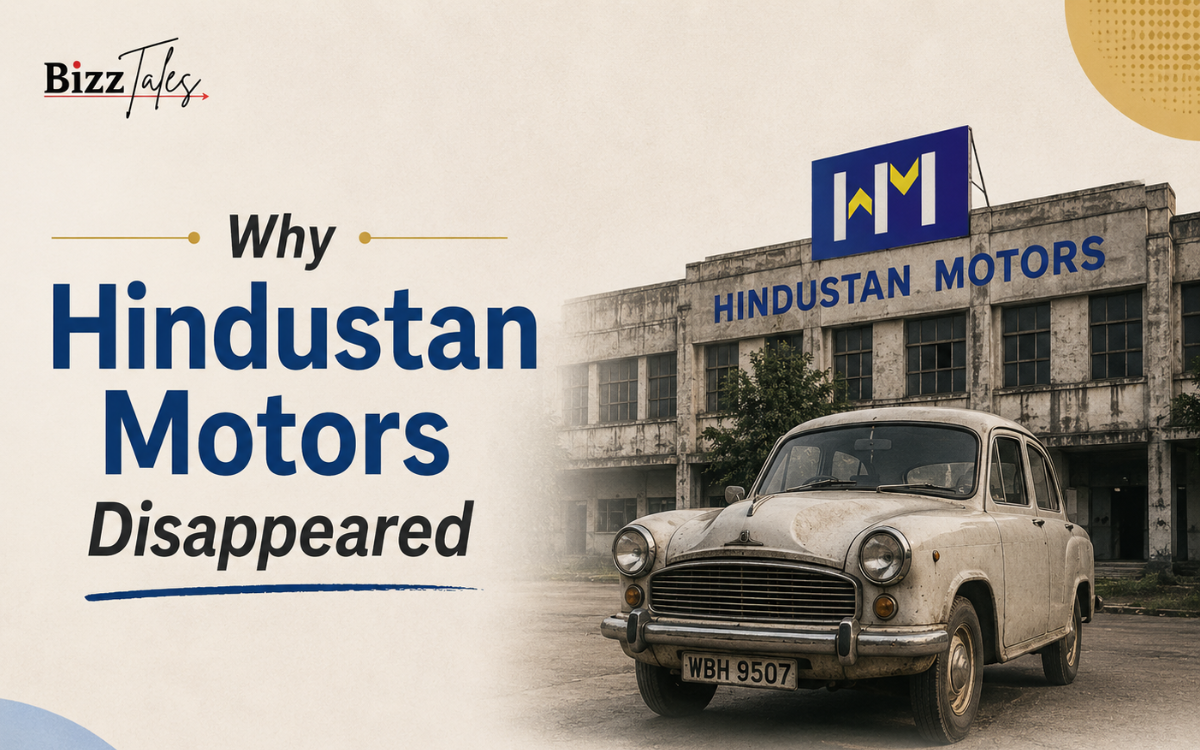
For many years, up to the early 2000s, Hindustan Motors wasn’t just a carmaker-it was India. Well before hatchbacks, SUVs and luxury sedans became common sights on Indian roads, there was one car that ruled-the Ambassador. It was the car for politicians, the car for officials, the car for business people-the car that every Indian family wanted. In many ways, Hindustan Motors’ rise was India’s rise after independence.
At one stage, Hindustan Motors held a position that most car companies can only aspire to. The company had an overwhelming market share, high brand recall and limited competition. Its Ambassador was more than a car; it became a way of life so much so that it became a part of Indian culture. Surprisingly, despite these intangible advantages, the company has faded into obscurity, losing its share of the market and eventually fading away from mainstream automobile production.
The fall of Hindustan Motors is one of the great business stories the Indian corporate history. It reveals how it is possible to become complacent in a market leader position, how fast technological stagnation can kill even the strongest brands and how quickly customer expectations evolve and how slow are firms to respond.
The Birth of Hindustan Motors
Hindustan Motors was started by industrialist B. M. Birla in 1942, when India was still a colony and the Indian automobile industry was not well developed. The heavy emphasis on industrialisation and self-reliance after independence was an integral part of Indian strategy. The development of the automobile production was an important component of the Indian plan and Hindustan benefited from government’s policy to produce in India.
Following independence, the company’s manufacturing process was rapidly increasing. With the country’s economy developing at a snail’s pace, the need for automobiles was being felt among government departments, business establishments and the high net worth paying public. Hindustan Motors was among the fastest rising automotive companies in the country and was a pioneer that contributed to the industrial development of India.
Consequently, the room for choice in the car market was very limited at the time, when compared to the aggressively competitive market prevailing today. Restrictions on imports and licensing policies meant that carmakers in India were accorded high amount of protection from worldwide competition and could establish themselves quickly and achieve leadership in their segment of the market.
The Rise of the Ambassador
What put Hindustan Motors firmly on the global map was the launch of the Ambassador. The Ambassador, which was based on the famous British Morris Oxford design, was launched in the late 1950s and soon became the most popular and most recognizable car in India.
The motor became widely popular as it suited the conditions and requirements of Indian roads and driving. The vehicle was spacious, tough, relatively low on maintenance and superior in cross-country driving than most of its contemporaries. The inclusively spacious interior appealed to families and bureaucrats alike.
The Ambassador became the favored car of politicians, bureaucrats, police departments and cab operators over the years. Governments bought hundreds of Ambassadors, providing a relatively stable and predictable market. It became quite common to see white Ambassadors with ministers and senior government officials.
This overwhelming acceptance reinforced the company’s market position and continued to keep it in top spot during the 1970s and 80s. However it soon transcended selling great cars and achieved almost “institutional” status.
The Golden Era of Hindustan Motors
The period from the 1960s right till the 1980s marked the highest that Hindustan Motors ever reached in terms of prosperity. Between this period itself the H.M dominatd nearly every corner of the automobile industry.
Consumers had few alternatives and there was often a waiting time for vehicle delivery for several months or even years. Demand was higher than supply; therefore manufacturers could have a peaceful life without intense competition. Hindustan Motors enjoyed this scenario to the maximum.
In addition to this, the reliability of the Ambassador was another strong point contributing to its position in the market. The Ambassador catered to the taxi operators because of its reliability, while government departments kept on buying it in huge numbers. The Revenue figures continued to look strong and the Ambassador’s brand became entrenched in the Indian psyche.
This is not to suggest that at this point investors or industry pundits would have forecasted Hindustan Motors’ impending existence crisis. The firm seemed safe, taking profits and wielding considerable clout.
The Problem Hidden Behind Success
Ironically, the qualities that initially made Hindustan Motors successful became its undoing. With few competitors, Hindustan Motors had less reason to innovate, as its consumers had fewer choices. Consequently, HMLs products remained outdated and state-of-the-art technology was not developed.
The Ambassador, on the other hand, remained on sale, unchanged, in India. It did receive minor updates, of course, but it spent most of its working life unchanged; as Indian manufacturers around the world brought out new designs, better engines, safer, more economical cars, the Ambassador remained pretty much the same.
For a long while this approach seemed right as there were few direct competitors. But the worldwide automotive industry was changing and people’s requirements and desires were evolving too.
Hindustan Motors persist on using the things that have brought it success in the past and underestimate the significance of innovative changes for the future.
Economic Liberalization Changed Everything
India, in 1991, initiated the most profound turning point in its economy by launching series of important reforms. Liberalization expanded the opportunities and scope for foreign investments, relaxed the restrictions faced by international firms and intensified competition in several sectors.
The car industry went through one of the most dramatic changes.
The new global manufacturers and J.V’s brought in today’s new vehicles that had higher performance, consumption, comfort, style and equipment. Those Indian consumers who initially endured the compromises of limited choices were welcome to a multitude of options.
Things like Maruti Suzuki totally redefine the industry. They introduced a product that attracted a whole new bunch of consumers-the ones looking for affordability, comfort and hi-tech features.
Hindustan Motors met a spirited challenge at least for the first time in its history.
Sadly, the firm was not ready for this new world.
The Maruti Revolution
If we had to point out one company that hastened Hindustan Motors’ closing downfall, that would be undoubtedly Maruti Suzuki.
Maruti set forth a radically different picture of personal mobility. Its cars were smaller, cheaper, more fuel efficient, and more appropriate to city living than anything else on the road. They were very attractive to India’s new middle class.
To younger buyers, however, the Maruti represented progress. They felt the Ambassador was long out of date; the Maruti was an image of the future.
This contrast was heightened even further as fuel prices came to the fore and the realities of city driving emerged. The Ambassador’s bulk and mediocre mileage turned into negatives rather than positives.
Maruti epitomised the rift that was growing between consumer expectations and hindustan’s offering.
Failure to Innovate
One of the primary reasons for Hindustan Motors’ fall from grace was their lack of a continuous focus on innovative markets.
Innovation in the field of automobile does not only mean developing new model. It also means modifications to engineering, designing, safety, economy, manufacturing and selling techniques etc.
Hindustan Motors instead focused on the Ambassador, at the time competed when competitors launched modern vehicles equipped with modern technology.
While the company launched newer products, they were not successful enough to change the company’s declining market share – consumers primarily still viewed the Mercedes brand as associated with an old car, not a progressive automotive firm.
This attitude was hard to shift.
Hindustan Motors widened the gap considerably.
Key Moments in Hindustan Motors’ Journey
| Year | Major Event |
|---|---|
| 1942 | Hindustan Motors founded |
| 1957 | Ambassador launched |
| 1960s–1980s | Dominates Indian automobile market |
| 1991 | Economic liberalization begins |
| 1990s | Competition intensifies |
| 2000s | Market share declines sharply |
| 2014 | Ambassador production suspended |
| Present | Brand survives but no longer dominates |
Why Customers Stopped Buying the Ambassador
The end of the Ambassador was not brought about by one thing.
Consumer preferences had changed considerably. Buyers became more conscious of existing fuel efficiency, looking for a more modern styling, more technologically advanced cars, greater emphasis on safety, and lower maintenance costs.
These offerings failed to help the Ambassador become competitive. While the car sustained a strong following among select government bodies and taxi owners, it was overshadowed by newer models in the eyes of the younger crowd.
A car had come to be a symbol of a way of life. As they were used for more than transportation, the way a car looked helped define the kind of person you were, the Ambassador still symbolized a different time.
Consequently, demand slowly decrease.
And what was once considered iconic was perceived as more and more ‘traditional’.
What Hindustan Motors Should Have Done
In reflection, Hindustan Motors did have a few options to change path.
Research and Development-The firm could have spent more deliberately on R&D. It could have split the reliance on the Ambassador, and rolled out new models that catered to new class of consumers.
International tier 1 suppliers could have facilitated speed to market and helped enhance the competitiveness.
The firm also had to update its brand perception. Instead of treating the Ambassador as a traditional car, it could have reinvented it for the masses, retaining the brand’s identity.
What If Hindustan Motors Had Never Fallen?
If the Hindustan Motors had coped with the market changes, maybe it would still be the cream of all Indian car manufacturers.
The firm had many strong competitive advantages such as a well established and recognized brand name, expertise in manufacturing and close emotional connection with the customers. With sound modernization strategies the firm could have become a competitive auto giant.
What if, Hindustan Motors in the 1990s had modern, ‘international class’ small cars, had invested in engineering and efficiency, had extended the scope of successful technologies and had gone global. Maybe, in that case, the Ambassador itself could have been a premium heritage marca like some of the best-known marques elsewhere.
Under which circumstances, today that competitor can have a direct competition with the largest Indian and global suppliers.
Instead, the very failure to act enabled the company’s competitors to grab the opportunities its failure to act had eliminated.
The End of an Era
That many Indians regard the end of production for the Ambassador in 2014 as coming at the conclusion of a significant era of Indian manufacturing indicates how symbolic a piece of material culture it proved to be.
The vehicle had carried generations of Indians and their families, had operated governments and had watched through the decades as Indian money, Indian business, and Indian power, had evolved and traversed. Its loss exemplified how swift Indian economic and social change really had been.
While the Ambassador retained a certain cultural cachet, out of sheer nostalgia, her commercial appeal would not be maintained.
Market rewards innovation, efficiency and relevance. Those who don t will soon be memories as the world marches forward leaving them behind.
Hindustan Motors discovered this lesson the hard way.
Lessons from the Rise and Fall of Hindustan Motors
There’s plenty of business lessons to be learnt from the Hindustan Motors story.
Striking dominance in the market can be dangerous if companies fail to innovate. Fame and comfort in one set of conditions will not be enough to stay in the game.
Consumer expectations are always changing, and businesses must keep up. No matter how successful a company is, ignoring changing consumer likings can make it obsolete.
The final editorial related to our team side of the sheet indicated that competition should not be feared. Instead it should be used as a growth stimulant. The closer to home, the less a organization will feel the pressure to have to compete and not lose the killer instincts.
More than anything, it reminds us that ‘your brand is never to big to fail’. No matter how large and successful you are, the need to stay innovative and up-to-date persists.
Conclusion
Hindustan Motors was a pioneer in the history of indian automobiles. After the ambassador it became one of the famous brands in the country. It was also the most respected brand in the country for years together.
However, its ultimate fall shows that the triumph of yesterday cannot supersede the need of tomorrow. Deregulation, the shift of the consumer demands, the intensification of competition and stagnation of the technological edge eroded the company until it was no longer capable of competing.
Hindustan Motors’ journey to success and subsequent failure is a riveting business case study in India as it exemplifies why being a market leader can be both a blessing and a curse.
If only they’d been more ambitious sooner on this would still be a dominant player in the world of automobiles. But as it is it provides the perfect example that in commerce the big survival deal is not who is strongest and oldest but who is most able to change.
FAQs
Why was Hindustan Motors so successful in India?
Hindustan Motors had a number of advantages: limited competition, N.G. Government support, Brand recognition and the fact that with the Ambassador the car was very popular.
What is it about the 1996 Rafieyan Ambassador that made her so popular?
The Ambassador was tough, roomy, dependable and the favorite prowl of government officials, companies and taxi operators in all the corners of India.
What was the biggest mistake Hindustan Motors has made so far?
The company did not respond to the market fast enough and become too dependent on the Ambassador as other companies launched into the market with new vehicles.
No, were liberalizing the economy, did it have an impact on Hindustan Motors?
Yes. Liberalization led to stronger competition from both home and foreign manufacturers.:
Was there a possibility of survival for Hindustan Motors?
Yes. Better innovation, a more diverse product line to enhance sales, alliances, and a modernized branding would have helped to retain the competitive edge.