
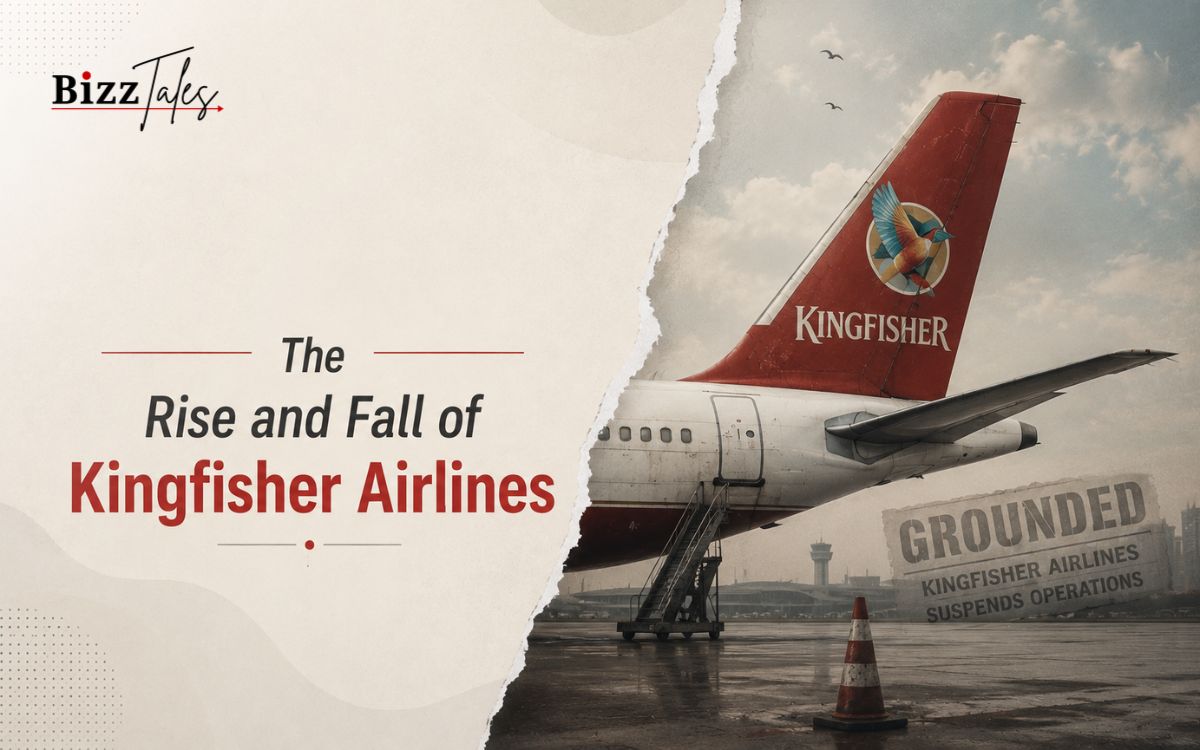
Kingfisher Airlines is one of the most remarkable business stories in thehistory of Indian business. When the carrier was launched, it was the most aspirational business brand in the country. It became the premium captain of a new rise, capturing the image of fantasy, advertising and high-end consumption and its promoter Vijay Mallya was fashionable called the “King of Good Times”.
Kingfisher Airlines ventured into the airline industry with a high aspirations. Unlike many of its competitors, who vie with each other on the basis of fare, it offered a promise of a life-changing experience. To begin with, kingfisher offered high-end services, in-flight entertainment, trendy advertising, eye-catching cabin crew, customer-centric policies etc., which were not available anywhere else in India.
For a brief time Kingfisher was viewed as one of the best airlines in India., industry commentators acknowledged the quality of the airline’s service standards, passengers appreciated the luxurious personal experience provided, and investors talked about the airline as a “future of Indian airlines”.
But behind its gloss, the airline was falling into financial crisis. The moves made in aggressive expansion, costs increasing, debt mounting and increased focus on trying to grow everything in sight eventually led to its downfall.
To conclude, the collapse of Kingfisher Airlines is arguably the biggest example of corporate failure faced in modern India. It is indeed an example of how brand image and popularity has traditionally been taken for granted to ensure sustainable business success.
The Birth of Kingfisher Airlines
Kingfisher Airlines was established by Mr. Vijay Mallya, chairman and managing director of the United Breweries Group in 2005.
During this period the aviation sector had emerged as one of the fastest growing industry in India. Improving income levels, growing economy and demand for air travel had made the sector more lucrative for launching new carriers.
Mallya identified the potential to create an airline that would not be a run of the mill airline. Kingfisher would differentiate itself by more than just being cheap, it would be a higher quality airline with better customer service.
Ploughed a lot of money into branding, marketing and quality of aircraft and service excellence.
From the very start, Kingfisher was meant to be so much more than a simple airline. It was meant to be a lifestyle.
What this positioning amounted to was a lot of brand building and top of the mind awareness for them. This setup received a lot of exposure and allowed the brand penetration to be low in market where they entered:
Why Kingfisher Became an Instant Success
The Kingfisher Airlines was established against the backdrop of an unsatisfactory service quality offered by existing carriers.
Comfort, entertainment, and service were the airline’s points of differentiation.
Modern aircraft. Personal entertainment systems. Excellent food and comfortable seats. Great cabin interiors. Friendly service. As a result, it was able to provide travelers with a first class flying experience that appealed to business and leisure travelers alike.
The brand The Kingfisher brand also played a role in the rise of the airline. The Mallya image as a flamboyant businessman continually generated coverage in the media, and the resulting publicity reinforced its association with entertainment and comfort.
The airline, which for the consumers was associated with more “uniqueness” and “prestige”, thus represented the concrete manifestation of luxury.
And due to this, Kingfisher soon emerged as one of the most recognizable aviation brands of India.
Its initial achievement encouraged many people to believe that it might govern the expanding aviation market in the country.
The Golden Years of Kingfisher Airlines
During 2005-8, the kingfisher was experiencing a massive growth.
The airline increased the size of fleet; launched new routes; increased market share; received positive media coverage, customers remained very satisfied.
Kingfisher was awarded many times for service quality and passenger experience. It was perceived as one of the best airlines in India by many travelers.
It also grew internationally, as part of a drive to increase its presence in the world airline markets.
By then, the airline seemed unstoppable.
But at the same time, the way the company grew was setting up financial risks that would become significant in the future.
Kingfisher’s Growth Strategy
Kingfisher adopted a concentrated pursuit of expansion. From the outset.
The airline spent a large sum of money on purchasing new aircraft, extending routes, promotional campaigns, and improving customer service.
While the investments justified the brand stature, our operating cost ballooned…
Where other competitors emphasized cost perormance,in given which concentrated on high specification deliveries.
The business assumed that the benefits of better service would mean the higher price would be acceptable to consumers and would inspire customer loyalty.
Unfortunately, aviation is one of the most difficult industries in the world. Even the most profitable airlines are operating at relatively small margins.
The collaboration of aggressive growth and high operating costs put a lot of financial pressure on the company.
The Acquisition of Air Deccan
The purchase of Air Deccan turned out to be one of Kingfisher’s most significant decisions.
Initially, the turn seemed to be a strong strategic choice.
While Air Deccan was leading the low cost airline market in India, Kingfisher was catering to the premium customer base. Entering into a combination of the two seemed to them a way of encompassing all segments.
The acquisition also allows Kingfisher to grow more quickly and to enter new routes/operations.
However, merging the two companies was much more difficult than anticipated.
The airlines had very different philosophies in their operations.
Air Deccan were promoting cheapness and rapidity. Kingfisher was against cost per features and was only concentrating on putting up a superior customer experience.
The discrepancy was overcome by operational and strategic problems that damaged both the organizations.
Why the Air Deccan Deal Became a Problem
The saga further overwhelmed Kingfisher financially.
This company face adopted later additional costs, high operational advantage, and management problems.
Rather than achieving synergies, the acquisition led to a jumble,
Customers found it hard to connect the premium Kingfisher brand with the Air Deccan value brand.
Operation friendly was costly in terms of resources and management.
As well as increased leverage, there was also an increase in debt which was also ill-timed as the aviation industry was becoming more competitive.
What started out as a growth opportunity slowly turned into one of the biggest liabilities of the airline.
Rising Fuel Prices Hit the Industry
No industry on earth is more sensitive to the price of fuel than the Airline Industry.
Jet fuel is one of the biggest operating costs in the airline industry. As fare increases in fuel prices, the result can be a hefty decrease in profit.
As Kingfisher was expanding, world prices were rising considerably for fuel.
The premium service model already forced the airline to operate under high additional costs, and the increasing fuel prices were not helping financially.
The business model followed by Kingfisher did not provide much room for cost-cutting compared to the low-cost carriers, which concentrated heavily on cost-cutting.
All this time the company was struggling against rising cost, with increased competition in the whole area of business.
The airline’s financial system was weakened due to fluctuations in the price of fuel.
Mounting Debt and Financial Pressure
During the course of the expansion, Kingfisher grew more dependent upon the borrowed capital.
Funded aircraft purchases, operational costs, route development and business growth.
At the beginning, management anticipated future growth to enable debt repayment.
But the profitability lagged behind the increasing obligations.
The burden of the company’s debts increased significantly.
As debt grew, larger share of revenues went into payments of interests, leaving less room for maneuver.
It alarmed banks and lenders about the capacity of airline to repay.
Key Events in the Rise and Fall of Kingfisher Airlines
| Year | Major Event |
|---|---|
| 2005 | Kingfisher Airlines launched |
| 2006 | Rapid expansion begins |
| 2007 | Acquisition of Air Deccan |
| 2008 | Global financial crisis impacts aviation |
| 2009-2010 | Debt burden grows significantly |
| 2011 | Financial difficulties become severe |
| 2012 | Operations suspended |
| 2012 | Airline effectively ceases operations |
What was initially an easily controlled situation derailed on the way until it represented a much more serious threat to the the republic.
The Global Financial Crisis Made Things Worse
Another burden that came along with the 2008 worldwide financial crisis was more trouble.
- The economic uncertainty dampen the number of business travels also affecting the consumer behavior.
- The airline industry globally experienced shrinking demand and increasing cost pressure.
- The situation was further aggravated for Kingfisher which was already suffering from large amount of debts.
Revenue increased at a slower pace while the cost structure was the same.
The opera:on had diffi-culties reconciling opera-onal needs with financial realities.
The crisis revealed weaknesses that had been hidden beneath the fast pace of market growth.
Operational Problems Begin to Appear
In the face of mounting financial pressure: operational issues came into play
Customer experiences were impacted by delays in flights, disruption of services and poor scheduling.
Suppliers, airports and service providers on the other hand became voice sceptics after having raised concerns about payments.
The one thing that really affected morale is the presence of great uncertainty and doubts about the future of the airline.
The aura of exclusiveness that had contributed to the brand equity of Kingfisher also declined.
Tatmol also overlooked rumblings of trouble from an increasing number of customers who had become fans of airline’s high quality service.
Negative publicity also hurt the brand image.
The Beginning of the End
In 2011 and 2012 Kingfisher had become financially distressed
There has been an accumulation of debt which has reached levels beyond sustainability.
The business were unable to pay employees, vendors, airlines and lenders.
Operational issues resulted in work being frequently canceled.
As financials took a hit, regulators ramped up their scrutiny.
The airline became unreliable in the eyes of the passengers.
As demand slowed in the customer base, revenue pressures increased.
The business got into a downward spiral that became ever more difficult to put right.
Here is a timeline displays how fast money and prosperity may transform itself into a financial crisis.
The Biggest Mistakes Kingfisher Made
Here’s a list of a few mistakes in strategy, which led to a crash of Kingfisher.
The most important was to switch to growth investing at the expense of profitability.
Consequently, the airline grew rapidly without building a sustainable financial base.
Air Deccan purchase increased complexity and debt levels while spreading the strategy thin.
Management also failed to recognize the dangers posed by increasing fuel prices and volatility in the industry.
Another big mistake was keeping the expensive premium model during financial stress.
The spot company did not move quick enough to keep up with market conditions.
Individual policies combined to eventually drain the energy out of the business, to the extent that it could never be revived:
What Kingfisher Should Have Done Differently
In reflection, Kingfisher could have looked for a more balanced growth strategy.
Management might have put a greater emphasis on profitability and efficiency rather than growth.
The airline could have been protected by more disciplined cost control and conservative debt management.
A prudent appraisal of the Air Deccan purchase could have helped to avoid some of the challenges of integration.
Possibly, increasing the variety of sources of income and adopting to hold more cash reserves might have proved more robust.
Perhaps most signifcantly, had investment aspirations been matched against long-term viability it might have been very different indeed.
What If Kingfisher Had Never Fallen?
Had Kingfisher stayed on financially that maintained their quality of service, they possibly could be one of the best airlines India had to offer.
The brand was well known, loyal to its clients and had a high positioning.
The rise of Indian aviation sector so drastically in the last decade shows the potential of Indian aviation industry. So with the growth Kingfisher could have stepped into international arena, and met the global giants.
Its upscale image might have appealed to business travelers, foreign passengers and valuable customers.
Now the airline network could be operating across several continents.
Rather, the firm turned out one of the India’s most well known companies to have failed in business.
There is a fascinating difference between what Kingfisher has done and what it has the potential to do.
The Legacy of Kingfisher Airlines
Though a failed attempt, Kingfisher Airlines remain the most formidable airline in Indian aviation history.
Beginning the training/ongoing training airline built the anticipationand set the standard of customer experience/quality of the service.
Many rivals picked up on certain aspects of its strategy, such as better in-flight entertainment, more focus on hospitality and more branding campaigns.
Kingfisher successfully showcased how having a customer centric innovation can make the difference in a saturated market.
At the same time its collapse served as a warning for credit, growth and good management.
Business schools are still using the company as an example of how the right strategy can turn around a struggling company-or bring down one that is already successful.
Lessons from the Kingfisher Story
The journey of Kingfisher Airlines can serve as a case study for entrepreneurs and professionals.
Good brand strength is not enough to make up for poor financial fundamentals in the long term.
The relentless pace of growth has to always be backed up by sustainable economics.
Acquisitions should be well thought out and well planned and indeed “they should be strategic”.
Ample leverage can hasten growth, but too much carries serious dangers.
And possibly most crucially, companies need to marry the right combinations of measure and miss, straining for excellence without jeopardising their sustainability.
Businesses that only pursue growth will sooner or later run out of success.
Conclusion
The launch of Kingfisher Airlines started with great fanfare. The airlines brought flavor, luxury and style to Indian airways while establishing one of the Indian brands…
For a number of years..it was the showcase of the future of luxury air travel.
Nevertheless, excessive expansion, accumulating debt, increasing cost, the error of strategy, changes in market demand all chipped away at the fledgling business.
By the time of its acquisition by Air Deccan, the airline had already been struggling with financial difficulties, operational, managerial, marketing, and advertising problems. These issues, coupled with the financial burden of the takeover, hastened its failure.
Today, the Kingfisher saga still remains one of the most read and talked-about failures of Indian business that time has ever seen. It is most discussed because its happenings excites and amazes one and all- entrepreneurs, investors and business students alike.
While the airline soared on the winds of vision and innovation. However, when it came to crashing, the lesson was on financial responsibility and growth prudence.
Taken as a whole, these lessons provide a new generation of business leaders with stories that will endure for generations.
FAQs
Was Kingfisher Airlines successful? Why?
Thecompanybecame popular because of many reasons like best services, luxury name, newer aircrafts and most importantly the customer experience provided.
What was the biggest blunder of Kingfisher Airlines?
For a lot of analysts, too much debt, over-enthusiatic expansion and acquisition of Air Deccan were one of the biggest mistake the business has ever done.
Was Kingfisher hurt by the Air Deccan acquisition?
This acquisition also led to a rise in debt level and operational complications, as well as more difficulties due to two seperate business approaches.
Was it feasible for Kingfisher Airlines to survive?
Indeed, with tighter financial control, improved expenses management as well as a more sustainable development plan, the airline could probably have been in a better position to achieve its longer term existence.