
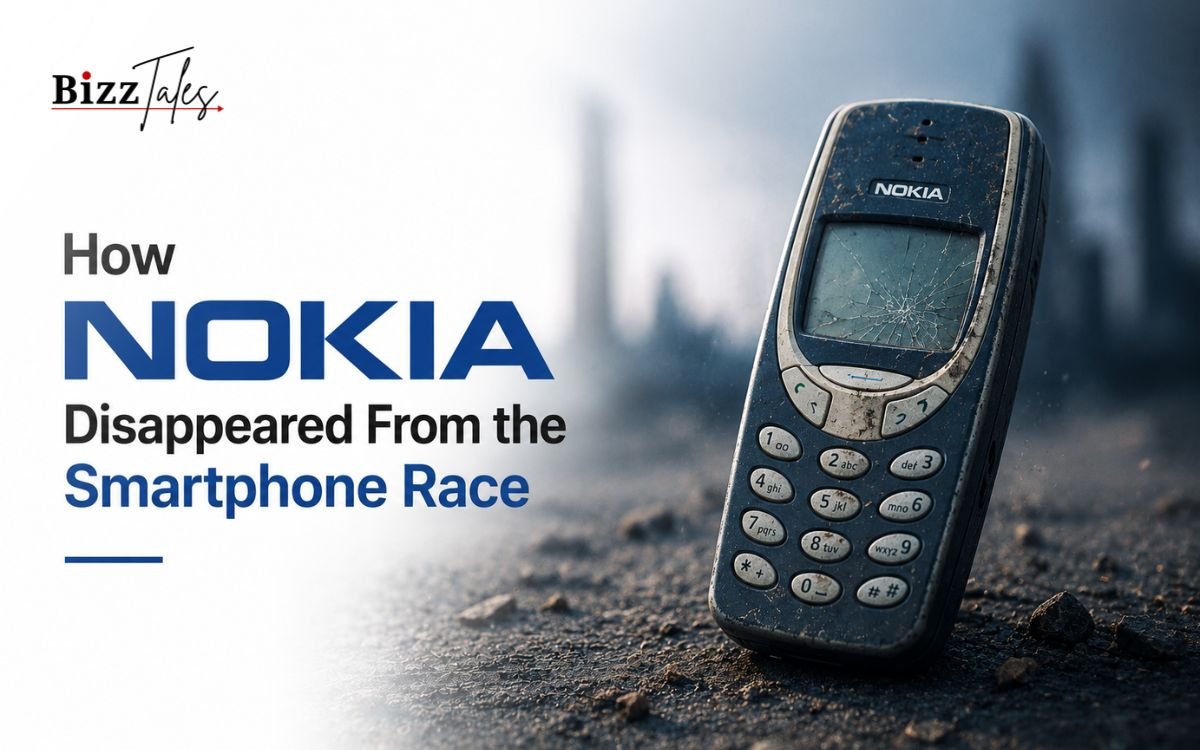
For a while there, Nokia wasn’t just a mobile phone company-it was the mobile phone company.
In the latter part of the 1990s and the early part of the 2000s Nokia ruled the world of mobile phones in a way very few technology companies have ever managed to. A Nokia handset could be relied upon to be reliable, tough and cheap and is used on a daily basis by millions and millions of people in the world. If you lived in New York, Mumbai, London or Beijing it was pretty likely that there is a Nokia handset being used by someone you knew.
At its height, Nokia had more than a 40% share of the worldwide mobile handset market. It was selling hundreds of millions of handsets per year, and was one of the most valuable tech brands in the world. It was the manufacturer of such phones as the Nokia 3310, Nokia 1100 and Nokia N95.
Yet, within a couple of years, Nokia had already relinquished its leadership position and was blanked out of the smartphone discussion.
Nokia’s downfall is still widely studied as one of business history’s best case studies. There are not many business schools that haven’t studied the rise and decline of Nokia, as it offers many lessons on how fast industry leading companies can become obsolete when consumer technology moves a lot faster than they can evolve.
The story of how Nokia was once the world’s dominant mobile maker, and is now one of the most significant case studies in missed opportunities in technology.
Nokia’s Dominance Before Smartphones
Before comprehending Nokia’s fall, let’s take a step back and understand how dominant Nokia once was,
When Nokia reigned supreme in the early 2000s,…the handset manufacturers’ user interfaces were quick, easy and with familiar features. On top of that, their network was remarkably resilient, and their batteries lasted ages, too.
The brand evoked trust among consumers, since products by Nokia were always meeting the customers needs from a mobile phone- reliability.
Furthermore, the company was more aware of international markets than most rivals. It supplied products at various prices so that people of different incomes could use mobile phones.
The supply chain, manufacturing strength, and distribution of Nokia were what they would have to be jealous of.
As the proliferation of cell phones spread across the world, Nokia seemed in a prime position to dominate for the next few decades.
However, technology was about to take a giant leap forward.
The Smartphone Revolution Begins
The first serious issue arose when mobiles entered the era of ‘smartphones’.
Prior to 2007, the majority of phones were built for calling, texting and simple Internet usage. Although, Smartphones were around, they were usually marketed towards professionals.
Opter for smartphones:Nokia were quick to acknowledge the potential of a smartphone market and so built their devices around the Symbian OS.
This approach initially proved effective.
Symbian became the most popular mobile platform worldwide. The popular Nokia N-Series and E-Series equipped with cameras, internet browsers, multimedia and productivity aids.
Many analysts assumed Nokia would, by default, own the smartphone battlefield, just as it owned the entire cell phone business.
But a big disturbance was on its way.
The Arrival of Apple’s iPhone
The game-changing hit were introduced by 2007.
Initially, a lot of market analysts didn’t even realize that this product exists. In those days, Nokia phones had a removable battery and a physical keyboard. In comparison, there were none of these features in the device.
But Apple realized something that many other competitors didn’t.
Software would be the defining feature of future mobile phones rather than hardware.
Thanks to the iPhone,we now have what seemed to be technology unimaginable in the not so distant past. Its revolutionizing touch screen experience changed everything.
Use gestures and touch buttons instead of using alt + tab combination to switch between applications; Interactive programs would be able to be accessed directly.
Intuitive, contemporary and very powerful were the overall learner experience feel.
After purchased this new way of payment, consumers already adopted this new way.
While Nokia still concentrated predominantly on hardware engineering, Apple was creating an ecosystem of software.
This disparity begins to grow more significant.
The Rise of Android
If Apple’s iPhone led the smartphone revolution, Android took it further…
Google introduced Android as a free-to-use open-source computer operating system for manufacturers.
Brand names like Samsung, HTC, Motorola and LG, and more recently Xiaomi and Oppo, were starting to make android phones.
This created a huge ecosystem of devices all at various price ranges.
Consumers now had instant access to mobile devices, with touchscreens, apps, web connectivity and more sophisticated software experiences ranging from all budgets.
Android quickly progressed.
The developers were aiming to develop apps for Android and iOS as people use these two operating systems the most.
Thus, app ecosystems flourished.
Nokia had to adapt to a new reality.
It was no longer about having the better phones.
The battle wasn’t solely between two languages, but involved developing a superior ecosystem for writing programs.
Why Symbian Failed
Nokia’s number one problem was Symbian.
Though winning through earlier than its Android and other system- Symbian… Poor against modern operating systems.
This software was built for a more archaic generation of mobile device and became much harder to translate into a touch-based experience.
Developers quite often deemed it more troublesome to develop applications for Symbian as opposed to Android and iPhone Operating System.
The difference was also quite apparent to consumers!
Compared to the modern and intuitive experience of Android and iPhone, Symbian seemed outdated.
Discovering the applications proved more difficult. The user interface was less user friendly and program updates were fewer and slower.
Nokia tried to make the platform better, but the others were much quicker.
When the improvements arrived the momentum had already built up on the long road to not only catchup, but actually get ahead;
Internal Problems Inside Nokia
Nokia also had to contend with the challenge posed by other technology companies.
The company also struggled with internal organisational problems.
Many industry experts and ousted Nokia executives have often cited internal politics, slow decision making, and fear-driven management practices that led to the eventual demise of Nokia.
Huge companies normally find it hard to change their organization fast in response to changing market conditions.
According to reports, Nokia’s senior management teams were at odds over strategic priorities which hindered their ability to counter challenges.
Engineerswere aware that major changes were necessary, leading to delays and sluggish decision-making.
In the meantime, our rivals persisted with their relentless pursuit of innovation.
Apple cleaned up the interface.
Google took Android by the horns.
Samsung made big investment to develop the idea of smartphone.
Nokia did not respond quickly enough to the new demands; they fell behind.
An Opportunity Missed
One of the most curious aspects of Nokia’s decline is that the company itself had perceived a good many of the trends taking place before rivals.
Nokia flirted with touchscreens, apps, the internet, etc., long before a lot of its contemporaries were successful in these areas.
The mistake wasn’t a lack of innovative thinking, it was one of execution. Nokia may have had good ideas, but others were better at bringing them to market in a timely, user-friendly, and meaningful fashion. Nokia’s R&D was solid, but their rivals did better executing that research and translating it into a commercially successful product, to their ever-increasing detriment.
The Microsoft Alliance
To counter a losing trend, in 2011 Nokia announced a drastic strategic partnership with Microsoft. Nokia agreed to use the Windows Phone operating system exclusively on its new line of smartphones. It seemed at the time like a marriage made in heaven, as Nokia represented top-notch hardware, and Microsoft had a globally recognized brand name and a deep software knowledge base that had been missing from Nokia’s previous efforts. Many thought this partnership might allow Nokia to put together a viable alternative to the established Google/Apple axis. At first, things looked good, and some early Windows Phone models got excellent reviews. The issue with the Microsoft partnership, though, was clear: apps. While Windows Phone has a great ecosystem of modern tile design, what was lacking in apps. Developers, of course, were more attracted to platforms with more potential users such as Google Android and Apple iOS. Because apps and an ecosystem continued to lag significantly, this partnership ultimately failed to reverse Nokia’s fortune.
Sale to Microsoft
By 2013 Nokia was on its last legs and eventually capitulated to Microsoft by selling its handset business for roughly $7.2 billion. It wasn’t easy to watch as a business which had brought mobile phones into the lives of so many of us disappeared, though even this Microsoft’s acquisition of Nokia phones never truly took off.
Where is Nokia Today?
Contrary to common perception, Nokia did not cease to exist after selling its phone business. The company actually restructured and refocused on the infrastructure business, and today it stands as one of the leading network providers globally, focusing on telecommunications network equipment, 5G, cloud services, and much more. It continues to partner with governments and providers all around the world to connect people through its technology.
Nokia Branded Phones Return
Eventually, a separate company known as HMD Global acquired the rights to use the Nokia brand on its smartphones, releasing a lineup of modern, affordable smartphones, many with an emphasis on nostalgia. While the nostalgia marketing has worked to some degree and some devices continue to get good reviews, even this venture has struggled to return the Nokia brand to its former market position.
Lessons learned from Nokia’s downfall:
The primary lesson from Nokia’s failure is that even dominant companies can become complacent, particularly during periods of unprecedented market change. It’s not enough to be innovative. Companies need to effectively execute their strategies. Apple and Google not only introduced superior technologies (touch screens, mobile apps) but also made it easy for developers to create complementary products, thus solidifying an entire ecosystem around their products. Nokia’s late response to these developments and their difficulty in adapting to change were critical in their fall.
Conclusion
Nokia’s downfall from a position of global market dominance in the mobile phone sector serves as a crucial case study for businesses today. The company’s failure was not due to a lack of brilliant minds, but a failure to adapt quickly to a rapidly changing market and consumer demands. Apple, Android and Google, on the other hand, built thriving ecosystems and focused on a superior user experience which proved decisive. Though Nokia, the company, continues to exist in a very different form, its reign over the consumer mobile landscape remains a stark reminder of how quickly even industry titans can fade if they cannot keep pace.
FAQs
What caused Nokia’s decline?
Nokia failed to adapt to the rapidly evolving mobile landscape. Its reliance on Symbian, a legacy operating system, made it difficult to compete with modern smartphone interfaces and app ecosystems offered by Apple and Google’s Android platform.
Was Nokia once the biggest phone company?
Yes, during its peak, particularly in the 2000s, Nokia was the world’s largest mobile phone manufacturer by volume.
Who bought Nokia’s phone division?
Microsoft acquired Nokia’s Devices and Services division in 2014.
What does Nokia do now?
Nokia is now a global telecommunications technology leader, focusing on network infrastructure, 5G, cloud services, and enterprise solutions, rather than consumer smartphones.
Can Nokia become a dominant smartphone company again?
Given the entrenched ecosystems of Apple and Android and the intense competition, it would be an extremely challenging task for Nokia-branded phones to regain their former dominant position in the smartphone market.