
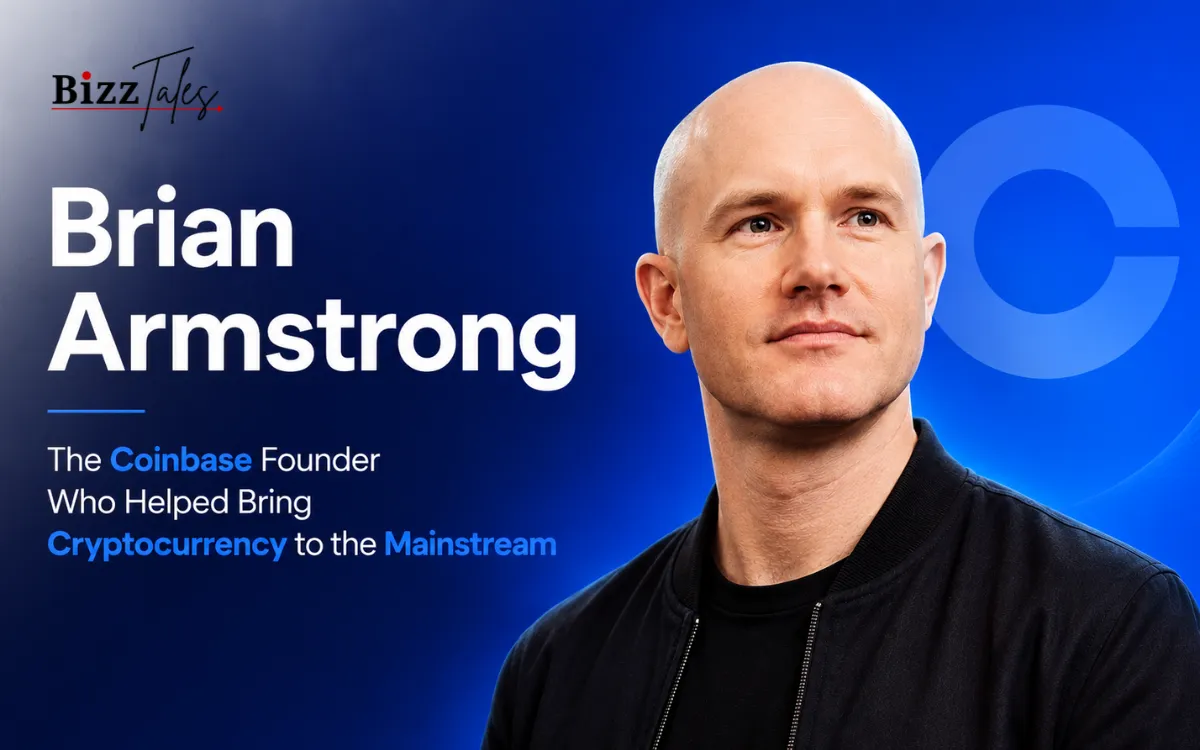
Find Brian Armstrong net worth, Coinbase history, rise and fall, investments, leadership style and how he became the billionaire CEO in crypto.
Brian Armstrong is a prominent personality within the cryptocurrency world, and the entrepreneurial leader who is the brain behind Coinbase – arguably the biggest digital currency exchange on the planet. Back when cryptocurrency was only being discussed by a few pioneers interested in the tech, Armstrong saw the revolutionary aspect of cryptocurrency and started out aiming to create platforms that enable anyone to use digital currencies.
The former software engineer turned billionaire embodies the rise of the crypto sector as Armstrong has witnessed the wild ride of cryptocurrency bull runs and his company’s debut on the stock exchange. His career has come with steep crashes and moments of doubt during the bear market that have stressed his leadership and his company’s sustainability.
Armstrong’s path to wealth is an alternative route that few others took, diverging from those who prospered in sectors unrelated to crypto with a core mission that decentralized finances through blockchain will transform global finance, he has empowered countless people with the ability to acquire, hold, trade, and understand virtual property using his company, Coinbase.
Today, Brian Armstrong is one of the most influential leaders in financial technology and cryptocurrency, and his story is one of ingenuity, risk, resilience and a powerful drive to help build the infrastructure for the digital economy of the future.
FORBES RANKINGS AND NET WORTH
| Year | Forbes Ranking | Net Worth |
| 2026 | #214 | $14.8 Billion |
| 2025 | #267 | $12.1 Billion |
| 2024 | #388 | $8.6 Billion |
EARLY LIFE AND EDUCATION
Brian Armstrong was born in San Jose, California, United States on January 25, 1983. He was born in the center of the United States (the state of Silicon Valley) that exposed him early to both technology and invention. His parents both had careers in engineering as well as technology; they fostered a natural and encouraging environment of curiosity and discovery while problem-solving was emphasized.
As a young person, Armstrong was keenly interested in computer science as well as engineering and entrepreneurship. He developed a passion for leveraging technology to solve large-scale problems and increase productivity in business. In his free time, he would experiment with programming as well as the burgeoning internet.
Once in high school he came to Rice University in Houston, Texas, where he graduated with dual degrees in Computer Science and Economics. It’s this blend of technology and finance that would continue to define him as he helped carve a path through the nascent world of digital currencies.
As a university student, Armstrong even worked on building various small online businesses and websites. Through his entrepreneurial endeavors, he ran into issues around payments, international transactions and general financial infrastructure.
His education provided a strong foundation in both technology and economics, preparing him for a future that would combine the two fields in revolutionary ways.
CAREER JOURNEY
Brian Armstrong spent his prior life in software engineering and tech startups, including starting an online tutoring marketplace that was moderately successful. He was a software engineer at Airbnb during his tenure where he discovered just how challenging international payments were. In 2010 he discovered bitcoin.
Armstrong saw the potential of the revolutionary blockchain technology to challenge traditional banking systems.
When the world saw bitcoin was still around in 2012 after many thought it was just a fad, Armstrong founded Coinbase with Fred Ehrsam to simplify purchasing bitcoin. Because as interest grows people need a way to make it easier and trusted to buy bitcoin on the open market. Coinbase is now a public company serving millions of customers worldwide.
BUSINESS VENTURES
A digital currency empire Brian Armstrong’s main vehicle is Coinbase, the exchange founded in 2012 that brought cryptocurrency into the mainstream. Over the years Coinbase – a platform that enables people to buy, sell and transfer bitcoin and other cryptocurrencies – has evolved beyond that simple use. It offers digital currency storage, staking, tools for institutional investors, blockchain infrastructure services and educational tools for people to learn more about digital currencies.
Armstrong is also known for prioritizing compliance and security, and he has worked hard to earn both consumer and institutional trust while some of his competitors tread a rocky legal path.
He is backing a number of other businesses including companies that develop decentralized finance tools and support the blockchain and artificial intelligence industries, and others focused on enabling economic freedom and advancing global financial inclusion. His activities span from investments in other tech and blockchain startups to those building next generation products for a digitally native economy.
SUCCESS STORY AND MAJOR ACHIEVEMENTS
The success of Brian Armstrong is directly linked with the growth of cryptocurrency itself. Having developed Coinbase at the time when Bitcoin was young took trust, persistence, and accepting uncertainty, but he prevailed. His most prominent achievement has been developing Coinbase into one of the most popular digital currency exchanges worldwide.
The company has been a major entry point for many millions into the crypto ecosystem.
Another major achievement has been steering Coinbase through the public offering; the transaction has served as a historically significant transaction for the company and, generally, the digital assets industry. He also developed guidelines for user experience, safety, and compliance, facilitating the widespread use of digital assets.
His campaigns in favor of decentralized finance and distributed ledger technologies have influenced a large number of people including those working in government, finance, private sector investment firms, and entrepreneurship across the globe.
Hardly anyone else did as much to push crypto-centric thinking out of its niche position in the global economy and into the mainstream conversations on finance and investing.
RISE AND FALL
One of the most amazing tales to emerge from modern fintech is the ascension of Brian Armstrong and Coinbase. Once Bitcoin broke through, Coinbase began an exponential trajectory of exponential user acquisition and billions in investor capital. On several bull markets for cryptocurrency, revenues sky-rocketed.
The company’s valuation shot into the tens of billions of dollars, and Brian Armstrong landed on lists of one of the richest in tech. 2021’s IPO was probably the high water mark.
Coinbase became synonymous with the arrival of crypto into mainstream finance and Armstrong, a celebrated figure and prophet.
But crypto is an industry for wild fluctuations, by nature.
As cryptocurrency prices declined during major market downturns, Coinbase experienced significant revenue pressure. Trading volumes fell, investor sentiment weakened, and the company’s stock price dropped substantially from its highs.
The broader industry also faced challenges including exchange collapses, regulatory investigations, and declining public confidence. Many critics questioned whether cryptocurrency could achieve widespread adoption.
Armstrong responded by focusing on long-term strategy rather than short-term market fluctuations. Coinbase reduced costs, strengthened compliance efforts, and continued investing in infrastructure and innovation.
He chose not to wallow when times were tough; instead, he stood by his belief in technology. When markets recovered, Coinbase gained strength and became one of the strongest companies in the space.
He stands as a good example for any company operating in an industry driven by innovation.
CHALLENGES, FAILURES, AND SETBACKS
Throughout Armstrong’s tenure, there were constant hurdles. Volatility is endemic to the crypto market, leaving businesses in the industry on unstable ground. However, one of the primary issues for Coinbase came in the form of increased regulation.
The discussion as to how to categorize and control digital assets was an ongoing theme for governments and the financial world.
Technical glitches that emerged as a result of an increase in trades at market upswings drew some ire too. A rising number of other trading exchanges meant increasing competition as Coinbase had to keep reinvesting. Bear crypto markets reduced demand for trading and stifled revenue growth.
Armstrong would try to keep sight of a long-term view and resist reacting too quickly to day-to-day movements, learning how to move through uncertainty as much as he has how to build.
INVESTMENTS AND ASSETS
Brian Armstrong has derived most of his fortune from his stake in Coinbase. As the founder and largest shareholder, he profited enormously from the exchange’s ascent and its stock’s market performance. Aside from Coinbase equity, Brian Armstrong holds significant cryptocurrency assets, such as bitcoin and other altcoins, a testament to his faith in the technology that will underpin the future of blockchain.
The serial entrepreneur also actively invests in high-growth startups operating in the areas of artificial intelligence, financial technology, innovative health solutions, and decentralized technologies.
Real estate properties and a diversified range of other investment vehicles help secure additional stability for Armstrong’s immense net worth. Brian Armstrong, whose approach to investing centers on the long-term potential of disruption technologies that offer compelling economic opportunity, has created a net worth well into the billions, largely through the convergence of business ownership, cryptocurrency assets, and venture-style investments.
LEADERSHIP STYLE AND BUSINESS PHILOSOPHY
The leadership approach Brian Armstrong espouses revolves around a commitment to innovation, focus, and the pursuit of long-term vision over trends. In his opinion, winning organizations should prioritize the solution of substantial issues instead of latching onto fads. This leadership paradigm is largely structured around economic liberty, with the belief that distributed financial networks have the potential to increase accessibility for citizens across the planet.
Moreover, the business guru advocates efficiency, highlighting Armstrong’s dedication to functional competence throughout the company’s journey to prominence in a turbulent market.
Finally, resilience is another hallmark of his approach; in the crypto space, investors’ fortunes inevitably wax and wane, necessitating leaders with the fortitude to view both exuberance and panic with detachment.
This framework advocates learning, innovation, and responsibility and has played no small role in Coinbase’s sustained standing within the industry.
PERSONAL LIFE
In his personal life, Armstrong has kept a low profile due to his high public profile. Typically, he prefers to keep his focus public attention away from himself and instead towards the business and the technology.
Outside the company, his personal interests center around the science and technology sector, economics, and business entrepreneurship. All these can influence his work, how he invests, and what he comments publicly on.
Armstrong has contributed to humanitarian projects and science endeavors such as those involved in the study of scientific discovery, education, and financial growth. He has shared a desire to harness technologies toward solving global issues.
He is viewed as analytical, dedicated, and driven by the pursuit of objectives by his close contacts and team.
SOCIAL MEDIA PRESENCE
LEGACY AND FUTURE OUTLOOK
The impact and legacy of Brian Armstrong can be inextricably tied to the mainstream acceptance of cryptocurrency. His platform, Coinbase, made it easy and safe for millions across the world to dip their toes into the crypto waters. Besides this, he’s been at the forefront of important discussions about blockchain and the future of money.
It seems clear that his business Coinbase will stay prominent in crypto, but I wouldn’t be surprised to see his reach extend into emerging areas of innovation, thanks to a variety of investments he’s making today.
Future entrepreneurs will likely look at his skill in fostering trust in one of the most polarizing and volatile fields out there today and consider how he achieved that feat in financial technology and Blockchain infrastructure.
CONCLUSION
Brian Armstrong’s path to cryptocurrency mogul starting out as software engineer exemplifies how important of an entrepreneurial saga we’ve seen in this tech era. For the countless individuals he introduced to interacting with the world of crypto, this paved a path for cryptocurrency to go mainstream, through its revolutionary and trailblazing Coinbase application.
He has led a truly legendary career filled with phenomenal achievements, significant crashes in the marketplace, obstacles with regulation, as well as a lot of time riddled with uncertainty. But he’s consistently kept pushing forward by investing in an enduring infrastructure for future finance.
It’s through technological innovation and leadership that this successful business- mogul developed among many regarded corporations in the digital cryptocurrency world. He now is seen as among one the world’s top pioneers of technology, a role that has a continuing future in worldwide finance.
FAQS
What is Brian Armstrong’s net worth in 2026?
Brian Armstrong’s estimated net worth in 2026 is approximately $14.8 billion.
How did Brian Armstrong become a billionaire?
He became a billionaire by founding Coinbase and helping transform it into one of the world’s largest cryptocurrency exchanges.
What companies does Brian Armstrong own?
He is best known as the founder and CEO of Coinbase and has investments in numerous blockchain and technology startups.
What is Brian Armstrong’s leadership style?
His leadership style emphasizes innovation, long-term thinking, efficiency, resilience, and economic freedom.
What is Brian Armstrong’s biggest business achievement?
His biggest achievement is building Coinbase into a leading global cryptocurrency platform and helping bring digital assets into mainstream finance.