
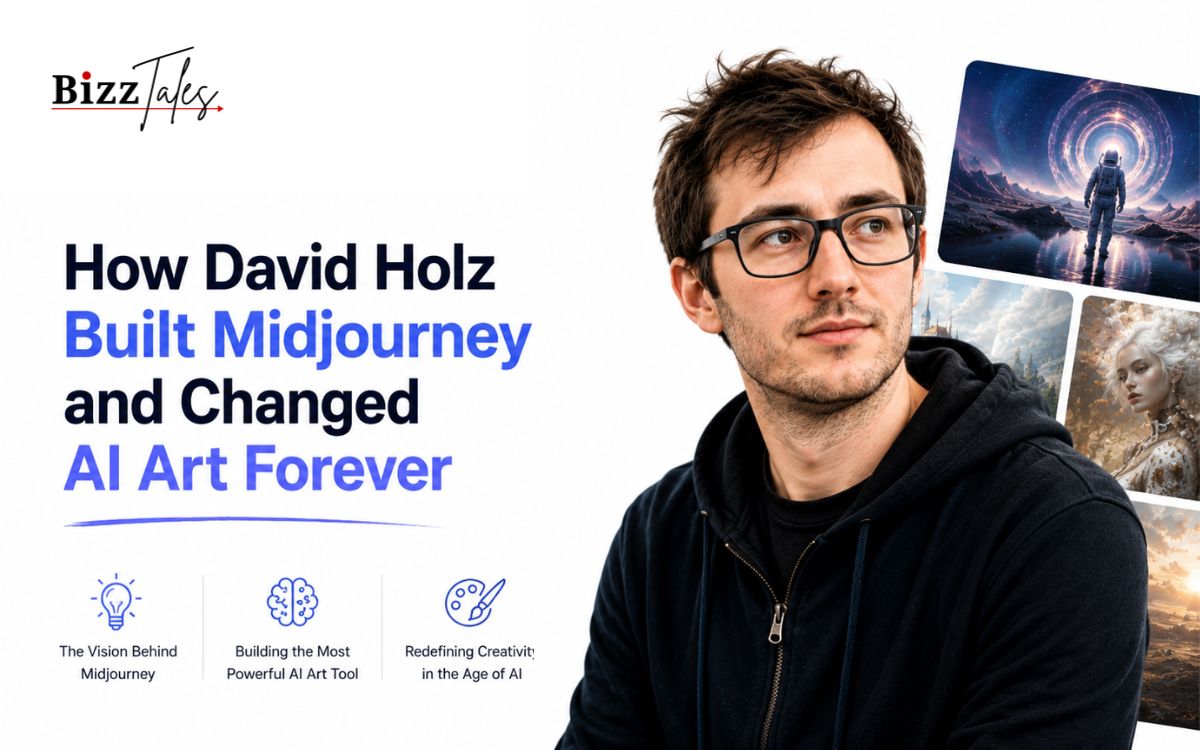
Artificial intelligence has broken into hundreds of fields and industries, but few have been affected as profoundly as digital art. For the last numerous decades drawing quality images was got only by years of training, costly software tools, and highly-competent skills. Technology enhanced and improved creative process, but art itself was always a human labor market.
Followed by generative artificial intelligence.
Today, you can just type in a few words and be able to generate beautiful images, cinematic scenery, photorealistic landscapes, fantasy worlds, design concepts, 3D digital artwork and nearly anything else within a few seconds, where something that used to take anything from a matter of hours to weeks to create can now be achieved in a flash.
Today, at the heart of this revolution, is Midjourney-the world’s leading AI image generation platform.
Even though millions are aware of the midjourney brand, most people have not heard of the story of the man behind the brand: David Holz.
Compared to many other founders in the technology world who are eager to attract press, Holz has not been quick to seek the limelight. Nevertheless his work, and Midjourney in particular, has helped shape the future of creativity. The platform has revolutionized the experience of creators, marketers, entrepreneurs, normal users, artists and designers alike.
The case for David Holz is not just about a starry-eyed guy creating an iconic software company. It’s about reinventing our assumptions about creativity. About capitalizing upon, and mastering, the healthful growth of, emerging technologies and about designing tools that enable millions of people to share ideas visually.
As the world of AI keeps reshaping the world of creativity, having a good grasp of the story of Midjourney will help you better grasp one of the most important technological change of our century.
Early Life and Passion for Technology
David Holz has forever been fascinated by human computer interaction.
While most entrepreneurs are more interested in business opportunities, Holz wasalways more enthralled by how technology could improve human ability.
His interest in computers and the digital world as well as in solving problems could be seen already in his early age.
As computing technology developed during the second-half of the twentieth century, Holz grew more intrigued by how computers could be used to supplement human intelligence than how they could be used to perform mechanical tasks.
It was this attitude which became a distinctive feature in his work.
While many technology leaders tend to think in terms of automating and replacing human effort, Holz has persistently been promoting to develop tools to enlargen human abilities.
This point of view grew into the most important reason Midjourney stood out.
Building a Foundation in Innovation
Before starting Midjourney, David Holz worked with a lot of new technologies.
It was always an area to which he was drawn during his career – projects that were innovative and concerned the interaction of human and computer.
Instead of following typical technological routes, Holz frequently sought out large problems that could be solved through innovative approaches and trial and error.
His work helped him gain more experience about how individuals communicate and interact with online resources and how technology can enhance user experience.
These insights would come in handy down the road, significantly shaping the development of Midjourney.
And most significantly, they confirmed his conviction that technology is a creative collaborator-not just a productivity instrument.
This concept would later form the basis of Midjourney’s principles.
The Leap Into Entrepreneurship
More traditional than the entrepreneurs above is the entrepreneur who is primarily a solution to some problem, and perhaps a very ready solution at that! Or, perhaps they’re something else entirely.
For David Holz, a recent breakthrough in “a new, powerful AI” presented this kind of possibility.
The programs used in machine learning were rapidly advancing to allow for image creation, language processing and pattern recognition. The problem was many of these initial AI systems were still designed with no user interface.
Holz quickly identified where he could step in to fill the void.
Instead of designing applications solely for researchers and technical professionals, he imagined a system where regular people could easily craft visual media from concise textual commands.
This vision was richer than technology.
It involved developing a deep understanding of human creative thinking and building processes that would turn thought into more visually striking presentation.
This would ultimately create Midjourney.
The Birth of Midjourney
Midjourney was born to a different purpose from many technology start-ups.
Company wanted to focus less on the automation or increased productivity, and more on new ways of creativity through AI.
The idea was simple yet impactful.
Users were able to describe a concept in natural language and have the system produce images.
At first glance, it would seem an easy task for today.
However, AI generated images were still a new concept for many when Midjourney launched.
It was often asked whether the piece satisfied standards of quality, subjective usefulness, or artistic taste.
Could artificial intelligence truly create meaningful art?
Could machines support creativity rather than replace it?
Midjourney assisted me in finding the answers.
Has proved itself to be a platform that could turn AI into a great creative partner.
Why Midjourney Became Different
Speed was the second factor, another could be the fact that what made Midjourney famous in a short amount of time was its quality art style.
Most image-generation tools tend to emphasize realism, but many Midjourney images were often more aesthetically elaborate, surreal and good-looking.
The platform became known for designing images that seemed more creative than technical.
Artists, designers, filmmakers, marketers, writers, entrepreneurs-anyone, in fact-who wanted to quickly visualize their ideas adopted the technology for this reason:
It was possible for users to produce concept art, storyboards, branding visuals, artwork, design prototypes of products and innumerable other types of visual creations.
The experience felt less like working a program and more like working with a creative collaborator.
This trademark distinction made Midjourney unique in an increasingly competitive market.
The Explosion of AI Art
Midjourney grew steadily in size with the rise of artificial intelligence to the mainstream.
Immediately images flooded the internet, created through AI.
Users posted images of fantasy worlds, future cities, film-style portraiture and dreamlike art created with nothing but plain text instructions.
The shareability of these pieces drew in millions of new users.
People who had never before labeled themselves artists seemed to be producing visually appealing work.
Midjourney gave a voice to individual creativity, in a way no other technological revolution before it managed to.
For several the first opportunity to make an imaginary production has occurred.
It is this accessibility that became one of the platform’s greatest strengths.
Transforming Creative Industries
The popularity of Midjourney was not limited to avid hobbyists.
The creative minds grasped onto it right away.
Designers used AI-generated ideas to streamline brainstorming sessions. Marketing teams created visual advertising campaigns faster. Writers had illustrations for stories and presentations created. Entrepreneurs created prototypes and branding ideas.
It has significantly lowered the barrier of creating visual content.
Though classic design skills were still … Quite impressive, Midjourney enabled users and companies.
This change was already reforming work processes in many businesses.
Instead of competition, creativity was bolstered by the tools in Midjourney.
They would be able to come up with a wider range of ideas, develop prototypes quicker, and dedicate increased time to high-level deliberation.
Controversies and Challenges
Similar to any disruptor, Midjourney has received flak.
Discussions about copyright, intellectual property, the rights of the artists, and the ethical use of AI remain ongoing.
Certain artists contend that AI programs absorb creative works and do not give proper homage to the versions of art-makers.
Others are also concerned about the wider effects on the creative industries.
Despite these conversations, David Holz and the Midjourney team had to reach their way through these discussions while still developing the platform.
The challenge of balancing innovation with responsibility continues to be the single biggest issue facing the entire AI industry.
The dialogue continues as policies, technologies, and public expectations evolve.
David Holz’s Vision for Creativity
One of the most intriguing insights into David Holz’s leadership is his belief in the nature of creativity.
He often talks about AI as an instrument to augment human imagination rather than as a replacement of artist.
His goal is to enable people to communicate ideas more easily.
In this type of system, Artifical intelligence is seen as a partner not as a competitor.
This approach appeals to many users as it see creativity as a collaboration between human and machine.
Instead of eroding artistic creativity, AI could aid in opening up new avenues of discovery and experimentation.
This vision still guides the development strategy of Midjourney.
The Business Behind Midjourney
Besides being technologically advanced, Midjourney is yet another successful marketing venture.
The said platform has implementation of subscription based models, for easy use of image-generation.
Midjourney became one of the more familiar brands in AI creativity space as the demand for AI created content rose.
Midjourney’s not typical; versus most startups that rely strongly on VC funding, it grew through product adoption and customer lust.
This business model has enabled the business to concentrate on long-term innovation while remaining autonomous.
The outcome is that this still-crowd-sourcing platform keeps changing at a hard-fast pace as it expands into a worldwide community.
The Future of AI Creativity
The evolving landscape of ai and creativity continues to be one of the most exciting topics in tech.
Generation of images has been escalating at a phenomenal rate.
New systems may generate full movies, totally convincing virtual worlds, interactive experiences, and specialized works of art.
Midjourney is where they can begin.
As visual AI applications increase their capabilities, the human-technology and art relationship are destined to evolve as well.
Holz has already been influential in millions of people’s everyday life art.
The next chapter could be more radical.
Lessons Entrepreneurs Can Learn From David Holz
The experience of David Holz is instructive for entrepreneurs.
Another lesson is finding and pursuing the long term vision rather than the short term trend.
The other relates to identifying the built-in opportunities within new technologies until they are apparent to the rest of the market.
I also learned how good it is to give the priority to the experiences of the user instead of the technical complexities.
Midjourney won because it made artificial intelligence cool and easy.
Finally, Holz demonstrates that such innovative efforts are built upon using technology to enhance human potential rather than substitutes.
That is more than, well-these principles apply far beyond artificial intelligence.
Conclusion
While Holz might not be as famous as some other web founders, there’s no denying his impact on the artistic community.
It was via Midjourney that he was able to pioneer turning artificial intelligence from a technical toy into an incredibly powerful creative tool used by millions of people across the globe.
It has revolutionized the production of image content, providing the means for individual and corporate expression to be defined and executed at an entirely unprecedented rate and with unmatched ease.
As AI still radically changes the creative industry, it appears to be this way for at least many years to come with the continued influence of Midjourney.
All in all, David Holz’s story is a story of imagination, tinkering and a belief in a future where technology will actually give us more tools for creativity, and not take them away, he has contributed to one of the defining creative revolutions of the digital era.
FAQs
Who is David Holz?
Midjourney, a major AI image-generation service, was founded by David Holz.
What is Midjourney?
Midjourney is an AI platform that generates images based on the text prompts submitted to it.
Why is Midjourney so popular?
Midjourney really has established itself as one of the most creative and artistic image generators around. The images that it delivers are usually very visually pleasing and often exciting for the casual user and professional alike.
How does Midjourney make money?
The platform earns most of its revenues through the subscription plans, which allows users to access the image-generation services.
What impact has Midjourney had on creative industries?
Midjourney has brought a new paradigm to content creation, facilitating the process and reducing the activation barriers to visualization while also enabling new modes of communication for people and businesses to utilize.