
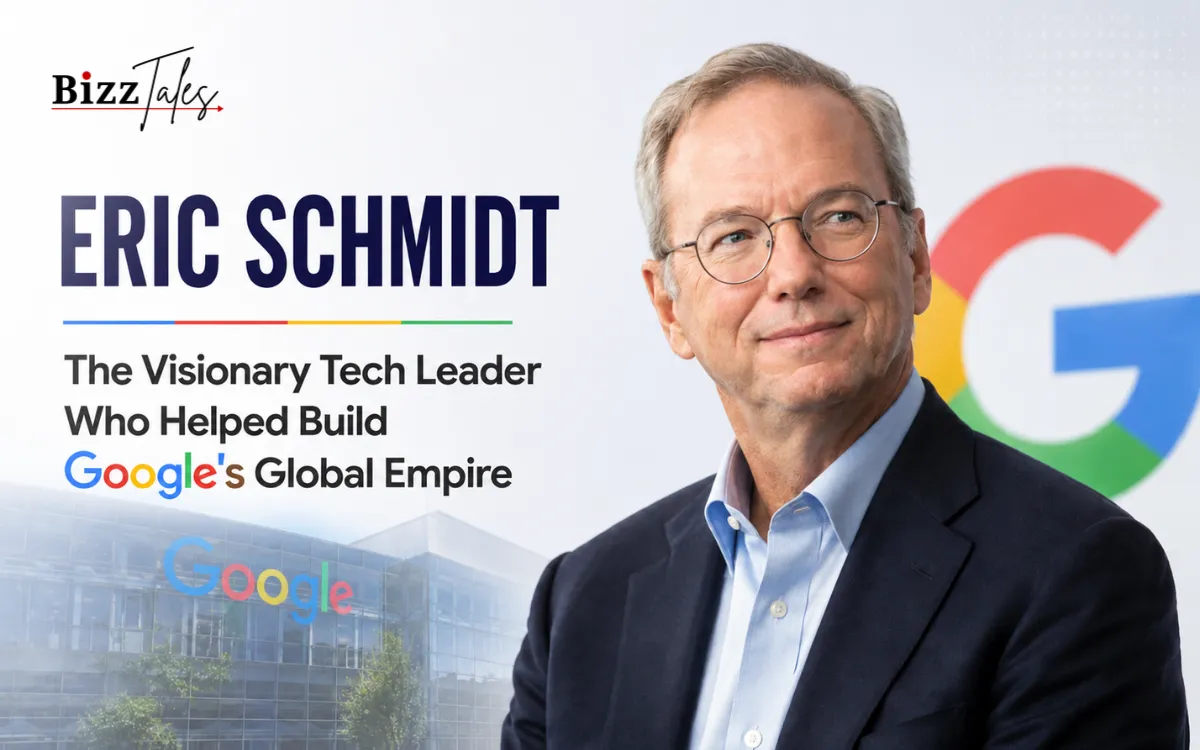
Eric Schmidt is certainly one of the most important people in the modern technology world. Invention of Google Search engine was credited to Larry Page and Sergey Brin; however the entrepreneurial magnate Eric Schmidt was responsible for turning rapid startup into a mighty technology empire. As the CEO and Executive Chairman of Google, Schmidt delivered the management, operational skills and strategic insights crucial for the enterprise’s expansion worldwide.
Throughout his life, Schmidt has been a chemist, software engineer, head of a high tech firm, investor, philanthropist, author and policy advisor. His work for Google is just a prelude, here are some of the other fields where he has affected: artificial intelligence, cyber security, national security, healthcare technology and science.
Today Eric Schmidt is no longer simply one of the most powerful executives of Silicon Valley, but a billionaire investor whose impact will influence the landscape of the Web for generations to come. Here we learn several lessons about leadership, resourcefulness and the importance of technology and commercial strategy knowledge.
Forbes Rankings
| Year | Forbes Rank | Estimated Net Worth |
| 2026 | #61 | $34.1 Billion |
| 2025 | #69 | $31.7 Billion |
| 2024 | #78 | $28.6 Billion |
Eric Schmidt’s wealth has grown steadily due to his substantial Google stock holdings, technology investments, venture capital activities, and ownership interests in emerging industries.
Early Life
Eric Emerson Schmidt was born on 27 April 1955, at Falls Church, Virginia, United States. He was born to a middle class family and was brought up with the love of education, curiosity and hard work.
Schmidt’s father was an economist for the U.S. Government, and this influenced his early exposure to analytical thinking and investigation. As a child he became interested in mathematics, science and technology.
Born during the emergence of the computer era, Schmidt had been interested in engineering and computing for some time before the industry went global. His early interest would go on to fuel one of the most successful Silicon Valley careers to date.
While many entrepreneurs had poor academic records, Schmidt was a brilliant student who also possessed outstanding technical skill from a young age.
Education
Education played a crucial role in Eric Schmidt’s success.
He earned a bachelor’s degree in electrical engineering from Princeton University, where he developed a strong foundation in mathematics, engineering, and computer science.
After graduating, Schmidt continued his studies at the University of California, Berkeley. There, he earned both a master’s degree and a Ph.D. in computer science.
His doctoral work focused on computer networks and distributed systems, areas that would later become fundamental to the growth of internet technology.
This advanced education provided Schmidt with deep technical expertise, allowing him to bridge the gap between engineering and business leadership throughout his career.
Career Journey
Eric Schmidt began his professional career at Bell Labs, one of the most respected research institutions in the technology world.
He later joined Sun Microsystems, where he played an important role in software development and eventually rose to become Chief Technology Officer. During his time at Sun, he helped develop technologies that contributed to the growth of enterprise computing.
Schmidt’s reputation as a highly capable technology executive continued to grow. He later became CEO of Novell, a major networking software company.
However, the defining chapter of his career began in 2001 when Google founders Larry Page and Sergey Brin recruited him as CEO.
At the time, Google was a rapidly growing startup with enormous potential but limited executive experience. Schmidt brought operational discipline, leadership experience, and strategic vision to the company.
Under his leadership, Google expanded far beyond search. The company launched products such as Gmail, Google Maps, Google News, Google Chrome, Android, and YouTube integration. During this period, Google also completed its highly successful IPO, becoming one of the world’s most valuable companies.
Schmidt served as CEO until 2011 before transitioning to Executive Chairman, continuing to play a major role in Google’s growth and global strategy.
Business Ventures
Google remains Eric Schmidt’s most significant business achievement.
During his leadership, the company transformed from a search engine startup into a global technology powerhouse operating across advertising, mobile computing, cloud services, artificial intelligence, video platforms, and enterprise software.
Beyond Google, Schmidt has invested heavily in emerging technologies.
Through his investment firms and venture capital activities, he has backed startups in artificial intelligence, biotechnology, cybersecurity, clean energy, space technology, and healthcare innovation.
He has also participated in government and policy initiatives focused on technological competitiveness and national security.
His ability to identify future technology trends has helped him remain influential long after stepping away from day-to-day management at Google.
Major Successes
One of Eric Schmidt’s greatest achievements was helping scale Google into one of the most valuable companies in history.
When he joined Google, the company was a promising startup. By the time he stepped down as CEO, it had become a global technology leader with billions of users.
Another major success was his role in overseeing Google’s IPO. The public offering generated significant wealth for investors while providing capital for future expansion.
Schmidt also played a key role in strategic acquisitions, including YouTube and Android, both of which became critical components of Google’s ecosystem.
His success as an investor has further strengthened his reputation. Numerous technology startups and innovation-focused companies have benefited from his support and guidance.
Challenges & Struggles
Like every successful business leader, Eric Schmidt faced significant challenges throughout his career.
Managing Google’s rapid growth was one of the biggest. Scaling a company from a startup into a global corporation required balancing innovation with operational discipline.
Google also faced increasing competition from technology giants such as Microsoft, Apple, Amazon, and Facebook. Maintaining leadership required constant innovation and strategic adaptation.
Regulatory scrutiny became another major challenge. As Google expanded globally, governments raised concerns regarding privacy, market dominance, data protection, and competition.
Schmidt also faced the challenge of balancing technological innovation with social responsibility, an issue that remains relevant throughout the technology industry today.
Despite these obstacles, his leadership helped Google maintain its position as one of the world’s most influential companies.
Leadership Style
Eric Schmidt is widely known for his collaborative and data-driven leadership style.
Unlike founders who often rely on intuition, Schmidt combined technical expertise with structured management practices. This approach helped Google maintain innovation while building a scalable corporate structure.
He strongly believed in hiring exceptional talent and empowering teams to solve complex problems.
Schmidt also emphasized openness, experimentation, and continuous learning. His leadership philosophy encouraged employees to think creatively while remaining focused on measurable outcomes.
Many business schools study his management approach as a model for scaling high-growth technology companies.
Other Businesses & Investments
Outside Google, Eric Schmidt has built an extensive portfolio of investments.
He has invested in artificial intelligence companies, biotechnology firms, cybersecurity startups, aerospace ventures, and clean energy projects.
Schmidt is also involved in national security technology initiatives and serves as an advisor on emerging technologies.
Additionally, he has interests in scientific research organizations, innovation funds, and future-focused technology programs.
His diversified investment strategy reflects his belief that technological advancement will continue driving global economic growth.
Philanthropy
Eric Schmidt is actively involved in philanthropy through the Schmidt Family Foundation and other charitable initiatives.
His philanthropic efforts focus on science, education, climate change, public health, technological innovation, and environmental sustainability.
He has funded research projects, educational institutions, scientific organizations, and programs aimed at solving global challenges.
Schmidt believes technology should be used not only to generate economic value but also to improve society and address complex global issues.
His contributions have supported numerous initiatives in healthcare, climate science, and technological development.
Personal Life
Eric Schmidt is married to Wendy Schmidt, a philanthropist and environmental advocate.
The couple has been involved in numerous charitable and educational initiatives over the years.
Outside business, Schmidt has a strong interest in science, technology, public policy, and global innovation. He is also an author and frequent speaker on the future of artificial intelligence, leadership, and technological transformation.
Despite his wealth and influence, he remains deeply engaged with emerging technologies and continues to advise organizations shaping the future of innovation.
Official Social Media Accounts
While Schmidt maintains some public online presence, he is generally more active through interviews, conferences, books, and policy discussions than traditional social media engagement.
Lessons for Entrepreneurs
Eric Schmidt’s career offers valuable lessons for entrepreneurs.
One important lesson is the value of combining technical expertise with business leadership. His success demonstrates that understanding both technology and management can create powerful competitive advantages.
Another lesson is the importance of scalability. Schmidt helped transform Google from a startup into a global corporation by building systems capable of supporting rapid growth.
Entrepreneurs can also learn the significance of hiring talented people. Schmidt consistently emphasized recruiting exceptional individuals and giving them the freedom to innovate.
His career highlights the value of adaptability. Technology evolves rapidly, and successful leaders must continuously learn and adjust to changing conditions.
Most importantly, Schmidt demonstrates that long-term success often comes from balancing innovation with disciplined execution.
Conclusion
Eric Schmidt’s journey from computer scientist to billionaire technology leader is one of the most remarkable success stories in Silicon Valley history. Through his leadership at Google, strategic investments, and contributions to technology policy, he has helped shape the modern digital world.
His impact extends far beyond search engines and internet services. As an investor, advisor, and philanthropist, Schmidt continues influencing industries ranging from artificial intelligence to healthcare and national security.
For entrepreneurs, business leaders, and technology enthusiasts, Eric Schmidt’s story serves as a powerful example of how expertise, vision, and disciplined leadership can create lasting global impact.
FAQs
1. Who is Eric Schmidt?
Eric Schmidt is an American billionaire businessman, former CEO of Google, investor, and technology leader.
2. What is Eric Schmidt’s net worth in 2026?
His estimated net worth in 2026 is approximately $34.1 billion.
3. Why is Eric Schmidt famous?
He is best known for serving as Google’s CEO and helping transform the company into one of the world’s largest technology corporations.
4. Does Eric Schmidt still work at Google?
No, he no longer manages Google but remains active as an investor, advisor, philanthropist, and technology strategist.
5. What can entrepreneurs learn from Eric Schmidt?
Entrepreneurs can learn the importance of scalability, innovation, talent management, adaptability, and combining technical expertise with effective leadership.