
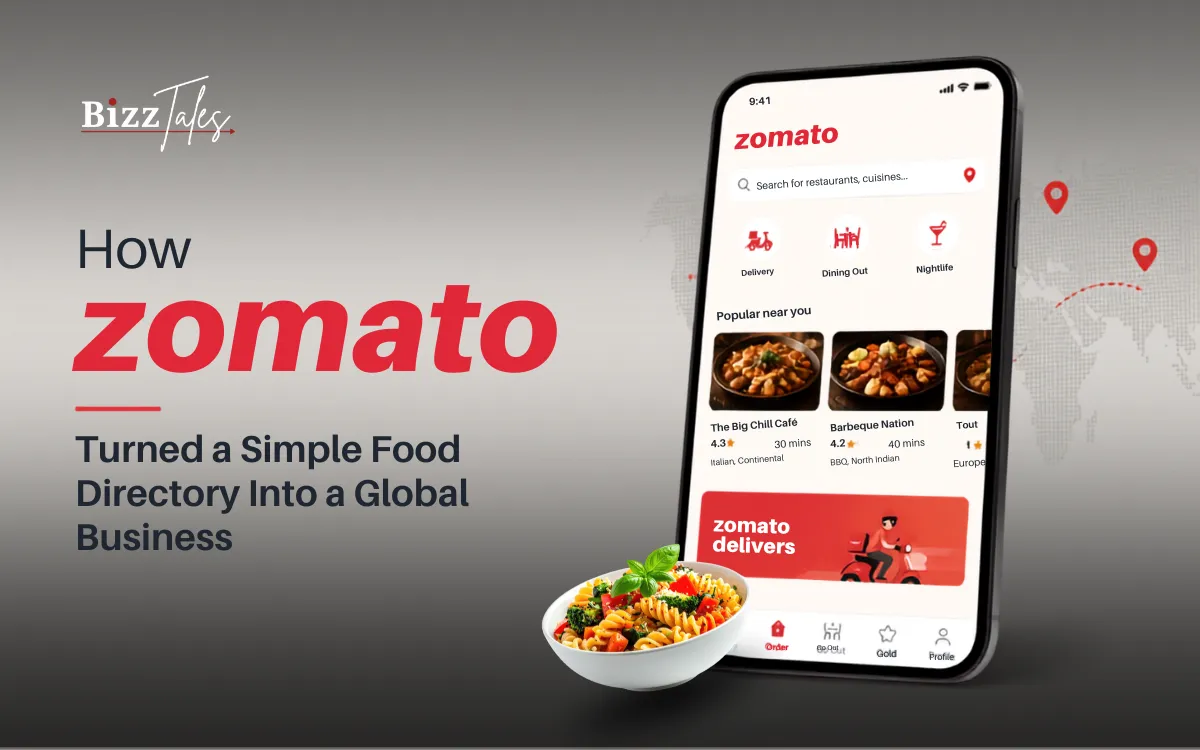
Today, discovering a restaurant can take seconds: open an app, browse menus, check ratings, see what is nearby, and place an order. But before food apps became part of everyday life, restaurant information was surprisingly fragmented. Menus were often available only at the restaurant, recommendations came through friends, and finding reliable information about where to eat could take real effort.
Zomato began by solving exactly that problem. What started in Delhi in 2008 as a website containing scanned restaurant menus gradually became a platform for discovery, reviews, dining, food delivery and restaurant services. Its journey is a useful example of how an internet company can expand by following changing customer behaviour rather than remaining trapped by its original product. The bigger question is: how did a simple restaurant directory become a major food-tech and consumer internet business?
The Beginning: A Simple Restaurant Directory
Zomato’s beginnings were deceptively unglamorous. Founder Deepinder Goyal developed a basic website in January 2008, first under the name Foodlet then Foodiebay. He worked with his wife and sister-in-law to gather menus, scan and upload them, giving users access to information about food online. The website received only 25 hits a day in the beginning. Pankaj Chaddah joined the Goyals in July 2008 and the two made up a team.
The idea was simple, yet powerful: restaurant data itself could be a product. Items such as menus, locations, and other simple restaurant information would help users choose where to dine. The more listings the site had, the more valuable it was.
That was the first step in Zomato’s Success Story. Consumers didn’t have to be encouraged to order food online, they just had to be encouraged to choose a restaurant easier.
By 2010, Foodiebay had been used by nearly two million people, listed more than 8,000 restaurants and expanded to five Indian cities. In the same year, the company changed its name to Zomato as part of a strategic rebranding process. The founders decided to rebrand partly because they needed a name that was more “future-proof” so it could help develop other food related activities.
From Directory to Food-Tech Platform
The directory was only the starting point. Zomato gradually added reviews, user-generated content, restaurant search and recommendations, and eventually dining-related services and online ordering. The logic was straightforward: if Zomato helped people decide where to eat, it could also help them complete more of the journey.
This mattered because discovery generated attention, while transactions created additional opportunities to capture value.
Zomato itself described its early product as a community-driven “social product,” where food lovers contributed information and reviews as well as consumed it. That created a richer database and made the platform more useful as it grew.
The transition into delivery was particularly important. Zomato’s own account of the shift shows that the company had been primarily a content and media product before launching online ordering in 2015. It learned that the same audience already using Zomato to discover restaurants could become customers for transactions.
The strategic advantage was therefore not simply adding another feature. Zomato was moving from helping consumers choose food to participating in the transaction itself.
That opened several monetization channels: restaurant advertising, commissions associated with food delivery, customer-facing fees and other services. Reservations and dining programs added further ways to connect restaurants and consumers. By the time of its 2021 IPO prospectus, Zomato described food delivery and dining-out as core consumer offerings, alongside Hyperpure, its business-to-business supply platform for restaurants.
The Business Model and Network Effects
The Zomato business model is successful because it enables multiple stakeholders to thrive on a single platform. Restaurants provide discovery, menus, reviews, order and delivery. Customers can discover restaurants, view menus, leave reviews, order and get delivery. Delivery partners provide the delivery infrastructure.
This creates a virtuous cycle. The more restaurant partners, the more choice for customers. The more customers, the more attractive the platform becomes to restaurant partners. The more orders, the more dense the delivery network can become which can bring efficiencies to the economics of the delivery network. And all the searches, orders, reviews, and interactions can help the platform understand demand.
Zomato in 2021 said how big this system was: in March 2021 it had 148,384 active food delivery restaurants, and 169,802 active delivery partners. It also said that most of its revenues came from food delivery and related restaurant commission, and from advertising spent by restaurants on the platform.
The important point is that Zomato was no longer selling a directory. It was operating an ecosystem in which information, transactions, logistics and data reinforced one another.
Going Global—and Learning From Failure
Zomato’s global expansion was ambitious. Rather than treating India as its permanent boundary, the company entered international markets organically and through acquisitions. By 2015, Zomato said it operated in 22 countries and had acquired local leaders in several markets, including Urbanspoon, which helped it enter the United States and Australia.
This strategy offered a shortcut to scale. Buying an established local platform could provide restaurant data, users, brand awareness and market knowledge much faster than starting from zero.
But the international story also demonstrated the limits of geographic expansion. Zomato eventually pulled back from a number of markets, including the United States, United Kingdom, Ireland, Singapore and others. The company said it was concentrating on markets where it had stronger positions and better prospects.
The retreat was an important strategic lesson. A product that works well in India does not automatically become a winning business elsewhere. Restaurant economics, consumer habits, competition, logistics and regulation differ from market to market.
By 2021–22, Zomato had effectively abandoned international food-delivery ambitions, while retaining some restaurant-discovery and dining activities in the UAE for a period.
That makes Zomato’s global expansion more interesting—not less. Its achievement was not conquering every market. It was learning when expansion created value and when it consumed resources better deployed elsewhere.
Building a Larger Food Ecosystem
Zomato’s next phase involved expanding the definition of its business again. Food delivery remained central, but the company built relationships with restaurants beyond the consumer order.
Hyperpure, for example, supplies food ingredients and other products to restaurants, creating a B2B connection alongside the consumer-facing marketplace. Zomato also continued developing dining and going-out experiences.
Then came quick commerce. Zomato invested in Grofers, later renamed Blinkit, and completed its acquisition in August 2022. The strategic argument was that rapid delivery of groceries and everyday products could complement the company’s existing hyperlocal delivery capabilities and customer base.
Not every experiment worked. Zomato’s grocery pilots faced fulfillment and inventory problems, while its short-lived Zomato Instant experiment showed how difficult it was to create a viable ultra-fast food-delivery proposition.
But experimentation was part of the broader strategy: use existing technology, customers, merchant relationships and delivery capabilities to explore adjacent markets.
The evolution has become so significant that in 2025 the parent company announced its intention to rename itself Eternal, with Zomato remaining the consumer food brand alongside Blinkit, District and Hyperpure. The change reflected a reality: Zomato had grown beyond being a single food-delivery company.
What Entrepreneurs Can Learn From Zomato
Zomato’s journey offers several practical lessons for entrepreneurs and Indian startups.
First, start with a specific problem. Restaurant discovery was narrow enough to solve but large enough to become a foundation.
Second, follow customer behaviour. Zomato expanded from discovery into transactions because its users were already trying to move from finding food to getting food.
Third, expand when the new business strengthens the core. Delivery, advertising, restaurant services and Hyperpure could all deepen relationships around food, while some experiments proved less compelling.
Fourth, technology is more than an app. The real advantage lies in the systems connecting consumers, restaurants, payments, logistics and data.
Finally, treat failure as information. Zomato’s international retrenchment and unsuccessful experiments were not proof that the original model was broken. They helped the company become more selective about where it could build durable advantages.
Conclusion
Zomato’s story is not really about how a menu website became a delivery app. It is about how a company repeatedly widened the problem it was solving.
The first problem was restaurant discovery. Then came ordering, delivery, dining, restaurant supplies, quick commerce and other consumer experiences. Some bets succeeded spectacularly; others were abandoned. The company learned that global growth did not mean being everywhere, and that diversification only works when new businesses can build on existing strengths.
Today, the parent company is pursuing a broader ecosystem under the Eternal identity, while Zomato remains its flagship food brand.
The enduring lesson for entrepreneurs is simple: the strongest internet businesses do not merely protect their original product. They keep asking what customers will need next—and whether the capabilities they have already built give them a credible right to solve it.
FAQs
1. What was Zomato originally created for?
Zomato started as a restaurant-discovery platform that made menus, locations and restaurant information easier to find online.
2. How does Zomato make money?
Its revenue model includes food-delivery commissions and fees, restaurant advertising, dining-related services, and other businesses within its broader ecosystem.
3. When did Zomato start food delivery?
Zomato entered online food ordering and delivery in 2015, expanding beyond restaurant discovery into transactions.
4. Why did Zomato expand internationally?
Zomato pursued global expansion to reach new customers and replicate its restaurant-discovery model in international markets, although it later exited several markets.
5. What can startups learn from Zomato?
Zomato shows the value of solving a specific problem first, adapting to customer behaviour, building complementary services, and learning from unsuccessful experiments.