
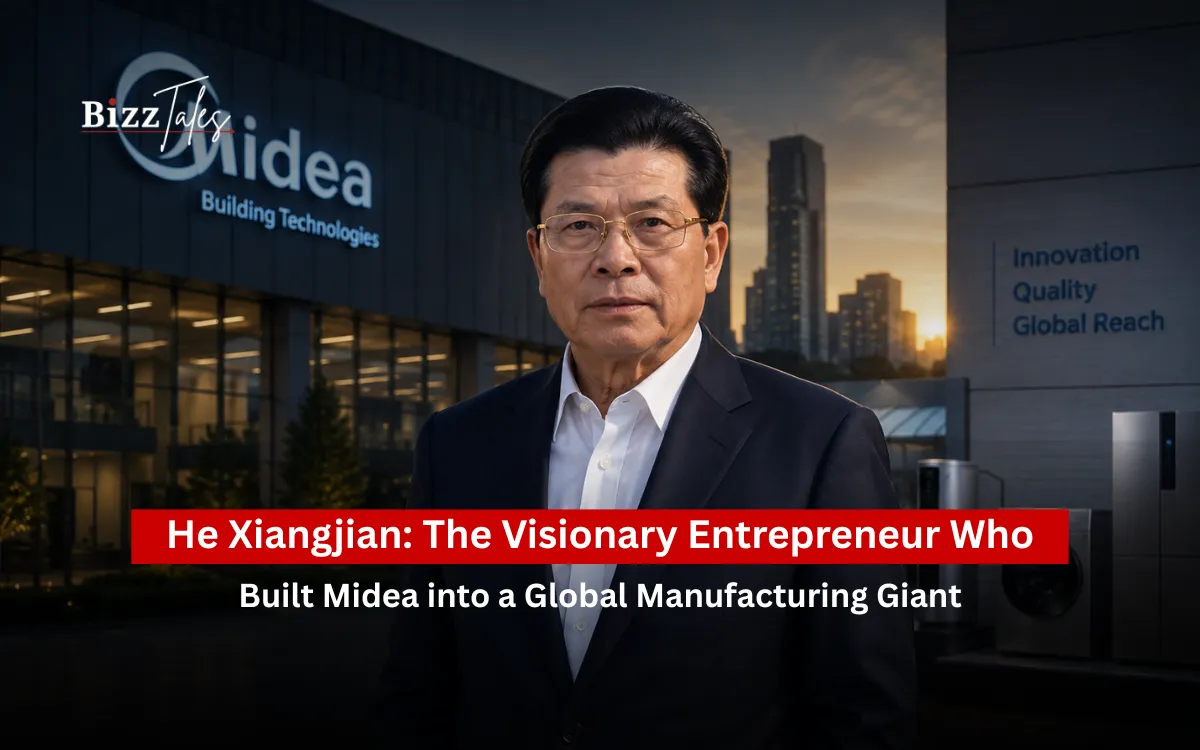
He Xiangjian is one of China’s most successful entrepreneurs and a remarkable example of how vision, persistence, and strategic leadership can transform a small local business into a global industrial powerhouse. Best known as the founder of Midea Group, He Xiangjian built one of the world’s largest home appliance manufacturers from humble beginnings in rural China.
Today, Midea products are found in homes, offices, factories, and commercial buildings across more than 200 countries and regions. The company manufactures air conditioners, refrigerators, washing machines, kitchen appliances, robotics, and smart home technologies, making it one of the most influential names in global manufacturing.
What makes He Xiangjian’s story particularly inspiring is that he started with very limited resources during a time when China’s economy was still developing. Through decades of hard work, innovation, and strategic decision-making, he transformed a small collective workshop into a multinational corporation worth billions of dollars.
His journey offers valuable lessons about entrepreneurship, leadership, resilience, and long-term thinking.
Forbes Rankings (2026, 2025, 2024)
| Year | Forbes Rank | Estimated Net Worth |
| 2026 | #72 | $30.8 Billion |
| 2025 | #78 | $28.5 Billion |
| 2024 | #85 | $25.5 Billion |
He Xiangjian consistently ranks among China’s richest entrepreneurs, with most of his wealth tied to his ownership stake in Midea Group and other strategic investments.
Early Life
He Xiangjian was born in October 1942 in Foshan, Guangdong Province, China.
His childhood took place during a period of significant economic and social challenges in China. Resources were limited, opportunities were scarce, and entrepreneurship was heavily restricted compared to modern standards.
Growing up in a modest household, he learned the importance of discipline, hard work, and perseverance at an early age. Like many people of his generation, he experienced firsthand the difficulties associated with economic uncertainty and limited industrial development.
These experiences shaped his determination to create opportunities not only for himself but also for his community.
Long before he became a billionaire, He Xiangjian was known for his practical mindset, strong work ethic, and ability to identify opportunities where others saw obstacles.
Education
Unlike many modern billionaires who hold advanced degrees from prestigious universities, He Xiangjian did not receive extensive formal higher education.
His knowledge came primarily from practical experience, observation, and self-learning.
Growing up during a period when educational opportunities were limited, he focused on gaining real-world skills and understanding how businesses operated.
Over the years, he developed expertise in manufacturing, management, finance, and industrial operations through hands-on involvement rather than academic training.
His success demonstrates that entrepreneurial achievement often depends more on determination, adaptability, and continuous learning than formal credentials alone.
Career Journey
He Xiangjian’s entrepreneurial journey began in 1968 when he gathered a group of local residents in Beijiao, a town in Guangdong Province.
Together, they started a small workshop that initially manufactured simple products such as bottle lids and basic industrial components.
At the time, few could have imagined that this modest operation would eventually become one of the world’s largest appliance manufacturers.
A turning point came in 1980 when the company entered the electric fan business. The success of its fan products provided the financial foundation for future expansion.
Recognizing growing consumer demand, He later expanded into air conditioners, which became one of Midea’s most successful product categories.
Throughout the 1980s and 1990s, Midea continuously broadened its product portfolio and improved manufacturing capabilities.
As China’s economy opened to global markets, he capitalized on new opportunities by investing in technology, production efficiency, and international expansion.
Under his leadership, Midea evolved from a local manufacturer into a globally recognized brand.
Business Ventures
Midea Group remains He Xiangjian’s most significant business achievement.
The company has grown into one of the largest home appliance manufacturers in the world and operates across multiple sectors including:
- Air Conditioners
- Refrigerators
- Washing Machines
- Kitchen Appliances
- Smart Home Solutions
- Industrial Automation
- Robotics
- Building Technologies
- Healthcare Equipment
Midea serves millions of customers globally and competes with some of the biggest names in consumer electronics and manufacturing.
One of the company’s most strategic moves was the acquisition of KUKA, a leading German robotics company. This acquisition significantly strengthened Midea’s position in industrial automation and advanced manufacturing technologies.
The company has also invested heavily in artificial intelligence, smart devices, and sustainable manufacturing practices.
These initiatives have helped Midea remain competitive in a rapidly evolving global market.
Major Successes
One of He Xiangjian’s greatest achievements is transforming a small local workshop into a Fortune Global 500 company.
Midea’s rise from a modest manufacturer to a multinational industrial giant is one of the most impressive business success stories in modern China.
Another major accomplishment has been the company’s successful international expansion.
Today, Midea operates manufacturing facilities, research centers, and sales networks across numerous countries, making it a truly global organization.
The acquisition of KUKA Robotics is widely regarded as one of the most significant strategic deals in the company’s history. It enabled Midea to strengthen its presence in automation and future-oriented technologies.
He Xiangjian’s ability to anticipate industry trends and invest in innovation has been a major factor behind the company’s long-term success.
Challenges & Struggles
Like many entrepreneurs, He Xiangjian faced numerous challenges throughout his journey.
Building a manufacturing company during China’s early stages of economic development required overcoming resource limitations, infrastructure challenges, and regulatory complexities.
Competition within the appliance industry intensified as both domestic and international brands sought market share.
Economic downturns, changing consumer preferences, and technological disruptions also created obstacles.
Managing rapid growth presented additional challenges. Expanding operations while maintaining quality, efficiency, and profitability required careful planning and disciplined execution.
The transition from traditional manufacturing to smart technologies and automation demanded significant investment and strategic adaptation.
Despite these challenges, He consistently demonstrated resilience and an ability to evolve alongside changing market conditions.
Leadership Style
He Xiangjian is widely known for his pragmatic and disciplined leadership style.
Unlike highly public business figures, he focused on operational excellence rather than personal publicity.
His leadership philosophy emphasizes:
- Long-Term Planning
- Continuous Innovation
- Customer Focus
- Operational Efficiency
- Talent Development
- Adaptability
He strongly believes in empowering professional managers and building sustainable organizational systems.
One of his most notable decisions was gradually transitioning management responsibilities to professional executives while maintaining strategic oversight.
This approach allowed Midea to scale effectively and remain competitive in global markets.
His leadership style is often cited as a model for successful corporate governance in large family-founded businesses.
Other Businesses & Investments
Beyond Midea Group, He Xiangjian has diversified his wealth through numerous investments.
His interests include:
- Financial Services
- Real Estate
- Industrial Manufacturing
- Technology Ventures
- Healthcare Investments
- Private Equity
Through investment firms and family holdings, he has participated in various opportunities across multiple sectors.
These investments provide additional sources of wealth while complementing his industrial expertise.
His diversified portfolio reflects a long-term strategy focused on stability, growth, and innovation.
Philanthropy
He Xiangjian has contributed significantly to charitable and social development initiatives.
Through foundations and philanthropic programs, he has supported:
- Education
- Healthcare
- Community Development
- Poverty Alleviation
- Disaster Relief
- Social Welfare Programs
Many of his charitable efforts focus on improving opportunities for future generations and supporting local communities.
His philanthropic philosophy reflects a belief that business success should contribute positively to society.
Over the years, his donations have benefited numerous educational institutions and social organizations.
Personal Life
Despite his billionaire status, He Xiangjian is known for maintaining a relatively private lifestyle.
He stepped back from active management of Midea in 2012 but remains an influential figure within the broader business community.
Family plays an important role in his life, and several family members have been involved in business leadership and investment activities.
Outside business, he is known for his interest in economic development, education, and philanthropy.
His modest and disciplined personality has earned widespread respect among entrepreneurs and corporate leaders.
Lessons for Entrepreneurs
He Xiangjian’s journey offers valuable lessons for entrepreneurs.
One lesson is the importance of starting small and thinking big. His business began as a modest workshop but grew through consistent improvement and strategic expansion.
Another lesson is adaptability. He continuously evolved Midea’s business model to match changing technologies and consumer demands.
Entrepreneurs can also learn the value of innovation. Investing in research, automation, and smart technologies helped Midea maintain its competitive edge.
His story demonstrates the importance of patience and long-term thinking. Sustainable success often requires decades of consistent effort.
Most importantly, He Xiangjian shows that extraordinary achievements can emerge from humble beginnings when combined with determination and vision.
Conclusion
He Xiangjian’s transformation of Midea from a small workshop into one of the world’s largest manufacturing companies is one of China’s most remarkable entrepreneurial success stories.
Through innovation, strategic thinking, and disciplined leadership, he built a global enterprise that impacts millions of consumers and businesses worldwide.
His legacy extends beyond financial success. As an entrepreneur, investor, and philanthropist, he has contributed significantly to industrial development, technological advancement, and social progress.
For aspiring entrepreneurs and business leaders, He Xiangjian’s story serves as a powerful reminder that persistence, adaptability, and long-term vision can create extraordinary results.
FAQs
1. Who is He Xiangjian?
He Xiangjian is a Chinese billionaire entrepreneur and founder of Midea Group, one of the world’s largest home appliance manufacturers.
2. What is He Xiangjian’s net worth in 2026?
His estimated net worth in 2026 is approximately $30.8 billion.
3. What company did He Xiangjian found?
He founded Midea Group, which manufactures home appliances, smart technologies, robotics, and industrial automation products.
4. What is He Xiangjian’s biggest business achievement?
His biggest achievement is transforming Midea from a small workshop into a global manufacturing powerhouse operating in more than 200 countries and regions.
5. What can entrepreneurs learn from He Xiangjian?
Entrepreneurs can learn the importance of innovation, adaptability, long-term thinking, operational excellence, and starting small while pursuing ambitious goals.