
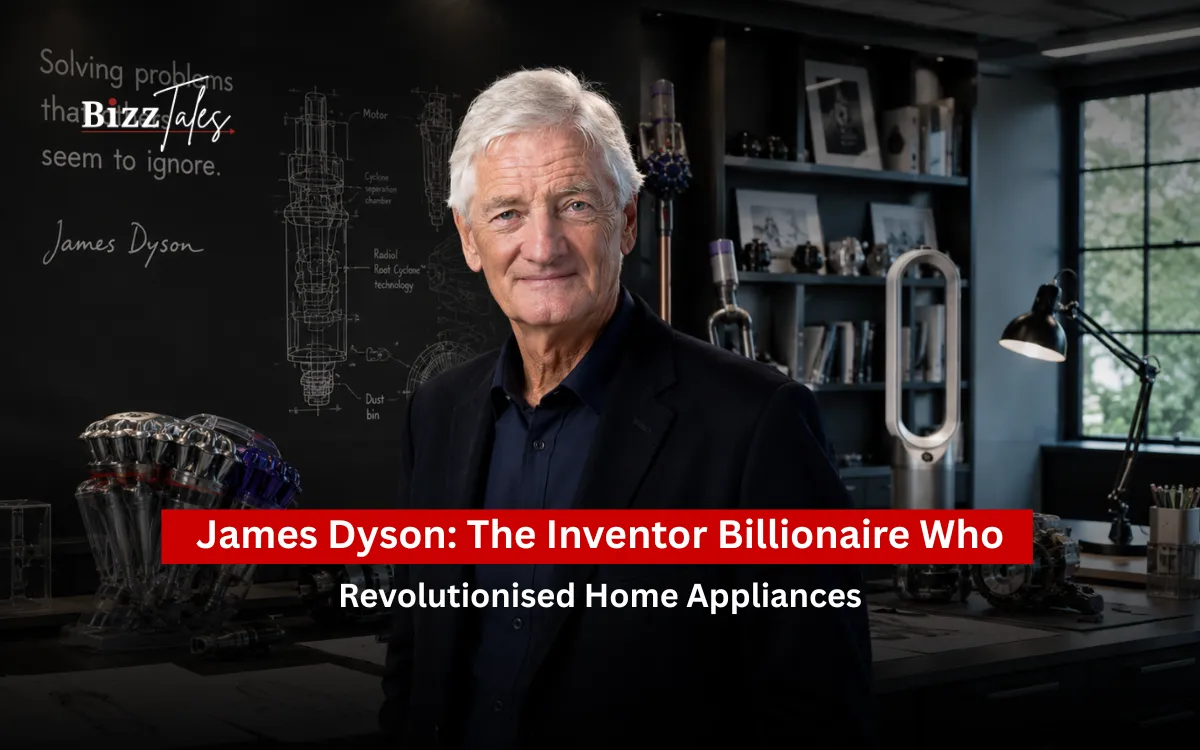
Few entrepreneurs have transformed an everyday household product into a global technology empire quite like James Dyson. Known worldwide as the founder of Dyson Ltd., James Dyson revolutionised the home appliance industry through innovation, persistence, and a relentless commitment to engineering excellence. What began as frustration with traditional vacuum cleaners evolved into one of the most successful consumer technology companies in the world.
Today, Dyson products are found in millions of homes across more than 80 countries. The company is recognized for its premium vacuum cleaners, air purifiers, hair care devices, hand dryers, lighting products, and advanced engineering innovations. Unlike many billionaires who built their fortunes through finance or software, James Dyson became wealthy by solving practical problems through design and engineering.
His story is particularly inspiring because success did not come quickly. Before creating his first successful vacuum cleaner, James Dyson endured years of financial difficulties, thousands of failed prototypes, and repeated rejection from major manufacturers. However, his determination eventually transformed him into one of Britain’s richest self-made entrepreneurs.
Beyond business success, Dyson has become a symbol of innovation, entrepreneurship, and engineering education. His influence extends far beyond household appliances, impacting technology, manufacturing, education, and scientific research.
Forbes Rankings and Net Worth
| Year | Forbes Ranking | Net Worth |
| 2026 | Among UK’s Richest Billionaires | Approximately $24.8 Billion |
| 2025 | Forbes Global Billionaire | Approximately $22.5 Billion |
| 2024 | Forbes Global Billionaire | Approximately $20.8 Billion |
James Dyson’s wealth comes primarily from his ownership of Dyson Ltd., one of the world’s most successful privately owned technology and engineering companies.
Early Life and Education
James Dyson was born on May 2, 1947, in Cromer, Norfolk, England. He grew up in a middle-class family where creativity and independent thinking were encouraged. His father worked as a schoolteacher and had a strong appreciation for art, education, and design.
During his childhood, Dyson developed an interest in making things and understanding how products worked. He often enjoyed building, experimenting, and solving practical problems. These early experiences helped shape the mindset that would later define his career.
Dyson attended Gresham’s School in Norfolk before enrolling at the Byam Shaw School of Art in London. Initially interested in fine arts, he later transferred to the Royal College of Art, where he studied furniture and interior design.
While at the Royal College of Art, Dyson became increasingly fascinated by engineering and industrial design. Rather than focusing solely on aesthetics, he wanted to create products that functioned better than existing alternatives.
This combination of design thinking and engineering problem-solving became the foundation of his future success.
Career Journey
James Dyson’s entrepreneurial journey began long before Dyson Ltd. became a global brand.
One of his earliest commercial successes was the Sea Truck, a high-speed marine vessel designed to transport cargo and passengers efficiently. The project demonstrated his ability to combine engineering innovation with practical functionality.
He later developed the Ballbarrow, a redesigned wheelbarrow that replaced traditional wheels with a ball mechanism for improved stability. Although the product achieved moderate success, it was only the beginning of his larger ambitions.
The turning point in Dyson’s career came during the late 1970s when he became frustrated with his household vacuum cleaner. Traditional vacuum cleaners relied on bags that gradually became clogged, reducing suction performance over time.
Believing there had to be a better solution, Dyson began experimenting with cyclone technology. Inspired by industrial cyclone separators used in factories, he sought to create a vacuum cleaner that could maintain consistent suction without requiring disposable bags.
The process was far from easy.
Over five years, Dyson reportedly built more than 5,000 prototypes before achieving a successful design. During this period, he faced financial hardship and struggled to convince manufacturers to license his invention.
Most companies rejected the idea because they profited from selling replacement vacuum bags.
Rather than giving up, Dyson decided to manufacture and market the product himself.
This decision changed everything.
Business Ventures
Dyson Ltd. remains James Dyson’s most important business venture and the primary source of his wealth.
The company’s first major success came with the launch of the Dual Cyclone vacuum cleaner. Its bagless technology attracted consumers seeking better performance and lower long-term costs.
As sales increased, Dyson reinvested heavily in research and development. This commitment to innovation became one of the company’s defining characteristics.
Over time, Dyson expanded into numerous product categories.
Vacuum cleaners remained an important business segment, but the company also developed bladeless fans, air purifiers, hand dryers, hair dryers, hair stylers, robotic cleaning devices, and advanced lighting systems.
One of the company’s most successful innovations was the Dyson Airblade hand dryer, which disrupted the commercial restroom industry through superior efficiency and hygiene.
Another major breakthrough came in the beauty technology sector. Products such as the Dyson Supersonic hair dryer and Dyson Airwrap became highly popular worldwide, generating billions in revenue.
The company also invested heavily in robotics, artificial intelligence, battery technology, and advanced manufacturing systems.
Although Dyson ultimately cancelled its electric vehicle project after investing substantial resources, the initiative demonstrated the company’s willingness to pursue ambitious technological challenges.
Today, Dyson operates globally and employs thousands of engineers, scientists, and designers.
Success Story and Major Achievements
James Dyson’s greatest achievement is creating a company that transformed multiple industries through innovation.
His invention of the bagless vacuum cleaner fundamentally changed consumer expectations and forced competitors to redesign their products.
Another major accomplishment is Dyson’s commitment to research and development. The company invests heavily in innovation, enabling it to remain ahead of competitors across multiple product categories.
Dyson’s products have won hundreds of design and engineering awards worldwide.
His success also helped elevate the importance of engineering and industrial design within British business culture. He became a leading advocate for innovation, manufacturing excellence, and STEM education.
Beyond business, Dyson established educational initiatives aimed at encouraging future generations of engineers and inventors.
His achievements demonstrate how persistence and innovation can create extraordinary long-term value.
Challenges, Failures, and Setbacks
James Dyson’s journey was filled with challenges.
The development of his bagless vacuum technology required years of experimentation and thousands of failed prototypes. Many entrepreneurs would have abandoned the project long before reaching success.
Another major obstacle involved securing manufacturing partnerships. Established companies repeatedly rejected his invention, forcing him to pursue alternative strategies.
Financial difficulties also created pressure. During the development process, Dyson and his family experienced significant economic uncertainty.
As Dyson Ltd. expanded internationally, the company faced increasing competition from large appliance manufacturers.
More recently, Dyson’s electric vehicle project represented a costly setback. Despite investing heavily in research and development, the company ultimately concluded that the project could not achieve commercial viability.
Although disappointing, the decision reflected Dyson’s willingness to prioritize long-term sustainability over emotional attachment to a project.
These experiences highlight the importance of resilience and adaptability in entrepreneurship.
Investments and Assets
Most of James Dyson’s wealth comes from his ownership stake in Dyson Ltd.
Because the company remains privately owned, Dyson retains significant control over its operations and strategic direction.
In addition to corporate holdings, he has invested in agricultural operations across the United Kingdom. Through Dyson Farming, he owns and manages thousands of acres of farmland focused on sustainable food production and renewable energy.
His agricultural ventures include crop cultivation, energy generation, and advanced farming technologies.
Dyson also owns substantial real estate assets, including residential properties and business facilities.
Another important area of investment involves education and engineering research. Through various initiatives, he supports innovation, scientific development, and talent cultivation.
His investment philosophy emphasizes long-term value creation and technological advancement.
Leadership Style and Business Philosophy
James Dyson is known for a leadership style centered on innovation, experimentation, and continuous improvement.
One of his core beliefs is that failure is an essential part of success. He frequently emphasizes that every unsuccessful prototype contributed valuable knowledge during the development process.
Another defining principle is challenging conventional wisdom. Rather than accepting existing solutions, Dyson encourages questioning assumptions and exploring alternative approaches.
He also believes strongly in research and development. The company consistently invests significant resources in innovation, even when immediate returns are uncertain.
Attention to detail is another hallmark of his philosophy. Dyson products are known for combining engineering precision with exceptional user experience.
His leadership demonstrates how curiosity, persistence, and a commitment to excellence can drive long-term success.
Personal Life
James Dyson is married to Lady Deirdre Dyson, a respected interior designer. Together, they have three children.
Despite his billionaire status, Dyson remains deeply involved in engineering, design, and educational initiatives. He frequently advocates for science, technology, engineering, and mathematics education.
Through the James Dyson Foundation, he supports schools, universities, research institutions, and aspiring inventors.
His philanthropic efforts focus primarily on innovation, engineering education, and scientific advancement.
Outside business, Dyson has a strong interest in architecture, farming, technology, and product design.
These interests reflect the same curiosity and creativity that have defined his professional career.
Legacy and Future Outlook
James Dyson’s legacy is firmly established within the worlds of engineering, design, and entrepreneurship.
His inventions transformed the vacuum cleaner industry and demonstrated how innovation can disrupt even mature product categories.
Beyond specific products, Dyson’s broader impact lies in promoting engineering as a creative and entrepreneurial discipline. He inspired countless inventors, designers, and entrepreneurs to pursue ambitious ideas.
The company continues investing in artificial intelligence, robotics, battery technology, automation, and advanced manufacturing systems.
As these technologies evolve, Dyson remains well-positioned to influence future consumer products and engineering innovations.
His educational initiatives will likely continue supporting future generations of scientists and engineers.
Few inventors have had such a lasting impact on both technology and design.
Conclusion
James Dyson’s journey from struggling inventor to billionaire entrepreneur is one of the most inspiring stories in modern business.
By refusing to accept the limitations of traditional vacuum cleaners, he created a technology company that revolutionized multiple industries. His willingness to endure years of failure and rejection ultimately produced one of the world’s most successful consumer brands.
Through Dyson Ltd., he demonstrated that engineering innovation can generate enormous commercial success while improving everyday life.
For entrepreneurs, inventors, and business leaders, Dyson’s story offers valuable lessons about persistence, creativity, problem-solving, and the importance of long-term thinking.
Today, James Dyson remains one of the most influential inventors and entrepreneurs of his generation, and his legacy will continue shaping technology and innovation for decades to come.
FAQs
1. What is James Dyson’s net worth in 2026?
James Dyson’s estimated net worth in 2026 is approximately $24.8 billion.
2. How did James Dyson become a billionaire?
He became a billionaire by inventing the bagless vacuum cleaner and building Dyson Ltd. into a global technology and appliance company.
3. What companies does James Dyson own?
James Dyson owns Dyson Ltd. and Dyson Farming, along with various investment and educational initiatives.
4. What is James Dyson’s leadership style?
His leadership style emphasizes innovation, experimentation, continuous improvement, engineering excellence, and learning from failure.
5. What is James Dyson’s biggest business achievement?
His biggest achievement is inventing bagless vacuum technology and building Dyson into one of the world’s most successful engineering and consumer technology companies.