
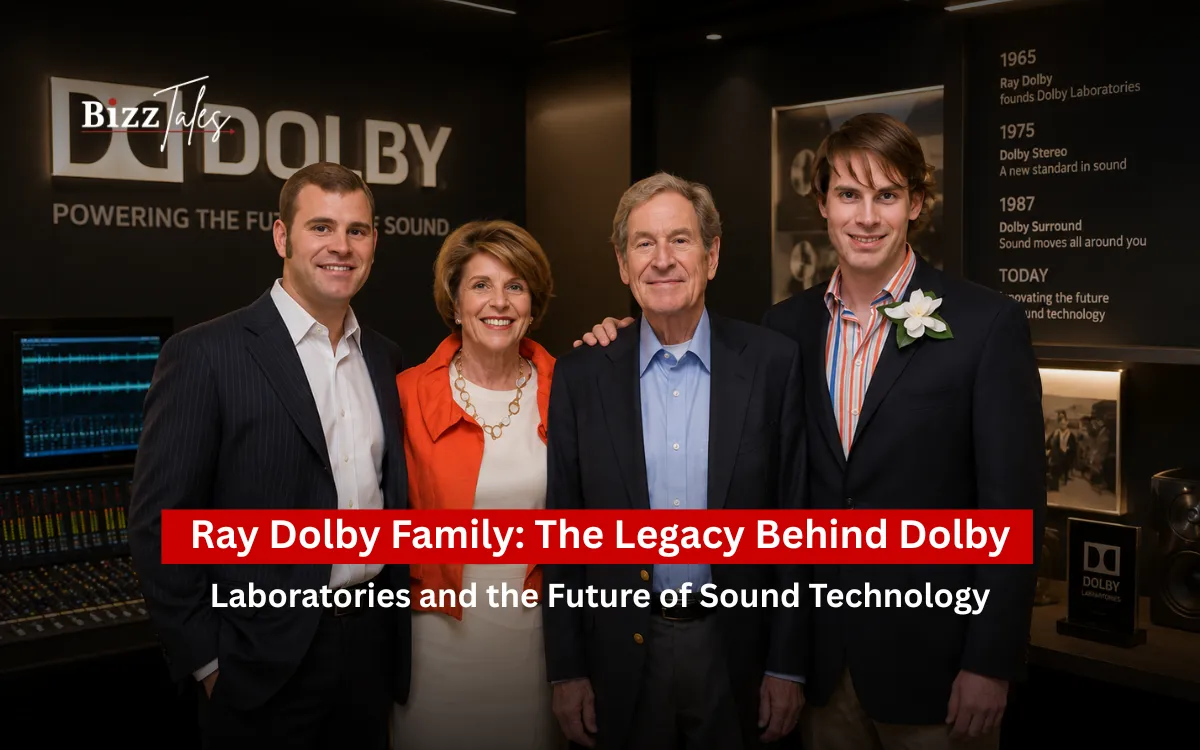
When people watch a movie in a cinema, stream content at home, listen to music through headphones, or experience immersive surround sound, there is a good chance they are benefiting from technology created by Ray Dolby. Few inventors have influenced entertainment and audio technology as profoundly as Ray Dolby, the founder of Dolby Laboratories. What began as an engineer’s vision to eliminate unwanted noise from recordings eventually transformed into one of the world’s most recognized technology brands.
Today, the Dolby family remains closely associated with the company and the technological innovations that continue to shape modern entertainment. Following Ray Dolby’s passing in 2013, his wife Dagmar Dolby and the family inherited substantial ownership in Dolby Laboratories and continued supporting the company’s mission while expanding their philanthropic activities. The family’s wealth, influence, and legacy extend far beyond business, touching education, scientific research, healthcare, and technological innovation.
The story of the Ray Dolby family is not simply a story about wealth. It is a story of invention, persistence, intellectual curiosity, and a commitment to improving how people experience sound and media. From pioneering noise reduction technology to supporting groundbreaking medical research, the Dolby family has left a lasting mark on multiple industries.
Forbes Rankings and Net Worth
| Year | Forbes Ranking | Net Worth |
| 2026 | Forbes Billionaire Family | Approximately $5.5 Billion |
| 2025 | Forbes Billionaire Family | Approximately $5.1 Billion |
| 2024 | Forbes Billionaire Family | Approximately $5.0 Billion |
The majority of the family’s wealth comes from its substantial ownership stake in Dolby Laboratories, a company that continues to generate revenue through licensing technologies used in cinemas, televisions, smartphones, streaming platforms, gaming systems, and consumer electronics.
Early Life and Family Background
The Dolby family’s remarkable story begins with Ray Milton Dolby, who was born on January 18, 1933, in Portland, Oregon. Even as a young student, Ray demonstrated extraordinary technical talent and curiosity. During his teenage years, he worked on early recording equipment and contributed to projects involving magnetic tape technology.
Unlike many future billionaires, Ray Dolby was first and foremost an engineer. His passion was not business but solving technical problems. He attended Stanford University, earning a degree in electrical engineering before completing a Ph.D. in physics at the University of Cambridge in England. These academic experiences provided the scientific foundation that would later enable him to revolutionise the audio industry.
During his years in England, Ray met Dagmar Bäumert, a German student who would later become his wife and one of the most important figures in the family’s legacy. Their relationship developed while Ray was pursuing advanced research and exploring opportunities in engineering and technology. The couple married in 1966 and eventually had two sons, Tom Dolby and David Dolby.
The family’s early years were characterized by international experiences, including time spent in India while Ray worked as a technical advisor to the United Nations. These experiences broadened their perspectives and reinforced their commitment to innovation and global impact.
Career Journey
Ray Dolby’s career began long before Dolby Laboratories was established. During the 1950s, he worked with Ampex, contributing to the development of some of the world’s earliest video tape recording technologies. This experience exposed him to the limitations of existing recording systems and inspired his future innovations.
After completing his doctoral studies and working internationally, Ray returned to England and founded Dolby Laboratories in London in 1965. Initially, the company was a small operation with only a handful of employees. However, Ray had already identified a significant problem within audio recording: unwanted background noise.
At the time, analog recordings suffered from hiss and other forms of distortion that reduced sound quality. Ray developed a noise reduction system capable of dramatically improving audio clarity without sacrificing performance. This breakthrough technology quickly gained acceptance within the music recording industry.
The success of Dolby noise reduction systems created opportunities for expansion into additional markets. The company soon entered film production, home entertainment, broadcasting, and consumer electronics. Over the following decades, Dolby Laboratories became synonymous with premium audio experiences worldwide.
Business Ventures
Dolby Laboratories remains the cornerstone of the Dolby family’s wealth and influence.
The company initially achieved success through professional recording technologies but later expanded into cinema sound systems. Dolby Stereo, Dolby Digital, Dolby Atmos, and other technologies became industry standards across entertainment platforms.
One of the most transformative developments was Dolby’s work in cinema audio. The company’s innovations allowed filmmakers to create immersive sound experiences that significantly enhanced storytelling and audience engagement. Movies equipped with Dolby technology became increasingly common in theaters worldwide.
As home entertainment evolved, Dolby expanded into televisions, DVD players, gaming consoles, smartphones, streaming services, and wireless audio products. The company’s licensing model proved highly profitable because manufacturers paid royalties to incorporate Dolby technologies into their devices.
The family’s business interests also extend into venture capital and technology investing. David Dolby, one of Ray and Dagmar Dolby’s sons, became actively involved in technology investment activities through Dolby Family Ventures, supporting innovative startups and emerging technologies.
These investments help ensure that the family’s influence extends beyond traditional audio technologies into future innovation sectors.
Success Story and Major Achievements
The Dolby family’s greatest achievement is undoubtedly the creation and global expansion of Dolby Laboratories.
Ray Dolby’s inventions fundamentally changed how sound is recorded, distributed, and experienced. His technologies became essential components of music production, film production, television broadcasting, and digital entertainment.
The company’s technologies have been used in thousands of films and countless consumer devices. Dolby’s contributions helped establish entirely new standards for audio quality and immersive entertainment experiences.
Ray Dolby received numerous prestigious honors during his lifetime, including Academy Awards, Emmy Awards, Grammy recognition, and the National Medal of Technology. These awards reflected the enormous impact of his work on both technology and entertainment.
Following his death in 2013, the family continued preserving and expanding his legacy. Dagmar Dolby became one of the largest shareholders in Dolby Laboratories and remained actively involved in philanthropic and educational initiatives.
Challenges, Failures, and Setbacks
Like many successful innovators, Ray Dolby faced significant challenges throughout his career.
One of the earliest obstacles involved convincing the recording industry to adopt new technologies. Engineers, producers, and equipment manufacturers were often hesitant to embrace unfamiliar systems.
Competition within the electronics industry also presented difficulties. As technology advanced, Dolby Laboratories needed to continually innovate to remain relevant and protect its intellectual property.
The transition from analog to digital media created additional challenges. Many companies struggled to adapt during this period, but Dolby successfully evolved its technology portfolio to meet changing consumer preferences.
The family’s most personal challenge came with Ray Dolby’s health issues. He was diagnosed with Alzheimer’s disease before his death in 2013 and later passed away from leukemia. These experiences inspired the family’s significant support for medical research and healthcare initiatives.
Despite these setbacks, the family continued building upon Ray’s vision and preserving the company’s leadership position.
Investments and Assets
The Dolby family’s largest asset remains its ownership stake in Dolby Laboratories.
Dagmar Dolby inherited a substantial shareholding following Ray Dolby’s passing and continues to be associated with the company’s success. Forbes has identified her as one of America’s wealthiest women due to this ownership position.
Beyond Dolby Laboratories, the family maintains investments through venture capital activities, private technology investments, and philanthropic organizations.
David Dolby has become particularly active in supporting technology startups through Dolby Family Ventures, focusing on innovation and emerging technologies.
The family also controls significant charitable assets through foundations and philanthropic organizations that support education, healthcare, scientific research, and cultural initiatives.
Leadership Style and Business Philosophy
The Dolby family’s leadership philosophy reflects Ray Dolby’s engineering mindset.
Innovation has always been at the center of their approach. Rather than pursuing rapid expansion for its own sake, the family focused on solving meaningful problems through technology.
Ray believed that engineering excellence and scientific rigor should guide decision-making. This philosophy helped Dolby Laboratories maintain a reputation for quality and reliability over multiple decades.
The family also emphasizes long-term thinking. Rather than prioritizing short-term profits, they consistently invested in research, development, and intellectual property.
Another defining principle is social responsibility. Through extensive philanthropic activities, the family demonstrates a belief that wealth should contribute to broader societal progress.
Personal Life
The Dolby family has maintained a relatively private public profile despite its considerable wealth.
Dagmar Dolby became widely respected not only as the wife of a famous inventor but also as a philanthropist and advocate for scientific research. Her charitable efforts focus on stem cell research, Alzheimer’s research, mental health, education, and healthcare innovation.
The family’s two sons, Tom Dolby and David Dolby, have pursued their own professional interests while remaining connected to the family’s legacy. David has become involved in technology investing and philanthropy, while Tom has worked in media and creative industries.
Together, the family remains committed to preserving Ray Dolby’s contributions while supporting future generations of innovators and researchers.
Legacy and Future Outlook
The Dolby family’s legacy is deeply embedded within modern entertainment and technology.
Ray Dolby’s inventions changed how people experience music, movies, television, and digital media. His innovations remain relevant decades after their introduction and continue influencing new technologies.
The family has also established a strong philanthropic legacy through substantial donations to universities, research institutions, and healthcare organizations. Notable contributions have supported Cambridge University, stem cell research, Alzheimer’s research, and scientific advancement.
As immersive entertainment, artificial intelligence, spatial audio, and advanced media technologies continue evolving, Dolby Laboratories remains positioned to play a significant role in shaping future experiences.
The family’s continued involvement in technology investing and philanthropy suggests that the Dolby legacy will remain influential for generations.
Conclusion
The Ray Dolby family represents one of the most remarkable success stories in technology history.
Through the vision and inventions of Ray Dolby, a small engineering company evolved into a global technology powerhouse whose innovations transformed entertainment worldwide. Today, Dagmar Dolby and the family’s next generation continue building upon that legacy through business leadership, investment activities, and philanthropy.
Their story demonstrates the power of innovation, education, persistence, and long-term thinking. Rather than simply creating wealth, the Dolby family created technologies that improved experiences for billions of people around the world.
Their influence on audio technology, scientific research, education, and philanthropy ensures that the Dolby name will remain significant for many years to come.
FAQs
1. What is the Ray Dolby family’s net worth in 2026?
The Ray Dolby family’s estimated net worth in 2026 is approximately $5.5 billion, primarily from their ownership stake in Dolby Laboratories.
2. How did the Ray Dolby family become wealthy?
The family became wealthy through Ray Dolby’s invention of audio noise reduction technologies and the growth of Dolby Laboratories into a global entertainment technology company.
3. Who owns Dolby Laboratories today?
The company is publicly traded, but the Dolby family remains one of the largest shareholders through holdings associated with Dagmar Dolby and family interests.
4. Who are Ray Dolby’s children?
Ray and Dagmar Dolby had two sons, Tom Dolby and David Dolby. David Dolby is active in technology investing and philanthropy.
5. What is the Dolby family’s biggest achievement?
Their biggest achievement is creating Dolby Laboratories and developing audio technologies that revolutionized music recording, cinema sound, broadcasting, and home entertainment worldwide.