
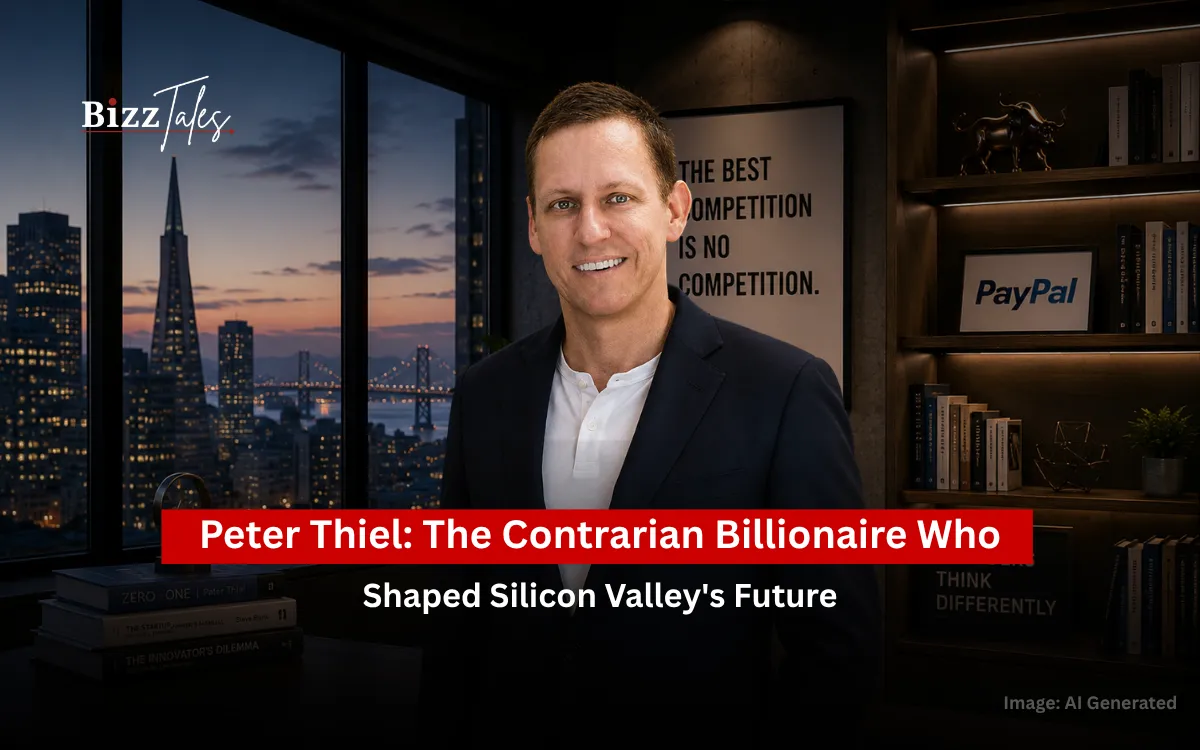
Few entrepreneurs and investors have had as much influence on modern technology as Peter Thiel. Known as a visionary thinker, venture capitalist, and serial entrepreneur, Thiel played a critical role in the creation of several of the most important technology companies of the 21st century. From co-founding PayPal to becoming Facebook’s first outside investor and backing companies such as Palantir Technologies and SpaceX, Thiel’s impact on Silicon Valley is extraordinary.
Unlike many investors who follow trends, Thiel built his reputation by identifying opportunities long before they became obvious. His willingness to challenge conventional wisdom and invest in transformative technologies earned him a reputation as one of the most successful venture capitalists in history. Over the years, he became a central figure in the startup ecosystem, helping shape industries ranging from digital payments and social media to artificial intelligence, defense technology, and space exploration.
Today, Peter Thiel is recognized as one of the world’s most influential billionaires. His journey from a young philosophy student to a global technology investor offers valuable lessons in innovation, risk-taking, and long-term thinking. This article explores his net worth, early life, career journey, business ventures, investments, leadership philosophy, personal life, and enduring legacy.
FORBES RANKINGS AND NET WORTH
| Year | Forbes Ranking | Net Worth |
| 2026 | #128 | $20.4 Billion |
| 2025 | #135 | $18.9 Billion |
| 2024 | #148 | $15.2 Billion |
EARLY LIFE AND EDUCATION
Peter Andreas Thiel was born on October 11, 1967, in Frankfurt, West Germany. His family later emigrated to the United States, where he spent much of his childhood moving between different cities due to his father’s work as a chemical engineer.
Growing up, Thiel demonstrated exceptional intellectual curiosity. He excelled academically and developed strong interests in mathematics, philosophy, history, and science fiction. His fascination with big ideas and unconventional thinking would later influence his approach to entrepreneurship and investing.
During his school years, he was known for his analytical abilities and competitive mindset. He became a skilled chess player and frequently participated in academic competitions, further sharpening his problem-solving skills.
Thiel attended Stanford University, where he earned a Bachelor of Arts degree in Philosophy. He later completed a Juris Doctor degree at Stanford Law School. Although he studied law, his interests increasingly shifted toward entrepreneurship, technology, and investing.
His education provided a foundation in critical thinking and intellectual independence. These qualities would later become central to both his business philosophy and investment strategy.
CAREER JOURNEY
After graduating from law school, Peter Thiel briefly worked as a judicial clerk and later joined a law firm. However, he quickly realized that traditional legal practice was not aligned with his ambitions.
He subsequently entered the financial sector and worked as a derivatives trader at Credit Suisse. While the role provided valuable exposure to markets and finance, Thiel remained focused on entrepreneurship.
In 1996, he founded Thiel Capital Management, an investment firm that allowed him to begin building his own portfolio. The experience helped him develop a deeper understanding of venture investing and startup growth.
The defining moment of his career came in 1998 when he co-founded PayPal alongside Max Levchin and other entrepreneurs. The company aimed to simplify online payments at a time when e-commerce was still in its early stages.
PayPal grew rapidly and became one of the most successful internet companies of its era. In 2002, the company was acquired by eBay for approximately $1.5 billion. The sale generated significant wealth for Thiel and many of his colleagues, who later became known as the “PayPal Mafia.”
Following PayPal’s success, Thiel shifted his focus toward venture capital and startup investments. He became Facebook’s first outside investor in 2004, purchasing a stake for $500,000. That investment ultimately generated billions of dollars in returns and became one of the most successful venture investments ever made.
His career continued to evolve through investments, company creation, and support for emerging technologies, establishing him as one of Silicon Valley’s most influential figures.
BUSINESS VENTURES
PayPal remains one of Peter Thiel’s most important business achievements. The company revolutionized digital payments and laid the foundation for the modern fintech industry. Its success also created a network of entrepreneurs who would go on to build many of today’s leading technology companies.
Another major venture is Palantir Technologies, which Thiel co-founded in 2003. The company specializes in data analytics, artificial intelligence, and software solutions used by governments, defense agencies, and corporations worldwide. Palantir became one of the most valuable technology firms in its sector.
Thiel also co-founded Founders Fund, a venture capital firm focused on investing in transformative technologies. Through Founders Fund, he backed companies involved in aerospace, biotechnology, artificial intelligence, robotics, and advanced manufacturing.
His investment portfolio includes early stakes in several groundbreaking companies. Among the most notable are Facebook, SpaceX, Airbnb, Stripe, and numerous biotechnology startups.
In addition, Thiel launched the Thiel Fellowship, a program that encourages talented young people to pursue entrepreneurship instead of traditional higher education. The initiative reflects his belief that innovation often emerges outside conventional institutions.
Through these ventures, Thiel helped shape some of the most important technological developments of the modern era.
SUCCESS STORY AND MAJOR ACHIEVEMENTS
Peter Thiel’s success story is one of extraordinary foresight and calculated risk-taking. His ability to identify transformative technologies before they became mainstream has generated enormous financial returns and lasting influence.
One of his greatest achievements was co-founding PayPal. The company’s success transformed online commerce and created a generation of influential entrepreneurs.
Another landmark achievement was his early investment in Facebook. The investment generated thousands of times its original value and became one of the most successful venture capital deals in history.
Palantir’s growth represents another significant accomplishment. The company established itself as a leader in data analytics and government technology, demonstrating Thiel’s ability to identify emerging market opportunities.
Through Founders Fund, he has supported some of the world’s most innovative startups, contributing to advances in space exploration, healthcare, financial technology, and artificial intelligence.
His influence extends beyond business success. As an author and public intellectual, Thiel has challenged conventional thinking about innovation, competition, and entrepreneurship.
CHALLENGES, FAILURES, AND SETBACKS
Like many entrepreneurs, Peter Thiel’s career has included challenges and controversies. Not every investment achieved the extraordinary success of Facebook or PayPal.
The technology industry itself is highly competitive and unpredictable. Many startups backed by venture capital firms fail to achieve commercial success despite significant investment.
Palantir faced years of skepticism before becoming profitable and widely accepted by public markets. Building the company required patience and long-term commitment.
Thiel has also attracted criticism for some of his political views and public statements. As a prominent public figure, his opinions frequently generate debate within business and academic communities.
Certain investment theses promoted by Thiel have faced mixed outcomes, demonstrating that even successful investors cannot accurately predict every market trend.
Despite these challenges, he consistently maintained a willingness to take risks and pursue unconventional opportunities. This resilience became one of the defining characteristics of his career.
INVESTMENTS AND ASSETS
Peter Thiel’s fortune is built largely through equity ownership and venture investments. Unlike many billionaires whose wealth comes primarily from operating companies, a significant portion of his assets consists of investment holdings.
His early Facebook stake remains one of the most profitable investments in venture capital history. Although he gradually sold portions of his holdings, the investment generated billions of dollars in gains.
Palantir represents another major component of his wealth. As a co-founder and significant shareholder, he benefited substantially from the company’s growth and public listing.
Through Founders Fund, Thiel has invested in companies across numerous industries, including aerospace, biotechnology, fintech, artificial intelligence, and defense technology.
He also maintains investments in cryptocurrencies, private companies, real estate, and alternative assets. His diversified portfolio reflects a strong focus on innovation-driven sectors.
Thiel’s investment strategy emphasizes identifying technologies capable of creating entirely new markets rather than merely improving existing ones.
LEADERSHIP STYLE AND BUSINESS PHILOSOPHY
Peter Thiel is known for a leadership style centered on independent thinking and contrarian analysis. He often encourages entrepreneurs to question assumptions and pursue opportunities overlooked by others.
One of his most famous concepts is the idea of creating monopolies through innovation. Rather than competing in crowded markets, he believes companies should focus on building unique products that dominate specific niches.
Thiel also emphasizes long-term thinking. Many of his investments involve technologies that may require years or even decades to reach their full potential.
Another defining characteristic is intellectual rigor. He values deep analysis, strategic planning, and careful evaluation of opportunities before making investment decisions.
His philosophy encourages entrepreneurs to seek breakthrough innovations rather than incremental improvements, reflecting a belief that significant progress comes from bold ideas.
PERSONAL LIFE
Peter Thiel maintains a relatively private personal life despite his prominence in the technology industry. He spends much of his time focused on investing, research, philanthropy, and intellectual pursuits.
He is known for his interest in philosophy, economics, politics, and scientific advancement. These interests often influence both his investments and public commentary.
Thiel has supported numerous educational and research initiatives through philanthropic efforts. His contributions focus on innovation, scientific discovery, and entrepreneurship.
The Thiel Foundation funds projects related to technological progress, longevity research, artificial intelligence, and education reform.
Despite his wealth, he is often described as intellectually driven and focused on ideas rather than lifestyle or celebrity culture.
His public image combines entrepreneurship, investing, and thought leadership, making him one of the most distinctive figures in modern technology.
SOCIAL MEDIA PRESENCE
LEGACY AND FUTURE OUTLOOK
Peter Thiel’s legacy is already firmly established within the technology industry. Through PayPal, Palantir, Facebook, and Founders Fund, he has influenced multiple generations of entrepreneurs and investors.
His emphasis on breakthrough innovation continues to shape venture capital and startup culture. Many founders view his ideas as essential frameworks for building transformative companies.
Future developments in artificial intelligence, biotechnology, space exploration, and defense technology are likely to further strengthen the impact of investments he helped initiate.
His educational initiatives and philanthropic projects also contribute to a broader legacy focused on encouraging innovation and independent thinking.
As technology continues to evolve, Thiel’s influence is expected to remain significant across both business and intellectual communities.
CONCLUSION
Peter Thiel’s journey from a philosophy student at Stanford to one of the world’s most influential technology investors is a remarkable example of vision, courage, and unconventional thinking. Through PayPal, Palantir, Founders Fund, and a series of historic investments, he helped shape the modern technology landscape.
His success stems from an ability to identify transformative opportunities before they become obvious to others. Whether through entrepreneurship, venture capital, or thought leadership, Thiel consistently challenged conventional assumptions and pursued ambitious goals.
Despite facing controversies and setbacks, he remained committed to innovation and long-term value creation. These qualities enabled him to build a fortune worth billions while leaving a lasting impact on technology and business.
Today, Peter Thiel stands among the most influential investors and entrepreneurs of the modern era, with a legacy that continues to shape the future of innovation.
FAQS
1. What is Peter Thiel’s net worth in 2026?
Peter Thiel’s estimated net worth in 2026 is approximately $20.4 billion.
2. How did Peter Thiel become a billionaire?
He became a billionaire through the success of PayPal, early investments in Facebook, the growth of Palantir Technologies, and venture capital investments through Founders Fund.
3. What companies does Peter Thiel own?
He is associated with Founders Fund, Palantir Technologies, Thiel Capital, and numerous investments in technology, biotechnology, and aerospace companies.
4. What is Peter Thiel’s leadership style?
His leadership style emphasizes contrarian thinking, long-term vision, innovation, intellectual rigor, and creating unique market opportunities.
5. What is Peter Thiel’s biggest business achievement?
His biggest achievements include co-founding PayPal, co-founding Palantir Technologies, and making one of the most successful early investments in Facebook’s history.