
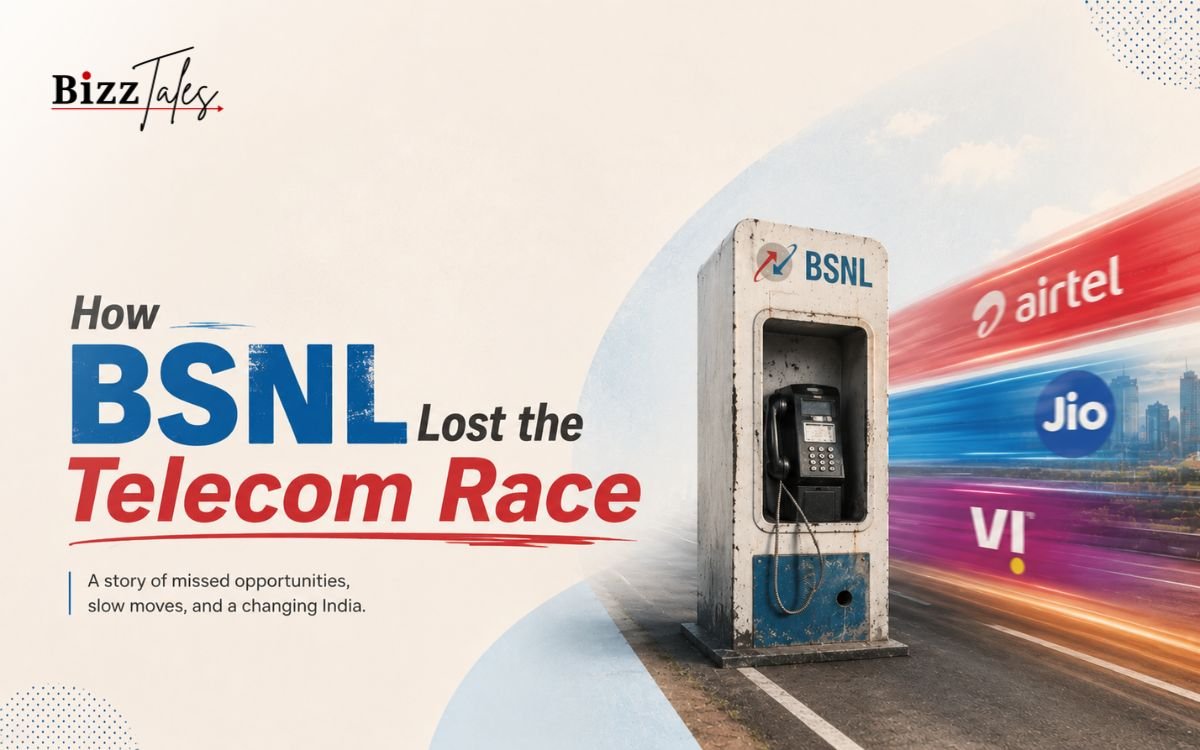
Back in the day, BSNL meant telecom for millions of Indians. Years before the days of Smartphones, 4G networks and unlimited data plans, Bharat Sanchar Nigam Limited (BSNL) used to serve homes, offices, government departments and villages all across the country. Having a BSNL landline number was almost a status-symbol and getting a new telephone connection used to take anything between a couple of weeks to a couple of months in some cases.
BSNL used to be among the world’s top telecom operators by subscriber base, and India’s largest by land covered. It had an extensive infrastructure to boast of, a respected name and unlimited reach into rural India. It was a government owned enterprise with resources many private players could only envy.
But despite having all these advantages, BSNL slowly lost its lead. Private players took to innovation, expansion on a scale that had not been seen before, and adapting to changing consumer preferences, while BSNL suffered from a large bureaucratic administration, slowness in decision-making, lagging technology, and even more stiff competitions.
Even now, BSNL is operating and catering to millions of customers, but the images of the erstwhile giant are gone and no longer towers over telecom in India. Its success story from being a market leader to a struggling challenger is among the most talked about stories in the history of Indian business.
And the story of BSNL is more than ‘sheer loss of market share ‘. It is a stark reminder that even the mightiest institutions can be brought down to their knees if they do not keep pace with the new wave of technology advancement.
The Birth of BSNL
BSNL was incorporated formally in October 2000, when the Indian government separated telecom service providers from the Department of Telecommunications. It was to be a stand alone telecom company to operate in an increasingly liberalized market.
During the time India was going through a significant phase of economic boom and had huge requirement of communication infrastructure. Mobile cost was still high, internet penetration was very low and land line connectivity was very high.
BSNL inherited a huge network of exchanges, towers, fiber infrastructure, and much of the customer base. While private companies had to develop their networks from zero, BSNL had the backbone in place.
This provided the company with a significant early advantage in the developing telecom market.
Perhaps the biggest advantage for BSNL is that it has established its brand in urban as well as rural areas. And this became one of the most trusted telecom brands in India within a very short span of time of its inception.
The Rise of BSNL
BSNL experienced phenomenal growth in the initial years of its inception.
Within a very short time, the company was established as the biggest telecom service provider of India. It provided millions of customers with fixed-line telephone, broadband and mobile connections.
Part of BSNL’s enormous strength was its huge infrastructure. It covered outlying villages and unprofitable areas which private operators did not want to venture into.
Its government ownership added strength to consumer confidence & faith. Customers believed that BSNL was a reliable service provider, owned by the Indian Govt.
In response, under the condition that the dominant’s entry would, in fact, be successful, the dominant began to utilize a staed price in an effort to discourage entry. Mobile services then quickly proliferated throughout India, with BSNL bringing in numbers with attractive prices and a wide network.
In fact by the mid-2000s BSNL had been a major telecom operator in the country with tens of millions of subscribers.
Employers also felt the company had the capacity to stay at the top for a long period of time.
BSNL’s Golden Era
Some people define the golden period of BSNL from 2003 to 2008.
Operating this period, the company enjoyed significant revenues and market share. It had great spectrum holdings, national coverage and one of the largest customer bases in the country.
Internet penetration In view of the fast penetration of internet in the country, BSNL’s broadband services also became popular. Through its substantial investments in its infrastructure, BSNL has provided access to internet to millions of subscribers
other than the limited service providers available at that time.
The company benefited from a unique combination of advantages:
| Strength | Impact |
|---|---|
| Government backing | High public trust |
| Nationwide infrastructure | Extensive network coverage |
| Rural reach | Limited competition |
| Large customer base | Strong recurring revenue |
| Established brand | High recognition and loyalty |
At this point B SNL almost seemed unstoppable.
But the telecom business was undergoing a lot of changes with new entrants getting ready to take the industry by storm.
The Arrival of Aggressive Private Competition
While BSNL stood on its current strengths, private telecom companies were instituting their own strategy of aggressive growth.
Airtel, Vodafone, Idea, Reliance Jio and others-these big players relied on customer care, better marketing, modernization of network, quick decisions etc. To capture the market.
On the other hand the private operators being less bureaucratic moved faster in terms of customer response, introducing newplans for customers, deploying new technology’s faster than BSNL.
Consumers were becoming more interested in speed, convenience, mobile internet, and high tech solutions.
Private companies saw the trend and responded to it.
Although…BSNL played an ineffective catch up.
It was beginning to dawn on me that there was a difference between how things were done in the public-sector and how things get done in the private-sector.
The 3G Opportunity That Was Not Fully Utilized
A key event in the history of BSNL occurred when the 3G technology was introduced.
In fact, BSNL was the first operator in India to roll out 3G services. So therefore, they could leverage upon this first-mover advantage.
However, having the technology is one thing, but turning it into a commercial product can be another…
Private competitors deployed aggressive marketing campaigns to attract customers and rapidly expanded their networks. They strongly promoted the value of data services and mobile internet.
Unable to ma ke maximum use of initial status B SNL.
As competitors converted technological leadership into market leadership, BSNL strength waned on operational inefficiencies and slowness of execution.
What was an ideal opportunity missed opportunities to enhance leaders and strengthen market position.
The Smartphone Revolution
Created the Global Smartphone Revolution is forever changed the telecom industry.
Market examples Consumers now prefer internet applications, video entertainment, social networks, digitalized payment systems, and others that use cloud-based computer applications instead of just calling and texting tools.
Telecos that went all-in on mobile data networks gained tremendously from this.
The BSNL was just lagging behind.
Prolonged decision making used to delay upgrades and modernizations of the networks. Procurement may have taken decades instead of months.
In the meantime, competitors kept developing and upgrading their facilities.
With the rapid penetration of smartphones throughout India, private operators were seen by consumers to provide better network quality and higher data speeds.
This view substantially affected the increase in subscribers.
The Biggest Mistake: Delayed 4G Rollout
Then, probably the most apt example of this ‘symbol’ of BSNL’s fall would be the delay in the implementation of 4G services.
As competitors hastily rushed in launching 4G networks and steeled themselves for the future, BSNL sat on the sidelines for ages without a nationwide 4G.
Not all above can be wrong, is disastrous.
The mobile internet emerged as the key catalyst for telecom sector growth. Customers started primarily choosing operators by data rates and digital services rather than voice..
Was used by private operators for marketing 4G in order to target huge number of customers and develop brand loyalty.
BSNL’s failure to provide services of the same quality at right time resulted into a significant loss of subscribers.
A lot of customers who had stayed loyal to BSNL switched to competitors who provided faster and better connectivity.
Before BSNL ramped up 4G, competition had already taken control.
Reliance Jio Changed Everything
2016 was revolutionized the Indian telecom Industry.
Jio launched disruptive pricing plans, affordable data packs, and best-in-class 4G network. All of a sudden consumers had access to fast internet at a significant lowering of the cost of connectivity.
The effects on industry were huge.
Competition was fierce; margins were shrinking; customers were changing rapidly.
While established private operators through consolidation and network investments, BSNL was unable to.
Jio’s make the sector more competitive when BSNL was already struggling with operational and technological issues.
They further gained market share as customers moved to operators delivering a more up-to-date digital experience.
Internal Challenges That Hurt BSNL
The fall of BSNL cannot be attributed to external competitors.
The company was also encountering multiple internal problems, such as:
Another difficulty was bureaucratic decision-making. In many big government organizations, all efforts need to be approved by some committees to launch any critical projects.
In other words, I think the “rigidity” of the above diagram may hinder the dynamics in the industry like telecommunications.
BSNL was also faced with man-related issues, old infrastructure, and growing financial strains.
The more the competitors became geared up for modern business practices and brought down the operational cost structure, the more BSNL got hamstrung by its own organization.
They caused difficulty while attempting to seize opportunities and threats.
What BSNL Should Have Done Differently
If had known then what we knew now, many of the choices could have been, under different circumstances,in favor of BSNL.
The company should have has the desire to implement technology adoption more aggressively. They should have used the first mover advantage of 3G more aggressively by the aggressive execution and customer driven innovation.
The network modernization should have happened more quickly, especially in the switch to 4G.
But again the PTCL could have played on its huge rural network to there the creation of dedicated digital ecosstems for the underserved regions.
Technology companies established partnerships, branding initiatives were strengthened and level of operational independence increased.
Most pertinently, it is also possible that quicker decision making might have given BSNL a fighting chance to get a foothold in the changing telecom environment.
What If BSNL Had Never Fallen?
One interesting question is how India’s telecom industry would have evolved were BSNL to continue its pre-eminence.
With its network infrastructure and the positive brand image coupled with the entire pan India coverage, BSNL could have been one of the largest Telecom Operator in the world.
In fact, a powerful and technologically sophisticated BSNL might have raced the wheels of our digital revolution.
There was opportunity to accelerate in the following categories: Fiber Broadband, 5G, Rural, Enterprise, and Digital Infrastructure.
And it’s huge network assets would have put it in a good position to be a significant player and early adopters in new technologies such as cloud, internet of things, smart cities and any other technical innovation.
Rather than suffering an erosion of market share, the state owned enterprise could have been fighting for industry leadership.
The opportunity missed is arguably the biggest “what if” in Indian business history.
BSNL’s Position Today
Despite having faced many challenges over the years BSNL continues to be a vital component of India’s telecom ecosystem.
The firm still provides service to millions of customers and is an important contributor to rural connectivity. Support by the government and further modernization enable the airline to continue.
Flagship network upgrade, indigenous technology deployment and countrywide 4G rollout come across as indicative signals that BSNL is making its efforts to revival.
The company retains important infrastructure assets, brand identity and market presence.
Despite the preference for private operators, BSNL continues to be a popular choice among consumers and still offers a competitive range of services. Though achieving past supremacy is a challenge, BSNL still and will keep playing a significant role in the telecommunications industry of India.
For what it is set to become; Its coming into being will be determined by its delivery, the desire to keep ahead with technology and its reaction to this fast changing consumers’ demands.
Lessons from BSNL’s Rise and Fall
These lessons are, of course, valuable to companies in any field.
Market leadership can never lead to complacency. Powerful brands and large resources do have their benefits, but they can’t make for innovation.
Technology change favors early adopters and makes late ones pay a penalty.
Customer expectations are constantly shifting, and it is those companies that evolve that will experience continued success.
As probably the most important point, any advantage will not last forever. Companies have to reinvent themselves continually to be successful in different ever-changing markets.
Conclusion
The rapid rise and fall of Telecom India’sBSNL is perhaps one of the most interessting business stories of postIndependentIndia.
The company’s rise was initially built on an unrivalled nationwide network with high-quality infrastructure, support from the Government and the faith of the people. It had dominated the Indian telecom scene for years and seemed well-placed to thrive for quite some time to come.
Over time, due to procrastination in technological adoption, administrative frailties, intensifying competition and strategic opportunity losses, the capability eroded.
Falling behind on early benefits received from new technologies-most notably in 4G-was the most costly act.
However BSNL story is not just of failure. It is also of perseverance. The company is still functioning and striving to serve the Indian citizen.
As BSNL is trying for modernization and network expansion, it’s remaining is a crucial part of India’s digital history. It would be interesting to see if the utility can have its dramatic come-back or not, however no doubt its falling and rising will be a life long lesson in business strategy, innovation and change.
FAQs
What are the reasons for success of BSNL particularly in initial years?
It had the advantage of the national infrastructure, supported by the government, a well recognized brand, and widespread rural access.
What did BSNL do wrong?
Perhaps the most damaging strategic blunder has been the delay to rolling out 4 G.
Jio was the reason for BSNL’s fall?
While Jio sped up the industry disruption, the blow for BSNL had already started earlier on account of technology delays & inefficiency.
Can BSNL rise back to becoming a telecom giant?
BSNL still have good infrastructure and brand image with potential market share, they need good modernization and successfully executing to get back to their past position.
What was the reason for customers leaving BSNL for private operators?
As better network quality, modern services, and improved customer experience became available as well as faster internet speeds, many customers migrated to competitors.