
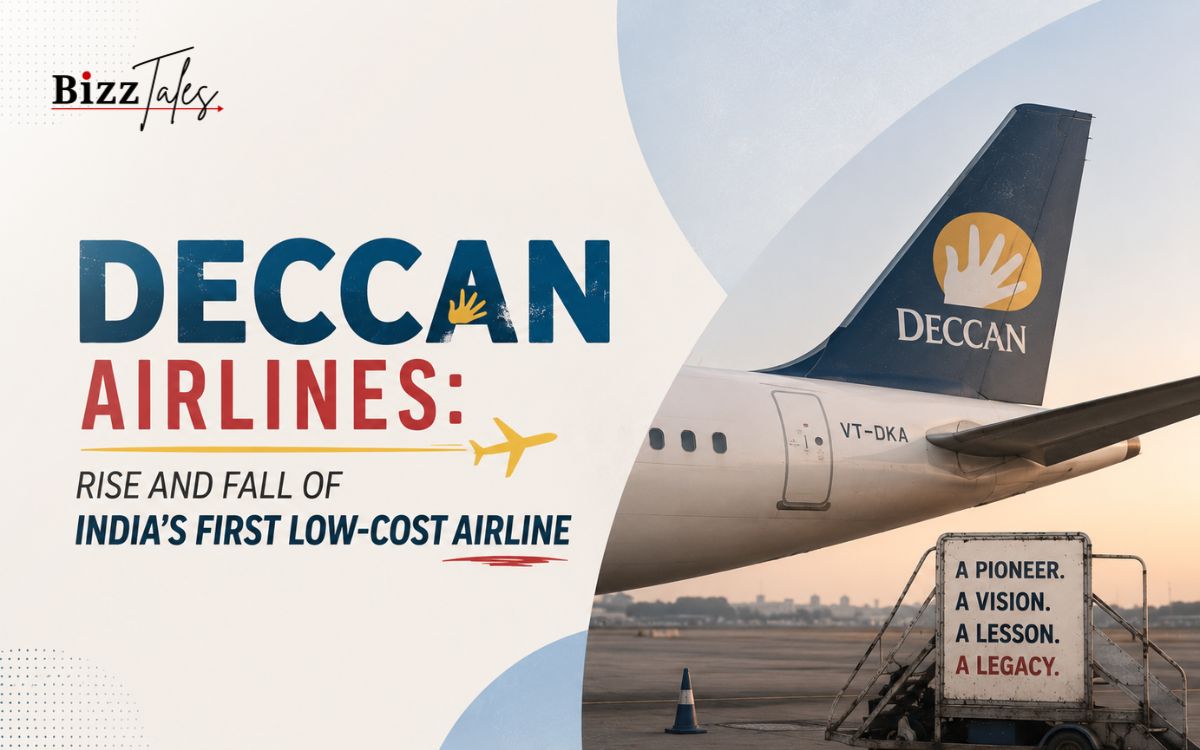
Apart from all other anything you would not discuss Indian aviation history without Deccan Airlines. Prior to the advent of budget airlines and subsequent common-ness of air travel, flights themselves were mostly a matter of luxury and privilege with financial tract holdings. Air tickets cost a fortune, and only business executives, affluent tourists and the government personnel could afford to “fly”. The common Indians undertook travel using trains.
Next we had Deccan Airlines, previously Air Deccan, an airline that revolutionized Indian Airlines and shook up the industry. It offered an initiative that was unheard of at the time – cheap flights. This incident not only created a paradigm shift in the industry but also increase air access to smaller cities in India.
For a short while, Air Deccan was one of the most exiting business success story of India. It took on the State established airlines, created a band wagon effect and changed the face of India aviation.
Throughout its history though, it remained hugely popular with the gamblers, many of the passengers, the adoring customer service staff and when it was announced that it would be ending its independence, the entire nation that was proud of its achievements. However, due to the ongoing financial difficulties, operational realities and strategic direction, it was to prove a victim of its own success.
The Deccan Airlines case is inspiring as well as cautionary tale. It proves that technology and innovation can have a profound impact on changing the nature of an industry but slow and steady growth without establishing an appropriate and sustainable financial base can lead to vulnerabilities over the long term.
The Vision Behind Deccan Airlines
The history of Deccan Airlines starts with Captain G. R. Gopinath, a retired officer in the Indian Army and an entrepreneur who felt that airline travel should not be a luxury for only the privileged.
The fact is, at that time, the Indian Aviation market was too small to cater to the huge population of India. Most airlines had their eyes on the premium segment and the big metro routes. Millions of Indians who would have loved to fly found it difficult to do so owing to high costs.
Captain Gopinath for, according to Hopkins, “presented a way out of the mess”.
He started thinking about how airlines operated in other part of the world and came up with his own idea of a low-cost airline: to keep the operating costs low, aircraft utilization high and share the benefits with the customer through lower ticket prices.
This vision was actually a blow to all conventional notions about flying and provided the basis of one of India’s most respected brands of airline.
Launching a New Era in Indian Aviation
Formed in 2003 with the official beginnings of Air Deccan.
In launching up the airline, the above business model was applied with an objective to have a low-cost entry. It aimed at filling the gap created by luxurious airlines by providing optimized services and products.
The firm relied on all of the practices that successful low-cost carriers generally employ-discounted, no frills service; fast turn around times; and competitive pricing.
Ecos do milionário de marketing: Por exemplo, uma de suas inovações mais famosas consistia na promoção ao extremo de tarifas promocionais extremamente baixas. O impacto na mídia foi assombroso.”> Headlines about airlines: air tickets that cost less than train prices captured the people’s fantasy.
For a large number of Indians, this was the first time when they got the chance of travelling by air.
Soon became an icon of democratized aviation.
Why Air Deccan Became an Instant Success
There are several reasons that Deccan’s pick up was almost like a jet.
The single most important factor was timing. Fast-growing India’s booming economy, rising disposable incomes and an expanding middle class created a market for transportation solutions. Indians wanted something faster, but not at a price.
This is where Air Deccan came in.
The airline was also willing to venture into underserviced and smaller cities, which other carriers did not serve. By linking together many tier-two and tier-three cities, the airline opened up new routes for travel and developed demand.
Its low-cost positioning resulted in a huge amount of brand awareness. Consumers perceived Air Deccan as an airline that fought against industry elitists, and brought affordability to common folks.
The huge growth of the airline indicated that the price of flying cheap is scalable in India.
Air Deccan’s Growth Years
The best time for the airline is from 2003 to 2007.
As the number of Indians taking to the skies grew, the airline quickly grew its fleet and routes and became a national icon.
The effects of Air DeCannan were felt across the airline industry. Competing airlines had to review price and efficiency.
The airline had successful redefined the consumer’s expections of how much air travel should cost.
Since then, its workforce has grown to 930 and it has continued to grow. Its success promoted other budget airlines to enter the market.
Was once the largest airline in passenger volume in India.
The company’s success was greeted enthusiastically as an example of innovation and enterprise.
Key Milestones in Air Deccan’s Journey
| Year | Major Event |
|---|---|
| 2003 | Air Deccan launches operations |
| 2004 | Rapid route expansion begins |
| 2005 | Passenger growth accelerates |
| 2006 | Becomes a major low-cost airline |
| 2007 | Faces mounting financial challenges |
| 2007 | Investment and stake sale to Kingfisher Airlines |
| 2008 | Brand transition begins |
| 2012 | Air Deccan effectively disappears |
Although these milestones show remarkable growth, they also show how success is so easily undermined by industry realities.
The Hidden Problems Behind the Growth
Air Deccan, though it looked like a highly successful venture from the outside was facing serious problems.
The low-cost airline concept is based on strict cost control combined with high operational efficiency. Any small disturbance can disproportionately affect profitability.
There were structural issues faced by the Indian aviation industry, namely.
Fares remained high, airport facilities were underused and congested, and costs rose rapidly as the airline grew.
Meanwhile, some aggressive pricing aimed at gaining market share rather than maximizing profits.
While operating Air Deccan attracted customers, translating this growth into a profitable ongoing operation was far more challenging.
The financial balance of the company was getting tighter as the competition grew more fierce.
Rising Fuel Prices Changed Everything
One of the most significant problem faced by Air Deccan was the soaring prices of aviation turbine fuels.
Fuel is one of the key operating costs for an airline. When fuel prices rise sharply, this will have a specific impact on budget airlines since their margins are usually already quite narrow.
Air Deccan strategy depended on cheap fares. The strategy would be polluted with the rise in fuel costs to the consumers directly.
The firm was stuck balancing cheap prices and keeping their economic position.
The crisis grew more difficult to manage as world oil markets became unstable.
Cost of fuel severely undermined the businessability ofthe airline businessmodel.
Operational Complexity Became a Burden
Growth is fast-paced and inherently difficult, and Air Deccan was no different.
As the airline added routes to its network, scheduling, maintenance requirements, staffing needs, customer service-all became more and more complex.
Customer satisfaction was now directly impacted by delays and operational irregularities.
The pressure for rapid growth occasionally push organization able resources to limits and may have put uncomfortable demands on them.
Ensuring a uniformly high quality of service for a growing network was challenging.
Getting bigger enables business to make more headlines and gain market share but, it also importantly: increases the risks and expenses of its operations.
And it was that same growth that helped make the airline so successful in the first place, which would lead to its downfall.
Competition Intensified
The performance of Air Deccan motivated others to follow suit.
The existing airlines launched low-cost carriers and new entrants arrived to take the same business.
The competition grew fiercer.
The price war lowered profitability industry wide. The airlines fiercely fought for the traveller, discounting for the sake of gaining market-share.
Competitively burdened with limited financial resources may be more successfullyabsorbing losses and struggling to survive when compared to Air Deccan.
As the Market became crowded, it was more difficult to sustain the differentiation.
The benefits that originally attracted customers to Air Deccan have now been ipso facto adopted as measures of the operations airline.
This lessened the company’s potential to maintain its initial acceleration.
The Kingfisher Deal
The most notable watershed in the history of Air Deccan was when Vijay Mallya-led Kingfisher Airlines purchased a sizable quantity of shares in Air Deccan.
Things looked promising at first.
Kingfisher provided great financial support, brand visibility and further opportunities. Most onlookers thought that this partnership would enhance Air Deccan’s business prospects and long-term survivability.
But the merger also brought strategic issues.
The Air Deccan image was established on low fares and frugal operation while Kingfisher promoted image of a premium airline with ultimate luxury and customer experience.
This proved not to be such an easy task.
However, as the integration progressed, the low-cost position of Air Deccan gradually got diluted over time.
Why the Merger Failed
The pairing of Kingfisher with Air Deccan can be considered a textbook example of strategic mismatch
The two companies targeted dissimilar customer segments and had dissimilar business models.
Air Deccan did well because it targeted cost-conscious clients looking for low-cost forms of travel.
Kingfisher focused on customers who were prepared to pay a premium.
Blending both methods resulted in a need to clarify where products should be placed and where attention should be focused.
Integration problems, rather than building up two businesses, actually made it harder to make decisions and caused the two organizations’ strategic emphasis to wither.
The fact that Air Deccan gradually lost its political and national identity will have also hurt the airline competitiveness. Indeed, this was one of its most valuable appeals.
What Air Deccan Should Have Done Differently
In retrospect, a few choice could have changed the airline’s future.
The company may have been better served by focusing more on profitability rather than on expansion and market share.
It could be argued that holding larger cash balances would have resulted in having better resilience to periods of increasing fuel prices and increased competition.
Could operational efficiency have been given more focus as they were growing?
More critical was the desire to project independence or to form a strategic alliance which would be more consistent with its low-cost neutrality.
Although these examples may seem clear in retrospect, they do highlight the hard lessons in balancing growth with sustainability.
What If Air Deccan Had Never Fallen?
Perhaps the most intriguing question about Air Deccan concerns put forward an alternative vision.
If the airline had not got into financial trouble and been open to independent management, then it had the potential of emerging as the number one low-cost carrier in India.
This early-market entry, widespread brand awareness and familiarity with low-price segment are the sources of strength which make Oasis completely at home in a fierce competitive environment.
Air Deccan might have gone international, would have improved regional linkages and may have played much bigger part in the growth of Indian aviation industry.
Given the vast expansion of air travel within the country over the last decade, an Air Deccan operating efficiently would probably currently be one of the largest low-cost airlines in Asia.
The lag in the company’s absence was filled by its rivals.
The Legacy of Air Deccan
Even though Air Deccan is no longer the major independent airline it was, their thoughts and influence can still be seen today in IndiAnaviation.
The company has totally altered the consumer perception.
Before Air Deccan, flying was a luxury. After Air Deccan, affordable air travel is a reality for millions of Indians.
The airline proved that low-cost carriers can work in India, and set the stage for future entrepreneurs to enter the aviation industry.
Many of the practices now entrenched in budget aviation were popularized through Air Deccan’s pioneercuts.
Its impact resonates long after it has been completed.
Lessons from the Rise and Fall of Air Deccan
The Air Deccan case study provides many business lessons that we can learn from.
Innovation can open up great possibilities, yet viable profits are a must;
Position in the market does not alone establish a business for long-term success. Individual businesses can predict economic situations and changing competition influences to maintain a viable position.
While improving rapidly, grow prudently! Should be complemented with operational discipline, and ensure healthy financial status.
Any strategic cooperation must involving the harmony between vision, culture, and business model.
Equally as important, business is to safeguard the fundamental essence for what is a winning formula.
Conclusion
Air Deccan changed the face of Indian aviation by bringing air travel to millions of Indians at a price they could afford. In the process, it broke the industry norms, opened up new markets and gave birth to an entire breed of low-cost carriers.
Its ascent showed the strength of innovation, entrepreneurship and customer-centered disruption.
However, increasing fuel prices, the increased operational intricacies, fierce competition, financial constraints and strategic maneuvering would all contribute to its downfall.
With the merger with Kingfisher Airlines, it was a downward journey for the erstwhile darling of Indian skies.
Whether the decease of Air Deccan, one thing’s for sure. There is not an Indian who chooses to travel by train ,when he could fly, who wouldn’t think of Air Deccan. For Indians, the airline may be dead, but the spirit lives on.
In many of the ways the Air Deccan succeeded in its most important mission: India fly.
There were a Movie also on the Air Deccan : Soorarai Pottru
FAQs
Proprietor of Air Deccan?
Air Deccan was established by Captain G. R. Gopinath, ex- Indian Army and businessman.
What made Air Deccan a success?
Airline success was achieved through cheap airfare, linking together smaller cities, and creating air travel available to India’s expanding middle class.
What brought about the collapse of Air Deccan?
Fuels prices increase, operational difficulties, fierce competition, financial circumstances and strategic problems following the Kingfisher purchase weakened the company.
What motivated Kingfisher to buy Air Deccan?
Kingfisher wanted expansion and increase in market share whereas Air Deccan needed financial aid to operate.
What really is the biggest legacy of Air Deccan?
Its biggest legacy is to democratize air travel in India, and show on a large scale that low-cost aviation can be successful.