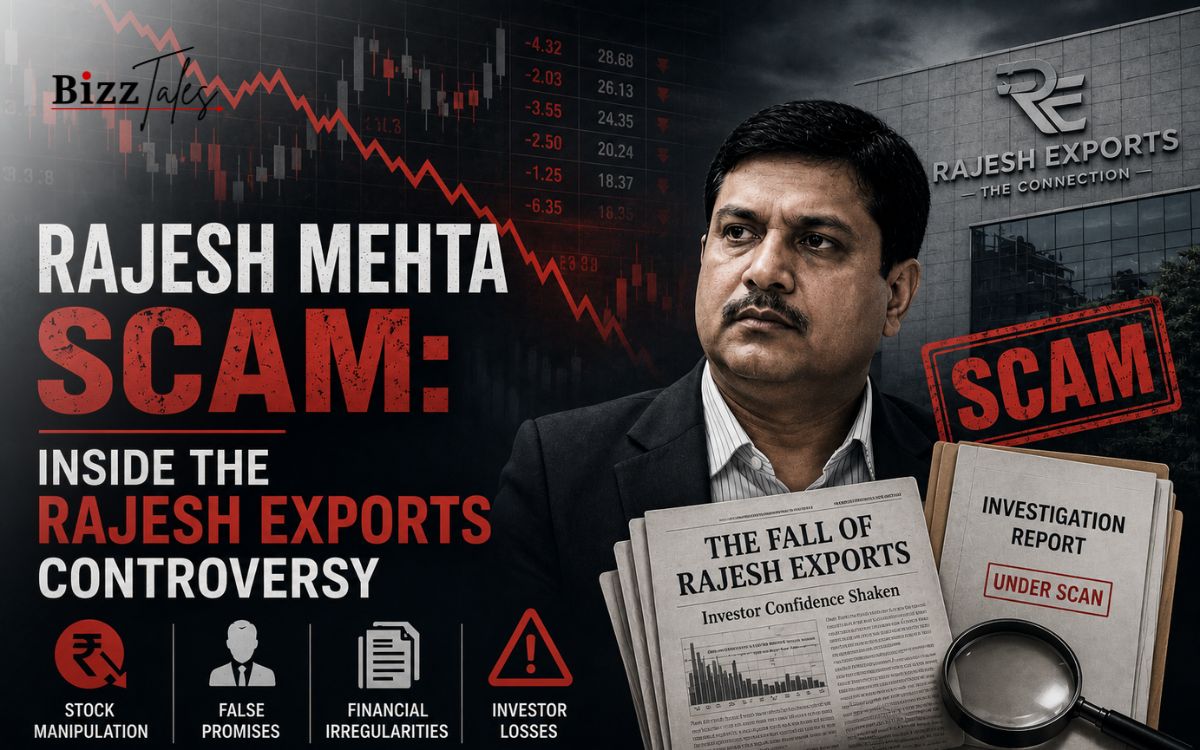
India’s corporate domain has been faced with a number of high-profile financial scandals and controversies over the last few years, right from an incident of stock market manipulation to major accounting scam that eroded investor confidence in the financial system. But when in June 2026, the financial markets hearing a major corporate scandal involving market regulators SEBI raising serious charges against gold refining and jewelry giant Rajesh Exports and its promoter-boss, Rajesh Mehta, , hit the headlines, began a lot of debates in the Wall Street in terms of huge money involved and minds engaged.
To a lot of investors, the story was hard to follow. Reports talked of alleged revenue inflation of lakhs of crores, raised questions about overseas subsidiaries, argued about financial disclosures, and called for regulatory action by SEBI. The size of the numbers involved made it one of the most talked about corporate accounts in India.
The man at the heart of the controversy is Rajesh Mehta, chairman and founder of Rajesh Exports. Starting out as a small jewellery manufacturer, Mehta transformed the company into one of the biggest gold refiners and jewellery manufacturers in the world. For many years, Rajesh Exports was seen as a shining example of Indian entrepreneurship. But the company’s recent problems cast his achievements in a new light.
Pending regulatory inquiry In addition, people should be aware that this case is still under regulatory inquiry. The charges elaborated in this article were all made by SEBI and Rajesh Mehta, individual and Rajesh Exports separately disagreed with many of that findings. How it will turn out is uncertain as it still in litigation.
Who Is Rajesh Mehta?
Before getting to know the controversy, first should know who Rajesh Mehta is and the reason for his company being so powerful.
Rajesh Mehta established Rajesh Exports in Bangalore in 1989. The company initially developed as a relatively minor jewelry manufacturing producer, however the company then expanded into gold refining, jewelry exports, retail operations and international bullion trading. After an extensive period of evolution, the development of the company reflected some of the most substantial growth and success to be experienced by India, and the group became one of the largest imports and exports of gold and jewelry.
The entry of Rajashewar in 2015 happened when two important acquisitions took place.. Of Missouri and Valcambi Swiss gold refinery. Valcambi is one of the biggest gold refineries of the world and formed the largest refiner of gold on a global scale with Rajashewar’s acquisition.
Rajesh Exports was long considered by investors to be a behemoth in the precious metals business. But, doubts were starting to surface as regulatory bodies began scrutinising the company’s financial disclosures and business practices.
How the Investigation Started
As per regulator’s findings, the controversy started with doubts expressed on large trade receivables and figures of some financial disclosures filed by the company. SEBI ordered an investigation into the matter and later appointed forensic auditors to investigate the company’s financial statements.
When investigating the firm the regulator found difficulty in confirming some figures and transactions when looking through company records. There were then variations in the regulator’s investigation to many different aspects such as overseas subsidiaries, revenue reporting issues and transactions to related parties.
What began as a routine investigation turned out to be one of the largest alleged misstatements by a corporation being ever debated in the Indian capital markets.
SEBI’s Allegations Against Rajesh Exports
In relation to the most serious charge, the board found that there was ‘large scale misrepresentation of revenues from overseas subsidiaries as in the case of Swiss based Valcambi’. The interim findings of SEBI indicated that almost three-fourths of the group’s reported revenue came from overseas operations, for which the accounts did not substantiate the reported numbers fully.
SEBI claimed that on review of documents available with it there were no specific documents in respect of about Rs. 15.15 lacs crore revenues claimed for various years. It further said there were inconsistencies found between reported consolidated figures and financial details available with it.
The regulator further inquired about some of the investments in the African gold mining companies, as the documentation was not found for some of them as part of the review.
One more significant charge was about the imaginary or unsubstantiated transactions with a regional broker as stated by SEBI. It was alleged by research that huge sale and purchase entries were made in the register of the concerned company without credible evidence against real business transactions.
Moreover, the regulatory findings seemed to have raised suspicions regarding the movement of company money and other governance breaches.
Rajesh Mehta’s Response
Rajesh Mehta and Rajesh Exports has vehemently denied any wrong doing and challenged various findings of SEBI. It had submitted that the SEBI’s analysis was not properly based on the manner of presentation and consolidation of revenue.
As per Mr. Mehta, the inconsistencies exist because investigators are supposed to have considered stand alone financials instead of consolidated group financials. Mr. Mehta has consistently asserted that the amount reported reflects actual numbers once the entire business structure is considered.
The company has additionally said that its international operations (most notably Valcambi) conduct a large amount of business and are responsible for the record revenues. Rajesh Exports has defended the company’s accountancy and is preparing to challenge the illegal activities through the courts.
Consequently, the issue remains contentious at this point.
Why the Case Matters to Investors
What makes the controversy so interesting is that a listed company with so many years of experience in the Indian capital markets has been caught in the controversy. Numerous retail investors, institutional investors, and mutual fund houses would have money invested in such listed companies.
When regulators question the financial reporting, investors naturally will worry about the transparency of company disclosure. Trust is the key principle of financial markets. Investors rely on company reports to make good investment decisions, while any accusations of misstatement will cause a great stigma to the market confidence.
Another issue the case raises is the difficulty faced by regulators in keeping track of increasingly large and complex multinational business, with a web of subsidiaries and operations in different legal systems. Today, companies are becoming ever larger, with a global presence, thus the need for transparency and checks becomes crucial.
Impact on Rajesh Exports Shares
The AGM managed to attract some heat on account of the disclosure SEBI made, which was followed by investors’ immediate sell-off. The company’s shares were hit and the market reacted swiftly to news of the regulatory agency’s questioning, as often happens with investors, when event of this sort cast nature and value of firm’s reported financial statements in doubt.
The measures taken by SEBI also involved restrictions on the securities transactions of Rajesh Mehta (promoter of the company) in the company.. Such restrictions added to adverse sentiment among investors and share market volatility.
The reduction in share prices also illustrates how rapidly investor confidence can erode in response to any issues involving governance, regulation or transparency.
Lessons for Retail Investors
Certainly the greatest learning for investors, or potential investors, in this story is to look past the headline revenue number. It was quite common for many to concentrate solely on the growth numbers without noticing the means, reporting and confirmations of the revenue figures.
Corporate governance further influences investment choices. Good governance mechanisms, operational independence, transparent reporting, timely disclosures promote investor confidence as well as confidence in investments.
Diversification is another lesson. Regardless how strong a company looks, allocating too much of your capital into one stock can lead you to unthinkable losses. A well-diversified portfolio can cushion the blow of additional company contraversy or market shocks.
This case also serves to remind investors that regulatory probes play a crucial role in preserving market integrity. Although such probes can spark temporary fears, they are designed to safeguard investors and promote confidence in financial markets.
What Happens Next?
What will happen in the future of the case is subject to investigations, regulatory action, responses by the company, and potential lawsuits that may take place. Further developments may arise as investigations continue to be carried out and the theories of the accused are heard.
This is something investors and others interested in the market will continue to watch as the implications could impact perceptions on corporate governance, regulatory framework and accounting standards in India.
Accusations and convictions must be kept distinct until the second stage of the process. For regulatory inquiries there can be substantial delays before determinations are made.
Conclusion
The case of Rajesh Mehta and Rajesh Exports is perhaps one of the most followed corporate stories in India in 2026. Summarizing the issue is a serious charge by SEBI regarding revenue reporting, overseas subsidiaries, corporate governance and financial disclosures. SEBI contends that there were huge differentiations in Rajesh Mehta and Rajesh Exports conduct of business while Rajesh Mehta and Rajesh Exports refute the charge and clarify they are diligently reporting their business.
No matter what decisions are made in the culmination of the case, FXI is a stark illustration of lack of transparency and accountability, the significance of investor due diligence, and the rapid erosion of investor confidence as soon as questions about the firm’s financial reporting methodology are raised.
For investors, the story is not merely about one company or one person. It’s also a larger reminder about risk, corporate governance, and the need to make investment choices through acumen not headlines.
FAQs
Who is Rajesh Mehta?
Rajesh Mehta established Rajesh Exports and holds the position of chairman. It is among the biggest gold refiners and jewelers in India.
What are the main allegations in the Rajesh Exports case?
SEBI has accused revenue misstatement, unsubstantiated transactions, issues relating to foreign subsidiary and corporate governance issues.
Has Rajesh Mehta accepted the allegations?
Rajesh Mehta and Rajesh Exports have denied any skulduggery, claiming that the regulator misinterpreted certain elements of the company’s consolidated financial reporting.
How much money is involved in the alleged misrepresentation?
A probe by SEBI interim found reported revenues over the period, with specific mention of missing Rs 151.5 lakh crore.
Why did Rajesh Exports’ share price fall?
Investors’ sentiments were of disappointment and concerns and intensified selling pressure in the counter.
Is the case closed?
No. The matter is unresolved and is currently being investigated and regulated. The case hasn’t been closed.