
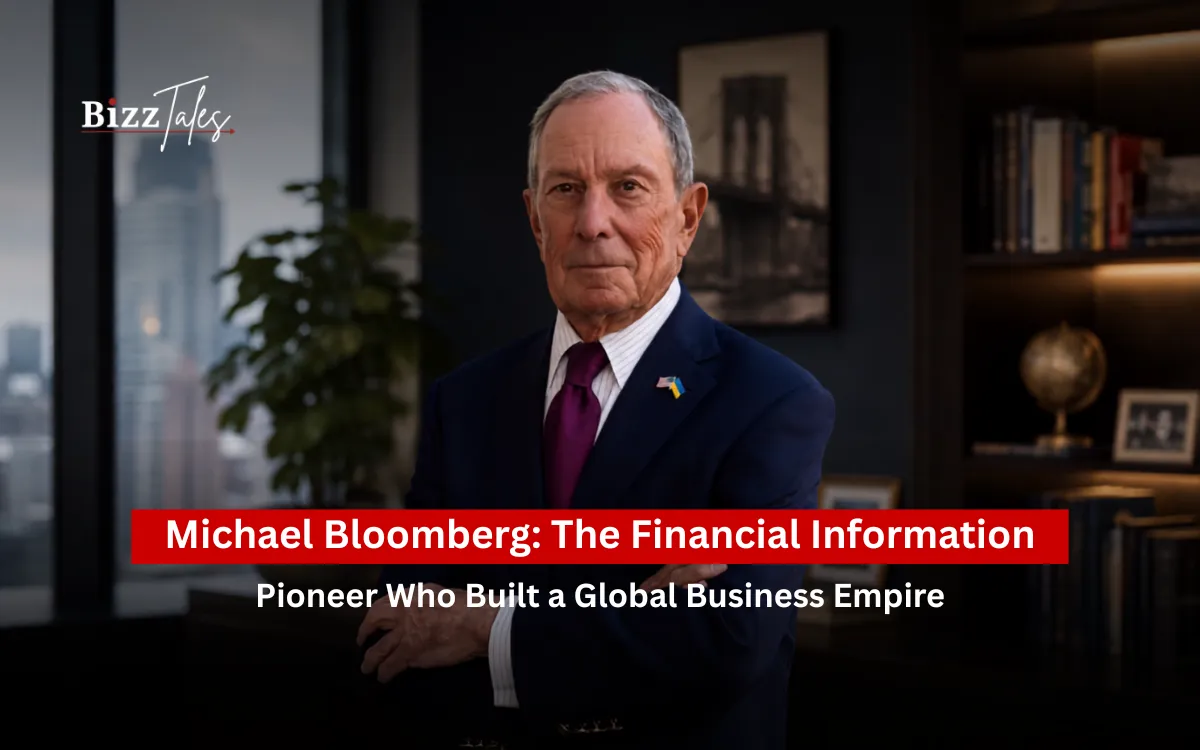
Michael Bloomberg is one of the most influential businessmen of the modern era. As the founder of Bloomberg LP, he transformed the way financial information is collected, analyzed, and distributed around the world. His company became an essential resource for banks, investment firms, corporations, governments, and financial professionals, helping shape the global financial industry.
Unlike many entrepreneurs who achieved success through consumer products or technology platforms, Bloomberg built his fortune by solving a highly specialized problem: providing accurate, real-time financial data to decision-makers. What started as a small startup in the early 1980s eventually grew into one of the most powerful financial information companies in the world.
Beyond business, Bloomberg is known for his extensive philanthropy, public service, and political involvement. He served multiple terms as the mayor of New York City and has donated billions of dollars to causes involving education, public health, climate change, scientific research, and social development.
Today, Michael Bloomberg remains one of the richest businessmen in the world. His journey from a middle-class family in Massachusetts to building a global business empire demonstrates the power of innovation, resilience, and long-term vision.
Forbes Ranking & Net Worth History
| Year | Forbes Rank | Net Worth |
| 2026 | #16 | $125 Billion |
| 2025 | #13 | $105 Billion |
| 2024 | #13 | $96 Billion |
Bloomberg’s wealth continues to grow through his ownership stake in Bloomberg LP, one of the most profitable privately held companies in the world.
Early Life and Family Background
Michael Rubens Bloomberg was born on February 14, 1942, in Boston, Massachusetts, United States.
He grew up in Medford, a suburb of Boston, in a middle-class family that emphasized education, discipline, and hard work.
His father worked as a bookkeeper, while his mother played an important role in supporting the family and encouraging academic achievement.
From an early age, Bloomberg demonstrated curiosity, ambition, and an interest in understanding how systems and organizations functioned.
Unlike many future entrepreneurs who focused solely on technology or finance, he developed a broad interest in business, leadership, and problem-solving.
These early influences would later shape his approach to entrepreneurship and innovation.
Education and Academic Foundation
Bloomberg attended Johns Hopkins University, where he studied electrical engineering.
His technical education provided a strong analytical foundation and taught him how to approach complex problems systematically.
After earning his undergraduate degree, he pursued a Master of Business Administration from Harvard Business School.
The combination of engineering and business education proved highly valuable throughout his career.
It allowed him to understand both technological systems and financial markets.
These skills later helped him identify opportunities that many others overlooked.
His educational background became one of the key factors behind his success.
Early Career on Wall Street
After completing his MBA, Bloomberg entered the financial industry.
He joined the investment bank Salomon Brothers, where he worked in various trading and management roles.
Over time, he gained valuable experience in financial markets, trading operations, and information systems.
The position provided insight into how investment professionals relied on data to make decisions.
Bloomberg observed that financial information was often difficult to access, fragmented, and inefficiently distributed.
This realization planted the seeds for what would eventually become his greatest entrepreneurial opportunity.
His years on Wall Street gave him both industry knowledge and credibility.
A Career-Changing Setback
One of the most important moments in Bloomberg’s life occurred in 1981.
Following a corporate merger involving Salomon Brothers, he lost his position at the company.
For many people, losing a successful job would have been a devastating setback.
For Bloomberg, it became an opportunity.
He received a substantial severance package and decided to use the funds to launch his own business.
Rather than seeking another executive position, he chose entrepreneurship.
This decision marked the beginning of one of the most successful business stories in modern history.
Founding Bloomberg LP
Using his severance money and industry knowledge, Bloomberg founded Innovative Market Systems in 1981.
The company’s goal was to provide real-time financial information and analytics to investment professionals.
At the time, the concept was revolutionary.
Financial institutions relied heavily on manual processes and fragmented information sources.
Bloomberg believed technology could solve these problems.
The company developed specialized computer terminals that combined market data, analytics, communication tools, and financial information into a single platform.
The product quickly gained attention within the financial community.
This innovation eventually became known as the Bloomberg Terminal.
The Success of the Bloomberg Terminal
The Bloomberg Terminal fundamentally changed the financial industry.
For the first time, traders, analysts, portfolio managers, and executives could access comprehensive financial information in real time.
The platform improved decision-making, increased efficiency, and created a powerful competitive advantage for users.
Demand grew rapidly.
Banks, investment firms, hedge funds, corporations, and government institutions adopted Bloomberg’s technology.
As the customer base expanded, Bloomberg LP generated recurring subscription revenue and extraordinary profitability.
The terminal became one of the most successful business products in financial history.
Its success transformed Michael Bloomberg into a billionaire.
Building a Global Information Empire
Over time, Bloomberg LP expanded far beyond financial terminals.
The company launched Bloomberg News, Bloomberg Television, Bloomberg Radio, and numerous digital media platforms.
These initiatives strengthened the company’s influence and diversified its operations.
Bloomberg became one of the world’s most trusted sources of business, economic, and financial information.
The company’s global reach extended across major financial centers and emerging markets.
Its ability to combine technology, data, analytics, and journalism created a unique business model.
This expansion significantly increased Bloomberg’s wealth and influence.
Challenges and Competition
Despite its success, Bloomberg LP faced competition from other financial information providers.
Companies such as Reuters and various technology firms sought to challenge its market position.
The financial industry also underwent significant changes due to globalization, technological innovation, and regulatory developments.
Bloomberg responded by continuously improving products, expanding services, and investing in technology.
His commitment to innovation helped the company maintain leadership despite intense competition.
These challenges reinforced the importance of adaptability and long-term thinking.
Public Service and Mayor of New York City
One of the most unique aspects of Michael Bloomberg’s career is his transition into public service.
In 2001, he was elected mayor of New York City.
He served three terms, leading the city through significant economic, social, and infrastructure challenges.
During his tenure, Bloomberg focused on public health, education, economic development, and urban planning.
His leadership style reflected many of the same principles that guided his business career: data-driven decision-making, efficiency, and long-term planning.
His time in government expanded his influence beyond the business world.
Philanthropy and Global Impact
Michael Bloomberg is among the most generous philanthropists in history.
Through Bloomberg Philanthropies, he has donated billions of dollars to initiatives involving public health, climate change, education, arts and culture, scientific research, and community development.
His charitable work spans multiple continents and addresses some of the world’s most pressing challenges.
Bloomberg frequently emphasizes measurable impact and evidence-based solutions.
His philanthropy reflects a belief that wealth should be used to create meaningful societal improvements.
These efforts have become a defining aspect of his legacy.
Other Investments and Business Interests
Although Bloomberg LP remains his primary source of wealth, Michael Bloomberg has interests in media, technology, finance, public policy initiatives, and philanthropic organizations.
His influence extends across business, government, education, and social impact sectors.
Unlike some billionaires who actively pursue numerous acquisitions, Bloomberg remains closely associated with the company he founded.
His continued ownership stake provides both financial strength and strategic influence.
Leadership Style
Michael Bloomberg is known for his disciplined, analytical, and results-oriented leadership style.
He emphasizes data, efficiency, accountability, and continuous improvement.
Employees often describe him as highly focused and deeply involved in operational details.
His leadership philosophy combines entrepreneurial thinking with rigorous execution.
These qualities helped transform Bloomberg LP into one of the world’s most successful private companies.
Many business leaders study his management approach as a model for sustainable growth.
Personal Life
Despite his immense wealth, Bloomberg maintains a relatively practical and disciplined lifestyle.
He remains actively involved in business and philanthropy and continues advocating for public health and environmental initiatives.
His personal story reflects the importance of perseverance, lifelong learning, and public service.
Even after achieving extraordinary success, he continues to pursue new challenges and opportunities.
Official Social Media Accounts
Bloomberg uses social media primarily to share updates regarding philanthropy, public policy, climate initiatives, and social impact projects.
Lessons Entrepreneurs Can Learn from Michael Bloomberg
One of the most important lessons from Bloomberg’s journey is the value of solving real problems.
He identified inefficiencies in financial information and built a product that delivered enormous value.
His story also demonstrates the importance of resilience.
Losing his job at Salomon Brothers could have ended his career, but instead it became the catalyst for entrepreneurship.
Entrepreneurs can learn from his commitment to innovation, data-driven decision-making, and long-term thinking.
His success proves that specialized expertise can create extraordinary opportunities.
Conclusion
Michael Bloomberg’s journey from a middle-class upbringing in Massachusetts to building one of the world’s most influential financial information companies is a remarkable story of innovation, perseverance, and vision. Through Bloomberg LP, he transformed financial markets and created a business that serves professionals around the globe.
His achievements in business, public service, and philanthropy have made him one of the most respected figures in modern society.
Today, his influence extends far beyond finance, touching education, healthcare, environmental sustainability, and public policy.
For entrepreneurs, business leaders, and future innovators, Michael Bloomberg’s story offers valuable lessons about opportunity, resilience, leadership, and the power of solving meaningful problems.
FAQs
1. Who is Michael Bloomberg?
Michael Bloomberg is the founder of Bloomberg LP, former mayor of New York City, and one of the richest businessmen in the world.
2. What is Michael Bloomberg’s net worth in 2026?
His estimated net worth is approximately $125 billion.
3. What is Bloomberg LP?
Bloomberg LP is a global financial information, media, software, and data company.
4. What is the Bloomberg Terminal?
The Bloomberg Terminal is a financial information platform used by investment professionals worldwide.
5. Why is Michael Bloomberg famous?
He is known for founding Bloomberg LP, serving as mayor of New York City, and his extensive philanthropy.
6. Did Michael Bloomberg work on Wall Street?
Yes. He worked at Salomon Brothers before founding Bloomberg LP.
7. Is Michael Bloomberg involved in philanthropy?
Yes. He has donated billions of dollars through Bloomberg Philanthropies.
8. What leadership style is Michael Bloomberg known for?
He is known for data-driven, analytical, and results-oriented leadership.
9. Is Michael Bloomberg active on social media?
Yes. He maintains active accounts on major social media platforms.
10. What can entrepreneurs learn from Michael Bloomberg?
Entrepreneurs can learn innovation, resilience, problem-solving, long-term thinking, and the importance of creating real value.