
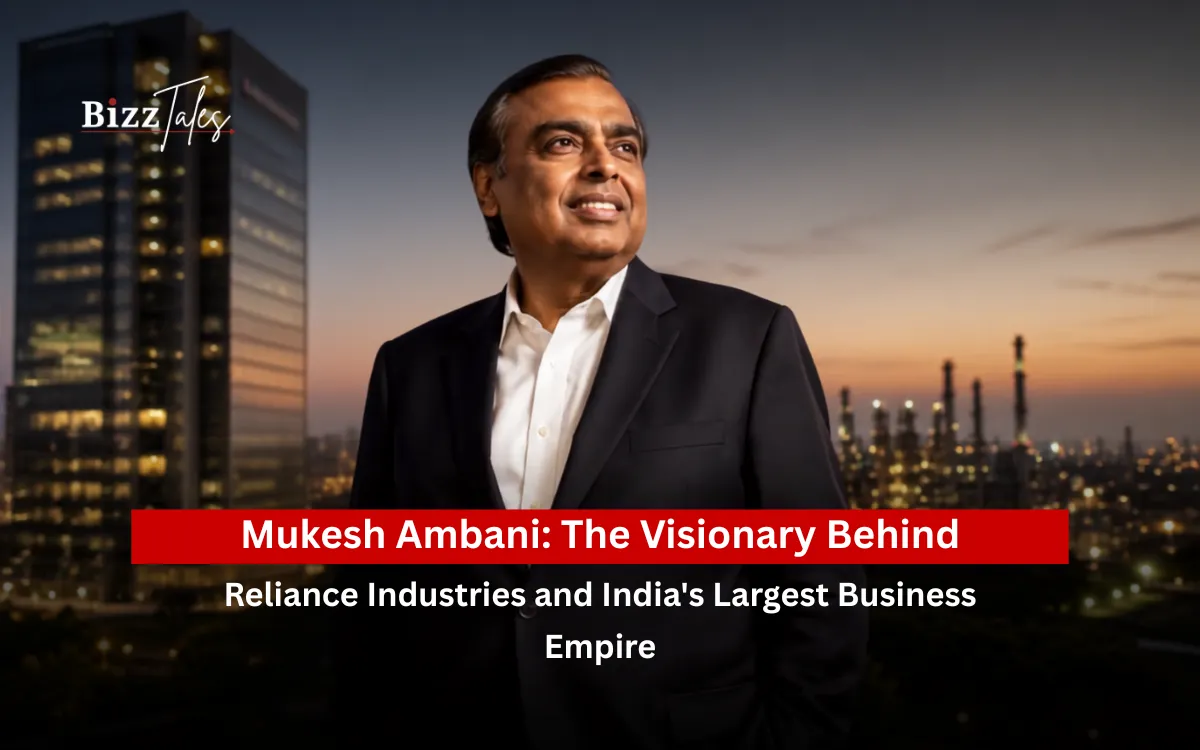
Mukesh Ambani is one of the most influential businessmen in the world and the richest person in India. As the chairman and managing director of Reliance Industries Limited (RIL), he transformed a company founded by his father into one of the largest and most diversified business empires in the world. His influence spans petrochemicals, oil refining, telecommunications, retail, media, digital services, renewable energy, and artificial intelligence.
Over the past three decades, Ambani has led some of India’s most ambitious business projects. Under his leadership, Reliance evolved from a petrochemicals giant into a technology-driven conglomerate serving hundreds of millions of consumers. His ability to identify future opportunities and invest at scale has made him one of the most respected business leaders globally.
Today, Mukesh Ambani is not only known for his immense wealth but also for his role in reshaping India’s digital economy. His journey from the son of a visionary entrepreneur to the architect of India’s largest corporate empire is a remarkable story of ambition, innovation, resilience, and long-term thinking.
Forbes Ranking & Net Worth History
| Year | Forbes Rank | Net Worth |
| 2026 | #20 | $96 Billion |
| 2025 | #18 | $116 Billion |
| 2024 | #9 | $116 Billion |
Although global market fluctuations affect rankings, Mukesh Ambani remains the wealthiest businessman in India and one of Asia’s most powerful corporate leaders.
Early Life and Family Background
Mukesh Dhirubhai Ambani was born on April 19, 1957, in Aden, Yemen.
His father, Dhirubhai Ambani, was building the foundation of what would eventually become one of India’s largest business groups.
The family later moved to Mumbai, where Mukesh spent most of his childhood.
Despite eventually becoming one of the wealthiest families in India, the Ambanis lived relatively modestly during their early years.
Mukesh witnessed firsthand how his father built Reliance through hard work, risk-taking, and entrepreneurial determination.
These experiences deeply influenced his understanding of business and leadership.
Growing up around the company’s early operations gave him valuable insights into entrepreneurship, finance, and industrial development.
Education and Academic Journey
Mukesh Ambani attended the prestigious Institute of Chemical Technology in Mumbai, where he earned a degree in Chemical Engineering.
Recognizing the importance of global business education, he later enrolled at Stanford University for an MBA program.
However, his father’s expanding business empire required leadership and involvement.
In the early 1980s, Mukesh left Stanford before completing his MBA to join Reliance Industries full-time.
This decision would prove transformational not only for his career but also for the future of the company.
Like many successful entrepreneurs, he chose practical business experience over completing a traditional academic path.
Joining Reliance Industries
When Mukesh joined Reliance, the company was already growing rapidly under Dhirubhai Ambani’s leadership.
Rather than immediately assuming a high-profile executive role, Mukesh became deeply involved in operational projects and industrial development.
One of his earliest major responsibilities involved overseeing the construction of manufacturing facilities and petrochemical plants.
His technical background helped him understand large-scale industrial operations.
He gained a reputation for attention to detail, project execution, and strategic planning.
These experiences prepared him for larger leadership responsibilities in the years ahead.
Building the World’s Largest Refining Complex
One of Mukesh Ambani’s most significant achievements was the development of the Jamnagar refinery complex in Gujarat.
Today, Jamnagar Refinery is recognized as one of the largest oil refining complexes in the world.
The project required enormous investment, advanced engineering, and long-term strategic planning.
Many observers viewed the initiative as highly ambitious.
However, Mukesh believed that scale and efficiency would provide significant competitive advantages.
The success of Jamnagar strengthened Reliance’s position as a global energy and petrochemicals leader.
It also demonstrated Mukesh’s ability to execute large and complex projects.
Leadership After Dhirubhai Ambani
Following the passing of Dhirubhai Ambani in 2002, Reliance entered a transitional period.
A well-known family division eventually separated business interests between Mukesh Ambani and his brother, Anil Ambani.
Mukesh retained control of Reliance Industries and its core businesses.
This period presented significant challenges.
He needed to maintain growth, reassure investors, and continue expanding the company in an increasingly competitive environment.
Under his leadership, Reliance not only remained strong but entered one of the most successful phases in its history.
Diversifying Beyond Energy
While Reliance’s foundation was built on energy, refining, and petrochemicals, Mukesh recognized that the future would require diversification.
He expanded aggressively into retail, telecommunications, media, digital services, infrastructure, and technology.
This strategic shift transformed Reliance from an industrial conglomerate into a consumer-focused business empire.
The diversification reduced dependence on energy markets and created multiple growth engines.
His willingness to invest heavily in emerging sectors became one of the defining characteristics of his leadership.
The Jio Revolution
Perhaps the most transformative project of Mukesh Ambani’s career was the launch of Jio Platforms.
Introduced in 2016, Jio disrupted India’s telecommunications industry by offering affordable data services and widespread network coverage.
At the time, many analysts questioned the enormous investment required.
However, Ambani believed that affordable internet access would transform India’s economy.
His prediction proved correct.
Jio rapidly acquired hundreds of millions of users and accelerated India’s digital transformation.
The company reshaped telecommunications, mobile data usage, online education, digital payments, entertainment, and e-commerce.
Jio became one of the most successful business launches in Indian history.
Building India’s Largest Retail Business
Alongside telecommunications, Ambani invested heavily in retail.
Today, Reliance Retail is among the largest retail businesses in India.
The company operates across grocery, electronics, fashion, lifestyle, consumer products, and digital commerce.
Its extensive network serves millions of customers nationwide.
Reliance Retail’s rapid growth reflects Ambani’s understanding of India’s expanding consumer economy.
The business has become a major contributor to Reliance’s overall valuation and future growth prospects.
Also Read: Mukesh Ambani: From Reliance to Global Empire
Media, Technology, and Digital Expansion
Mukesh Ambani’s vision extends beyond traditional industries.
Reliance has expanded into media, entertainment, streaming, cloud computing, artificial intelligence, and digital infrastructure.
Strategic partnerships with global technology companies strengthened the group’s capabilities and global influence.
His investments position Reliance at the center of India’s digital future.
As AI and advanced technologies continue developing, Ambani remains focused on creating long-term competitive advantages.
This forward-looking strategy continues attracting investor attention.
Renewable Energy and Sustainability
Recognizing global shifts toward cleaner energy, Ambani announced significant investments in renewable energy and sustainability initiatives.
Reliance has committed billions of dollars toward solar energy, green hydrogen, energy storage, and clean technology infrastructure.
These projects aim to position the company as a leader in the energy transition.
The strategy reflects Ambani’s belief that future growth will increasingly depend on sustainable business models.
His investments demonstrate a willingness to adapt to evolving global economic trends.
Challenges and Competition
Like every major business leader, Mukesh Ambani has faced challenges.
Reliance operates in highly competitive sectors involving telecommunications, retail, energy, technology, and digital services.
Economic fluctuations, regulatory changes, and intense competition create ongoing pressure.
However, Ambani’s ability to make long-term investments and maintain strategic focus has helped Reliance navigate uncertainty.
His leadership during periods of disruption has strengthened the company’s position.
These experiences highlight the importance of adaptability and resilience.
Leadership Style
Mukesh Ambani is known for his strategic vision, long-term thinking, and execution capabilities.
He often focuses on large-scale opportunities capable of transforming entire industries.
Employees and business observers describe him as disciplined, ambitious, and deeply involved in major projects.
His leadership philosophy emphasizes innovation, scale, and operational excellence.
This approach has enabled Reliance to remain at the forefront of multiple industries simultaneously.
Philanthropy and Social Impact
Through the Reliance Foundation, Mukesh Ambani and his family support initiatives involving education, healthcare, rural development, disaster relief, sports, and community welfare.
The foundation operates across numerous regions of India and impacts millions of lives.
These efforts reflect a commitment to social development alongside business growth.
Philanthropy has become an increasingly important aspect of the Ambani legacy.
Personal Life
Mukesh Ambani is married to Nita Ambani, who plays a major role in the Reliance Foundation and various business initiatives.
The family is among the most recognized business families in India.
Despite his immense wealth, Ambani remains actively involved in business operations and strategic decision-making.
His focus continues to be on expanding Reliance’s influence across emerging industries.
Lessons Entrepreneurs Can Learn from Mukesh Ambani
One of the most important lessons from Ambani’s journey is the value of thinking at scale.
Many of his biggest successes came from investing in opportunities that others considered too ambitious.
His story also demonstrates the importance of diversification.
By expanding beyond energy into telecommunications, retail, and technology, he created multiple growth engines.
Entrepreneurs can learn from his willingness to take calculated risks, embrace innovation, and invest for the long term.
His career highlights the power of vision combined with disciplined execution.
Conclusion
Mukesh Ambani’s transformation from the son of a visionary entrepreneur to the leader of India’s largest business empire is one of the most significant business stories of modern times. Through Reliance Industries, he expanded into energy, telecommunications, retail, media, technology, and renewable energy, creating a diversified conglomerate with global influence.
His leadership helped accelerate India’s digital transformation and reshape multiple industries.
As Reliance continues investing in artificial intelligence, sustainability, and digital infrastructure, Ambani’s influence is likely to grow even further.
For entrepreneurs, investors, and business leaders, his journey offers valuable lessons about scale, innovation, resilience, and long-term strategic thinking.
His legacy remains deeply connected to India’s economic development and the future of global business.