
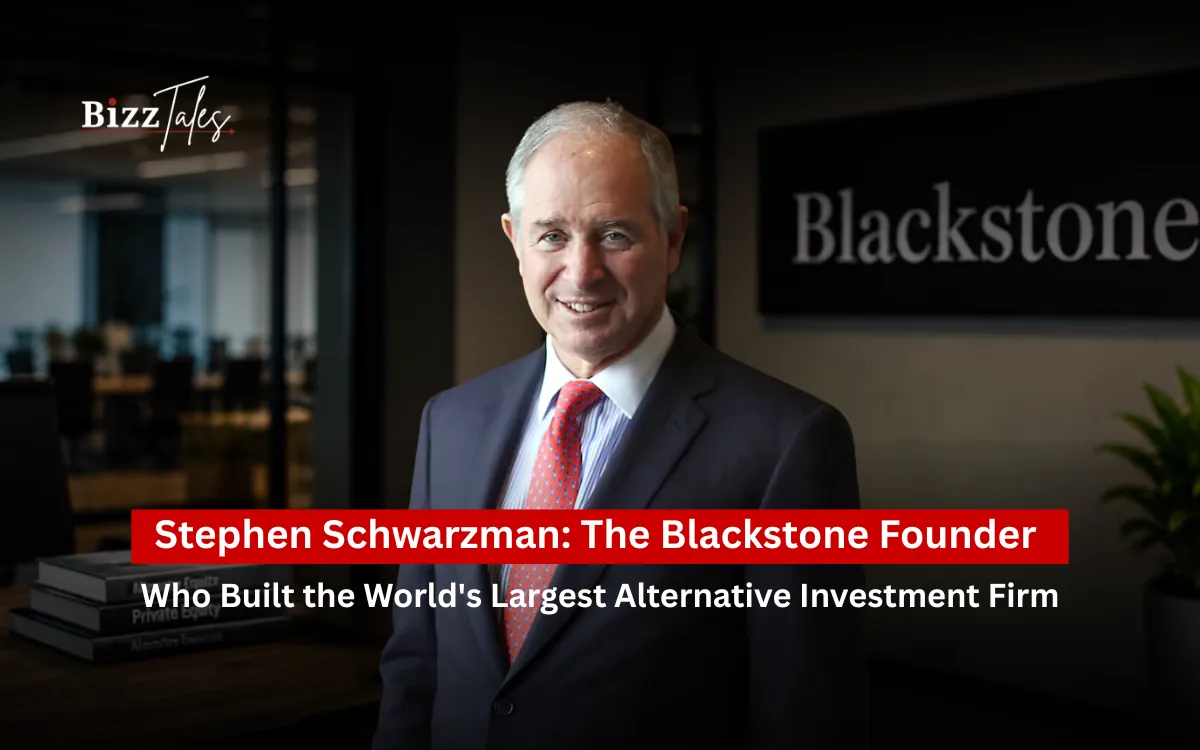
In the world of finance, few names command as much respect and influence as Stephen Schwarzman. As the co-founder, chairman, and CEO of Blackstone, Schwarzman transformed a small investment partnership into the largest alternative asset management company in the world. His journey from a middle-class upbringing in Philadelphia to becoming one of the richest financiers on the planet is a remarkable story of ambition, strategic thinking, and relentless execution.
Over the past four decades, Schwarzman has played a pivotal role in reshaping the global private equity industry. Through Blackstone, he pioneered investment strategies that extended beyond traditional buyouts into real estate, private credit, infrastructure, hedge funds, insurance assets, and technology investments. Today, Blackstone manages more than a trillion dollars in assets, making it one of the most powerful financial institutions in the world.
What distinguishes Schwarzman from many business leaders is his ability to identify long-term economic trends and build investment platforms capable of capitalizing on them. His leadership helped Blackstone navigate multiple economic cycles, financial crises, and market transformations while consistently expanding its global influence.
Beyond finance, Schwarzman is also recognized for his philanthropic contributions to education, leadership development, healthcare, and public policy. His impact extends far beyond Wall Street, influencing business, academia, and international relations.
Forbes Rankings and Net Worth
| Year | Forbes Ranking | Net Worth |
| 2026 | #37 World’s Billionaires | Approximately $49.5 Billion |
| 2025 | Forbes Global Billionaire | Approximately $42 Billion |
| 2024 | Forbes Global Billionaire | Approximately $39 Billion |
Stephen Schwarzman’s wealth is primarily derived from his ownership stake in Blackstone and the firm’s continued growth across global investment markets.
Early Life and Education
Stephen Allen Schwarzman was born on February 14, 1947, in Philadelphia, Pennsylvania, United States. He grew up in a middle-class Jewish family where entrepreneurship and hard work were strongly valued. His father owned a linen and textile business, exposing him to business operations from an early age.
Unlike many future financiers who grew up surrounded by wealth, Schwarzman learned the fundamentals of customer service, sales, and business management through his family’s company. These experiences helped develop the work ethic and commercial instincts that later contributed to his success.
As a student, Schwarzman demonstrated strong academic abilities and leadership qualities. He attended Abington Senior High School, where he excelled in both academics and extracurricular activities.
After graduating, he enrolled at Yale University, earning a degree in political science in 1969. During his time at Yale, he became involved in student leadership and developed relationships that would later become valuable professional connections.
Determined to pursue a career in business, Schwarzman continued his education at Harvard Business School, where he earned an MBA in 1972. His experience at Harvard provided advanced training in finance, management, and corporate strategy, laying the foundation for his future career in investment management.
Career Journey
After completing his MBA, Stephen Schwarzman joined the investment bank Donaldson, Lufkin & Jenrette. The position provided valuable experience in mergers and acquisitions, corporate finance, and deal-making.
His strong performance quickly attracted attention, and he eventually moved to Lehman Brothers, one of Wall Street’s most prestigious investment banks at the time. There, Schwarzman specialized in mergers and acquisitions and rose rapidly through the organization’s leadership ranks.
By the age of 31, he became a managing director at Lehman Brothers, an impressive achievement that established him as one of Wall Street’s rising stars.
Despite his success, Schwarzman believed there was a significant opportunity to create a new type of investment firm focused on private equity and long-term value creation. In 1985, he partnered with Peter Peterson, a former U.S. Secretary of Commerce and Lehman Brothers chairman, to launch Blackstone.
The firm began with approximately $400,000 in startup capital and a small team of professionals. At the time, private equity was still a relatively young industry, and many institutional investors remained skeptical about alternative investments.
The early years were challenging. Raising capital required convincing investors to trust a new firm operating in an emerging sector. However, Schwarzman’s determination and strategic vision gradually attracted clients and investment opportunities.
Over time, Blackstone became one of the most successful investment firms in financial history.
Business Ventures
Blackstone remains Stephen Schwarzman’s most important business venture and the primary source of his wealth.
Initially focused on mergers and acquisitions advisory services and private equity investments, the firm gradually expanded into multiple asset classes. This diversification became one of the key drivers of Blackstone’s long-term success.
The firm’s private equity division completed some of the largest and most influential buyouts in corporate history. These transactions generated substantial returns and established Blackstone as a dominant force in global finance.
Real estate became another major growth engine. Under Schwarzman’s leadership, Blackstone assembled one of the largest real estate portfolios in the world, investing in office buildings, logistics facilities, hotels, residential properties, data centers, and industrial assets.
The company also expanded into private credit, infrastructure investing, hedge fund solutions, life sciences, insurance assets, and technology-focused investments.
By continuously identifying new opportunities and expanding its investment capabilities, Blackstone evolved into the world’s largest alternative asset manager.
Its global operations now span North America, Europe, Asia, the Middle East, and Latin America, serving pension funds, sovereign wealth funds, institutions, and individual investors.
Success Story and Major Achievements
Stephen Schwarzman’s achievements are among the most significant in modern finance.
His greatest accomplishment is undoubtedly building Blackstone from a startup investment partnership into a global financial powerhouse managing over a trillion dollars in assets.
Few entrepreneurs have successfully created institutions of such scale and influence. Under Schwarzman’s leadership, Blackstone consistently expanded across new markets while maintaining strong investment performance.
Another major achievement was helping legitimize private equity as a mainstream asset class. During the early years of the industry, many investors viewed private equity as highly speculative. Blackstone’s success demonstrated the long-term value of alternative investments and contributed to the industry’s growth worldwide.
Schwarzman also played a key role in transforming real estate investing. Blackstone’s ability to acquire, improve, and monetize large property portfolios generated extraordinary returns and reshaped global real estate markets.
Beyond business, his philanthropic initiatives have had substantial impact. Programs such as Schwarzman Scholars have supported leadership development and international education, attracting talented students from around the world.
His contributions to finance, education, and philanthropy have earned numerous awards and global recognition.
Challenges, Failures, and Setbacks
Like all successful entrepreneurs, Stephen Schwarzman faced significant obstacles throughout his career.
Launching Blackstone during the 1980s required overcoming investor skepticism and intense competition from established financial institutions. Raising capital and securing deals was far more difficult than it is for the firm today.
Economic downturns created additional challenges. The savings and loan crisis, the dot-com crash, the global financial crisis of 2008, and other market disruptions tested Blackstone’s resilience.
The 2008 financial crisis was particularly challenging. Many investment firms suffered severe losses, and private equity faced heightened scrutiny. Although Blackstone experienced market pressures, the firm ultimately emerged stronger by identifying opportunities during the recovery.
Public criticism of private equity also created reputational challenges. Critics argued that buyout firms prioritized profits over employees and communities. Schwarzman frequently defended the industry’s role in improving businesses and generating economic growth.
Market volatility, regulatory changes, and geopolitical uncertainty remain ongoing challenges in the investment industry. Nevertheless, Schwarzman’s leadership enabled Blackstone to navigate these complexities successfully.
Investments and Assets
Most of Stephen Schwarzman’s wealth comes from his ownership stake in Blackstone and related investment interests.
His holdings include significant shares of the company, which generate substantial income through dividends and capital appreciation.
Beyond Blackstone, Schwarzman has exposure to a wide range of investments through the firm’s diversified portfolio. These include private equity transactions, real estate assets, infrastructure projects, technology companies, healthcare businesses, and credit investments.
Blackstone’s real estate portfolio alone includes billions of dollars worth of assets across multiple countries and sectors.
Schwarzman also owns luxury properties and personal assets reflecting his success as one of the world’s leading financiers.
His investment philosophy emphasizes diversification, long-term value creation, disciplined risk management, and identifying opportunities during periods of uncertainty.
Leadership Style and Business Philosophy
Stephen Schwarzman is widely known for his disciplined and highly analytical leadership style.
One of his core principles is preparation. He frequently emphasizes the importance of rigorous analysis, detailed planning, and understanding every aspect of a business before making major decisions.
Another defining characteristic is long-term thinking. Rather than focusing on short-term market fluctuations, Schwarzman prioritizes sustainable growth and value creation over extended periods.
He also believes strongly in attracting exceptional talent. Blackstone’s culture emphasizes meritocracy, intellectual rigor, and continuous improvement.
Risk management plays a central role in his philosophy. While Blackstone pursues ambitious investments, Schwarzman consistently stresses the importance of understanding downside scenarios and protecting capital.
His leadership demonstrates how discipline, strategic thinking, and adaptability can drive extraordinary business success.
Personal Life
Stephen Schwarzman is married to Christine Hearst Schwarzman and resides primarily in New York City.
Outside of business, he is deeply involved in philanthropy and education. His charitable contributions have supported universities, libraries, medical research institutions, cultural organisations, and leadership development programs.
One of his most notable initiatives is the Schwarzman Scholars program at Tsinghua University in China. The program aims to develop future global leaders by providing world-class educational opportunities and fostering international collaboration.
Schwarzman is also an active supporter of the arts and public policy initiatives.
Despite his immense wealth, he remains highly engaged in business operations and continues to play a central role in Blackstone’s strategic direction.
Legacy and Future Outlook
Stephen Schwarzman’s legacy is firmly established within global finance.
Through Blackstone, he helped create one of the most influential investment firms in history and transformed alternative asset management into a mainstream component of institutional investing.
His impact extends beyond private equity into real estate, infrastructure, credit markets, and global capital allocation.
Looking ahead, Blackstone is expected to continue expanding across emerging industries such as artificial intelligence infrastructure, digital assets, healthcare innovation, renewable energy, and private credit.
His philanthropic initiatives will likely continue shaping education and leadership development for future generations.
Few business leaders have had such a broad influence across finance, investing, education, and public policy.
Conclusion
Stephen Schwarzman’s journey from a middle-class upbringing in Philadelphia to becoming one of the world’s richest financiers is an extraordinary example of vision, discipline, and execution.
By co-founding Blackstone and transforming it into the largest alternative asset manager on the planet, he reshaped global finance and created enormous value for investors.
His success reflects decades of strategic thinking, disciplined risk management, and a commitment to excellence. At the same time, his philanthropic efforts demonstrate a desire to create impact beyond financial markets.
For entrepreneurs, investors, and business leaders, Schwarzman’s story offers valuable lessons about leadership, long-term thinking, talent development, and the importance of continuous learning.
Today, he remains one of the most influential figures in modern finance, and his legacy will continue shaping global investing for decades to come.
FAQs
1. What is Stephen Schwarzman’s net worth in 2026?
Stephen Schwarzman’s estimated net worth in 2026 is approximately $49.5 billion.
2. How did Stephen Schwarzman become a billionaire?
He became a billionaire by co-founding Blackstone and building it into the world’s largest alternative asset management company.
3. What company does Stephen Schwarzman own?
Stephen Schwarzman is the co-founder, chairman, and CEO of Blackstone, a global investment management firm.
4. What is Stephen Schwarzman’s leadership style?
His leadership style emphasizes preparation, long-term thinking, disciplined risk management, talent development, and strategic execution.
5. What is Stephen Schwarzman’s biggest business achievement?
His biggest achievement is transforming Blackstone from a small investment partnership into the world’s largest alternative asset manager with over a trillion dollars in assets under management.