
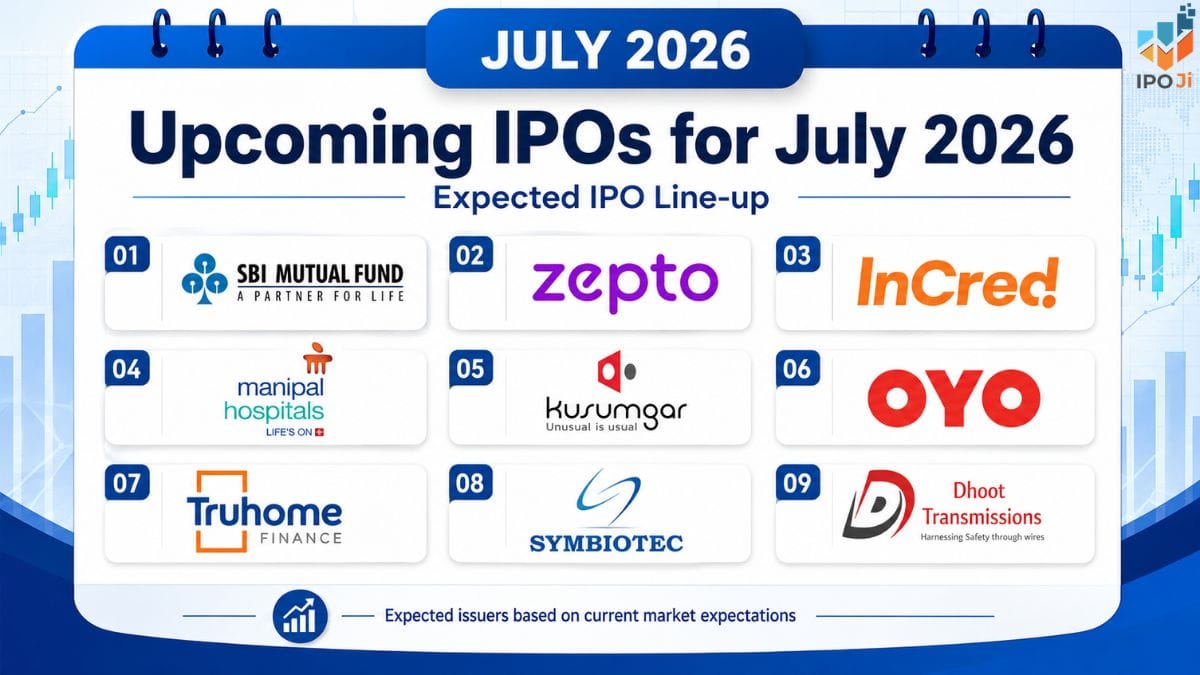
The Indian stock market continues to attract millions of retail and institutional investors, and few events generate as much excitement as an Initial Public Offering (IPO). Whether it is a fast-growing startup, a profitable manufacturing company, a technology business, or a financial services giant, IPOs often capture the attention of investors looking for new opportunities.
Over the last few years, India’s IPO market has experienced significant growth. Companies across sectors have used public listings to raise capital, expand operations, reduce debt, and increase visibility. At the same time, investors have increasingly viewed IPOs as opportunities to participate in the growth stories of emerging businesses.
July 2026 is expected to be another active month for the primary market.
Several companies from diverse industries are preparing to enter the public markets, while investors are closely monitoring regulatory approvals, grey market activity, subscription trends, and valuation expectations.
The interest surrounding IPOs goes beyond short-term listing gains.
Many investors now evaluate public offerings as long-term investment opportunities, analyzing business fundamentals, industry prospects, management quality, and future growth potential before making decisions.
As market participation continues increasing across India, understanding upcoming IPOs has become an important part of investment planning.
This article explores the IPO landscape in July 2026, the sectors attracting the most attention, what investors should evaluate before investing, and the companies likely to remain on market watchlists throughout the month.
Why IPOs Continue to Attract Investors
An IPO represents the process through which a private company offers shares to the public for the first time.
For businesses, going public provides access to capital that can be used for expansion, acquisitions, research, debt reduction, infrastructure development, and other strategic initiatives.
For investors, IPOs provide an opportunity to participate in a company’s growth journey from an early stage in its public market life.
Historically, some IPOs have delivered substantial returns after listing, creating significant interest among retail investors.
However, IPO investing has evolved considerably.
In earlier years, many investors focused primarily on listing gains. Today, investors increasingly evaluate IPOs based on long-term fundamentals rather than short-term speculation.
This shift reflects the growing maturity of India’s capital markets.
As financial awareness improves, investors are paying closer attention to business models, profitability, competitive advantages, and industry outlooks.
This trend is expected to continue throughout 2026.
The Current State of India’s IPO Market
India’s IPO market remains one of the most active among major global economies.
Strong economic growth, increasing digital adoption, rising investor participation, and supportive regulatory frameworks have contributed to continued market activity.
The number of demat accounts has grown significantly over the past several years, bringing millions of first-time investors into the stock market.
This expanding investor base has created strong demand for new investment opportunities.
Companies from technology, healthcare, manufacturing, renewable energy, financial services, consumer products, and logistics sectors have increasingly explored public listings.
At the same time, institutional investors continue allocating capital toward promising growth stories.
The result is a dynamic IPO environment where demand often exceeds available supply.
July 2026 is expected to reflect many of these broader market trends.
Which Sectors Are Dominating IPO Discussions?
One of the most interesting developments in the IPO market is the diversity of sectors preparing for public listings.
Technology continues to attract significant investor interest.
Artificial intelligence, software services, fintech, cloud computing, cybersecurity, and digital infrastructure companies remain popular among both retail and institutional investors.
Renewable energy is another sector receiving considerable attention.
As governments and businesses invest heavily in sustainability initiatives, companies operating in solar energy, battery storage, electric mobility, and clean technology are increasingly viewed as attractive long-term opportunities.
Financial services also remain a major source of IPO activity.
Banks, non-banking financial companies, insurance providers, wealth management firms, and fintech platforms continue exploring public market opportunities.
Healthcare, pharmaceuticals, manufacturing, and consumer-focused businesses are expected to contribute additional listings throughout the year.
This sectoral diversity provides investors with a broad range of opportunities to consider.
What Investors Should Look for Before Applying
IPO excitement can sometimes lead investors to overlook fundamental analysis.
However, evaluating a company carefully before investing remains essential.
One of the most important factors is the business model.
Investors should understand how the company generates revenue, who its customers are, and whether its products or services address a sustainable market need.
Financial performance is equally important.
Revenue growth, profitability trends, operating margins, debt levels, and cash flow generation provide valuable insights into a company’s health.
Management quality should also be considered.
Experienced leadership teams with strong execution records often contribute significantly to long-term success.
Industry outlook matters as well.
A well-managed company operating in a declining industry may face challenges despite strong internal performance.
Investors increasingly recognize that IPO decisions should be based on a combination of factors rather than market hype alone.
The Role of Grey Market Premiums
Whenever a major IPO approaches, discussions about Grey Market Premiums (GMPs) become widespread.
The grey market is an unofficial market where IPO shares trade before official listing.
A positive GMP often indicates strong investor demand, while weaker premiums may suggest more cautious sentiment.
However, GMPs should not be treated as guarantees.
Market conditions can change rapidly between the subscription period and listing date.
Many experienced investors use GMP data as one indicator among several rather than relying on it exclusively.
Fundamentals, valuation, and business quality remain far more important for long-term investment decisions.
As July 2026 IPOs approach, GMP discussions are expected to generate significant attention across investor communities.
Why Retail Participation Keeps Growing
Retail investors have become a powerful force in India’s IPO market.
Several factors have contributed to this growth.
The widespread availability of online brokerage platforms has simplified the investment process.
Applying for IPOs now takes only a few minutes through mobile applications and digital banking services.
Financial education has also improved.
Investors have access to more information than ever before through financial media, educational content, analyst reports, and market discussions.
The success of several high-profile listings in recent years has further encouraged participation.
As a result, subscription levels for popular IPOs often reach remarkable levels.
This growing retail interest is expected to remain a defining characteristic of India’s capital markets.
Why Companies Are Choosing to Go Public
The decision to launch an IPO is rarely driven by a single factor.
For many businesses, public listings provide access to capital that supports future growth.
Companies may use IPO proceeds to expand manufacturing capacity, enter new markets, invest in technology, reduce debt, or pursue acquisitions.
Going public can also improve brand visibility.
Publicly listed companies often receive greater attention from customers, investors, partners, and media organizations.
Employee retention can benefit as well.
Stock-based compensation programs become more attractive when shares trade publicly.
In many cases, early investors and founders also gain liquidity through public market participation.
These advantages help explain why IPO activity remains strong across multiple industries.
Market Conditions Could Influence Performance
While company fundamentals remain important, broader market conditions also influence IPO outcomes.
Interest rates, inflation trends, economic growth, geopolitical developments, and investor sentiment all affect market behavior.
Strong market environments often support higher valuations and stronger subscription levels.
Conversely, periods of uncertainty can create challenges for new listings.
Investors evaluating July 2026 IPOs should consider both company-specific factors and broader market dynamics.
Successful investing often requires balancing optimism with risk awareness.
Understanding market context helps investors make more informed decisions.
Long-Term Investing Versus Listing Gains
One of the most important questions facing IPO investors is whether they are seeking short-term gains or long-term ownership.
Some investors focus primarily on listing-day performance.
Others evaluate IPOs as potential long-term investments.
Both approaches involve different strategies and risk considerations.
Long-term investors typically spend more time analyzing business quality, industry growth prospects, management capabilities, and competitive positioning.
Short-term investors may focus more heavily on demand indicators, market sentiment, and subscription trends.
Regardless of strategy, disciplined decision-making remains essential.
The excitement surrounding IPOs should never replace thorough research.
What Could Be the Biggest IPO Themes of 2026?
Several themes are expected to dominate IPO activity throughout 2026.
Artificial intelligence remains one of the strongest growth narratives in global markets.
Companies connected to AI infrastructure, software, automation, and digital transformation continue attracting investor attention.
Renewable energy is another major theme.
As sustainability initiatives accelerate worldwide, businesses operating in clean energy sectors may receive increasing interest.
Financial technology continues evolving rapidly.
Fintech firms focused on payments, lending, wealth management, and digital banking remain attractive to investors seeking exposure to India’s digital economy.
Consumer-focused brands, healthcare innovators, and manufacturing leaders are also expected to contribute significantly to future IPO pipelines.
These themes are likely to shape investor discussions well beyond July 2026.
Risks Investors Should Remember
While IPOs offer exciting opportunities, risks should never be ignored.
Newly listed companies often experience greater volatility than established businesses.
Valuation concerns can emerge if market expectations become unrealistic.
Industry competition, regulatory changes, operational challenges, and economic slowdowns can also affect performance.
Investors should avoid making decisions based solely on market excitement or social media discussions.
A disciplined approach based on research and diversification remains essential.
Understanding risks is just as important as identifying opportunities.
Conclusion
The IPO market continues to play a vital role in India’s financial ecosystem, connecting businesses seeking growth capital with investors searching for new opportunities.
July 2026 is expected to attract significant attention as companies across technology, renewable energy, financial services, healthcare, and manufacturing sectors prepare for potential public listings.
While investor enthusiasm remains strong, successful IPO investing requires more than simply applying for popular offerings.
Understanding business fundamentals, industry dynamics, management quality, valuation, and market conditions remains critical.
The growing sophistication of India’s investor base suggests that long-term value creation is becoming increasingly important alongside listing-day performance.
As new companies prepare to enter public markets, investors who combine research with discipline will likely be best positioned to navigate opportunities and risks.
The IPO landscape continues evolving, and July 2026 promises to be another important chapter in India’s growing capital market story.
FAQs
What is an IPO?
An IPO, or Initial Public Offering, is the process through which a private company offers shares to the public for the first time and becomes publicly listed.
Why do companies launch IPOs?
Companies launch IPOs to raise capital, expand operations, reduce debt, increase visibility, and support long-term growth plans.
What is a Grey Market Premium?
A Grey Market Premium is the unofficial price at which IPO shares trade before their official stock market listing.
Are IPOs good long-term investments?
Some IPOs become successful long-term investments, but outcomes depend on business quality, industry growth, valuation, and execution.
What should investors evaluate before applying for an IPO?
Investors should analyze the company’s business model, financial performance, management team, industry outlook, competitive position, and valuation before investing.