
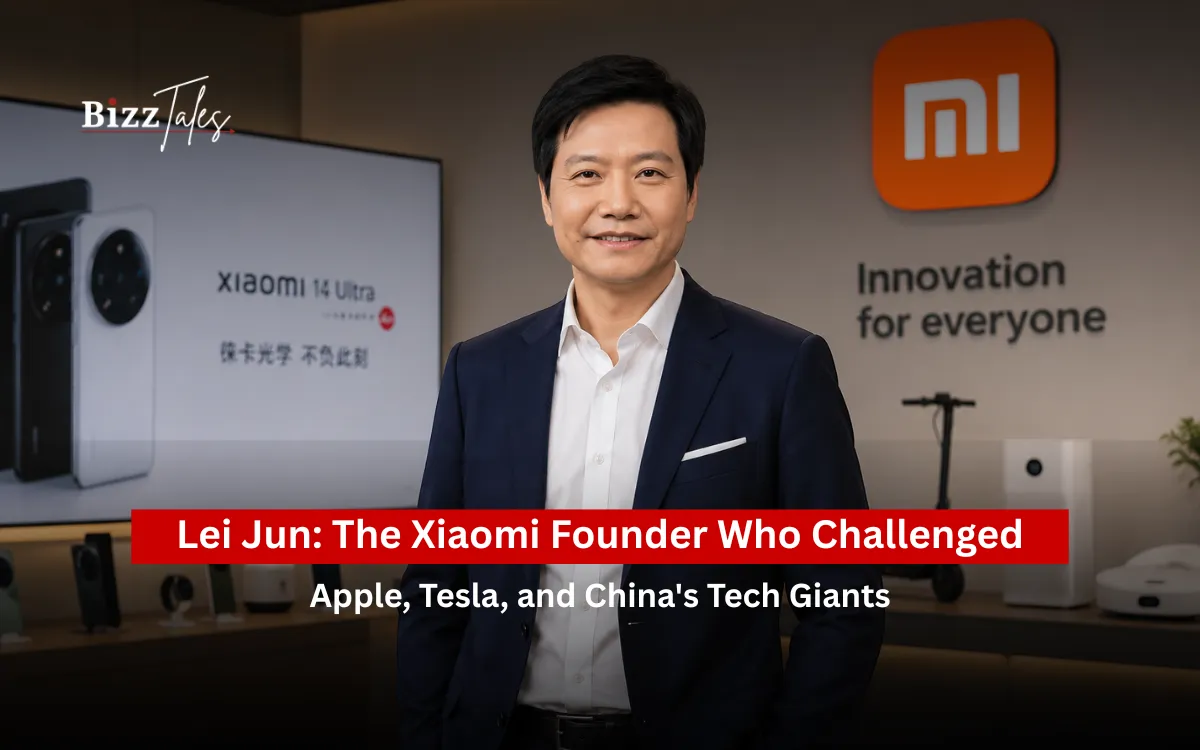
Lei Jun is one of China’s most influential technology entrepreneurs and the founder, chairman, and CEO of Xiaomi. Often referred to as the “Steve Jobs of China,” Lei transformed Xiaomi from a startup founded in 2010 into one of the world’s largest smartphone manufacturers and a rapidly growing electric vehicle company. His journey from a small city in Hubei Province to becoming one of the richest businessmen in Asia is a remarkable story of innovation, persistence, and strategic thinking.
Unlike many entrepreneurs who achieved success through a single company, Lei Jun built a diverse business empire that includes software, e-commerce, venture capital, smartphones, smart devices, artificial intelligence, and electric vehicles. Through Xiaomi, Kingsoft, and Shunwei Capital, he has played a major role in shaping China’s modern technology ecosystem.
Today, Lei Jun is recognized as one of the most successful technology founders in the world and a leading figure in China’s innovation economy.
Forbes Ranking & Net Worth History
| Year | Forbes Global Rank | Net Worth |
| 2026 | #90 | $27.9 Billion |
| 2025 | Top 5 Richest People in China | $35.3 Billion |
| 2024 | Top 120 Global Billionaires | Approximately $10.9 Billion |
According to Forbes’ 2026 World’s Billionaires List, Lei Jun ranked #90 globally with an estimated net worth of $27.9 billion. His wealth has fluctuated significantly in recent years due to changes in Xiaomi’s stock performance and investor sentiment surrounding its electric vehicle business.
Early Life and Family Background
Lei Jun was born on December 16, 1969, in Xiantao, Hubei Province, China.
His parents were teachers, and the family lived a modest life. Growing up in rural China during a period of economic transformation, Lei developed a fascination with electronics and technology at an early age.
As a child, he enjoyed taking apart radios and electronic devices to understand how they worked. According to biographical accounts, he even built a simple electric lamp using batteries and wires while still young. These early experiments sparked a lifelong interest in engineering and innovation.
Unlike many future billionaires, Lei did not come from a wealthy business family. His success would ultimately be built through education, entrepreneurship, and determination.
Education at Wuhan University
Lei attended Wuhan University, one of China’s most respected institutions.
He studied Computer Science and graduated in 1991 with a bachelor’s degree in engineering.
During his university years, Lei became inspired by technology entrepreneurs and software development.
He was particularly influenced by books and stories about Silicon Valley innovators, which convinced him that technology entrepreneurship offered extraordinary opportunities.
His technical education provided the foundation for his future career in software, internet services, and consumer electronics.
Joining Kingsoft
After graduation, Lei joined Kingsoft as a software engineer in 1992.
At the time, Kingsoft was a relatively small software company competing against larger technology firms.
Lei quickly distinguished himself through his technical skills, leadership abilities, and business understanding.
In 1998, he became CEO of Kingsoft and helped guide the company through a period of rapid growth.
Under his leadership, Kingsoft expanded its software offerings and eventually completed a successful public listing on the Hong Kong Stock Exchange in 2007.
This achievement established Lei as one of China’s most promising technology executives.
The Success of Joyo.com
Before founding Xiaomi, Lei achieved success in e-commerce.
In 2000, he founded Joyo.com, an online retail platform.
The company grew rapidly and attracted attention from international investors.
In 2004, Amazon acquired Joyo.com for approximately $75 million.
The sale provided Lei with both financial resources and valuable entrepreneurial experience.
The transaction also strengthened his reputation within China’s technology industry.
Becoming an Investor
After stepping down as Kingsoft CEO in 2007, Lei became an active investor.
He invested in numerous internet and technology startups across China.
Some of his most successful investments included:
- YY Inc.
- UCWeb
- Kingsoft
- E-commerce startups
- Mobile technology companies
His investment success helped grow his personal fortune while expanding his influence throughout China’s startup ecosystem.
These experiences also helped him identify emerging technology trends.
Founding Xiaomi
In 2010, Lei Jun co-founded Xiaomi alongside a team of technology entrepreneurs and former executives.
The company entered a highly competitive smartphone market dominated by Apple, Samsung, Nokia, and other established brands.
Many observers doubted Xiaomi could compete successfully.
Lei believed otherwise.
His strategy focused on delivering premium technology at affordable prices.
Xiaomi combined high-quality hardware, custom software, online sales channels, and strong community engagement.
Consumers responded enthusiastically.
The company’s growth exceeded expectations and quickly disrupted the smartphone industry.
The Rise of Xiaomi
Xiaomi’s expansion was extraordinary.
Within just a few years, the company became one of the largest smartphone manufacturers in China.
Its success later spread internationally.
The company expanded into markets across:
- India
- Southeast Asia
- Europe
- Latin America
- Middle East
- Africa
Xiaomi eventually became one of the world’s top smartphone brands by shipment volume. Forbes noted that Xiaomi ranks among the world’s most popular smartphone manufacturers.
The company’s rapid growth significantly increased Lei’s wealth and global recognition.
Building an Ecosystem Beyond Smartphones
One of Lei’s smartest decisions was expanding beyond smartphones.
Xiaomi developed a vast ecosystem of connected products, including:
- Smart TVs
- Wearable devices
- Smart home appliances
- Air purifiers
- Security systems
- Electric scooters
- IoT devices
This ecosystem strategy helped Xiaomi create multiple revenue streams and strengthen customer loyalty.
Today, millions of households use Xiaomi products daily.
The company’s ecosystem approach became one of its strongest competitive advantages.
Entering the Electric Vehicle Industry
Perhaps the most ambitious decision of Lei Jun’s career came in 2021 when Xiaomi announced plans to enter the electric vehicle industry.
Lei committed billions of dollars to the project and personally led the initiative.
Many analysts viewed the move as risky due to intense competition.
However, Lei believed electric vehicles represented the next major technology platform.
In 2024, Xiaomi launched its first EV, the SU7 sedan.
The vehicle generated enormous consumer interest and achieved strong preorder numbers shortly after launch.
Challenging Tesla
Xiaomi’s EV expansion placed Lei Jun in direct competition with Tesla and its CEO, Elon Musk.
Chinese media frequently compared the two entrepreneurs.
In 2025 and 2026, Xiaomi expanded its EV lineup and introduced new models aimed at challenging Tesla’s position in China. Forbes reported that Lei Jun’s SUV launch intensified competition in the world’s largest electric vehicle market.
The EV business has become one of Xiaomi’s most important growth opportunities.
Shunwei Capital
Beyond Xiaomi, Lei co-founded Shunwei Capital in 2011.
The venture capital firm invests in:
- Artificial intelligence
- E-commerce
- Consumer technology
- Internet platforms
- Mobility startups
Through Shunwei Capital, Lei has supported hundreds of entrepreneurs and helped build numerous successful companies.
His investment activities have further expanded his influence throughout the technology sector.
Philanthropy and Social Impact
Lei Jun is also known for philanthropy.
In 2021, he donated billions of dollars worth of Xiaomi shares to charitable causes.
His philanthropic initiatives support:
- Education
- Scientific research
- Technology innovation
- Disaster relief
- Community development
These contributions have made him one of China’s most prominent technology philanthropists.
Leadership Style
Lei Jun is known for combining engineering expertise with entrepreneurial vision.
Employees often describe him as:
- Product-focused
- Detail-oriented
- Innovative
- Ambitious
- Highly disciplined
He is deeply involved in product development and frequently interacts with customers to understand their needs.
His leadership philosophy emphasizes continuous improvement and long-term thinking.
These qualities have helped Xiaomi remain competitive in rapidly changing industries.
Personal Life
Lei Jun is married to Zhang Tong and has two children.
Despite his immense wealth, he generally maintains a relatively private lifestyle.
Most of his public appearances focus on technology, entrepreneurship, and product launches.
His passion for innovation continues to drive both Xiaomi and his investment activities.
Official Social Media Accounts
Lei actively uses Chinese social media platforms to communicate with consumers and share updates about Xiaomi products.
Lessons Entrepreneurs Can Learn from Lei Jun
One of the most important lessons from Lei Jun’s journey is the power of persistence.
Before founding Xiaomi, he spent years building experience through software development, entrepreneurship, and investing.
His story also demonstrates the value of identifying large market opportunities.
Rather than focusing solely on smartphones, he built an entire technology ecosystem.
Entrepreneurs can learn from his willingness to enter highly competitive industries and challenge established leaders.
Most importantly, his career proves that innovation, execution, and long-term thinking can create extraordinary success.
Conclusion
Lei Jun’s transformation from a software engineer in Hubei Province to the founder of Xiaomi and one of China’s richest entrepreneurs is one of the most impressive technology success stories of the modern era. Through smartphones, software, internet services, venture capital, and electric vehicles, he built a business empire that serves hundreds of millions of consumers worldwide.
His influence extends across technology, mobility, artificial intelligence, and entrepreneurship.
Today, Xiaomi continues expanding globally while pursuing ambitious opportunities in electric vehicles and next-generation technologies.
For entrepreneurs, investors, and future business leaders, Lei Jun’s journey offers valuable lessons about innovation, resilience, adaptability, and the importance of thinking beyond traditional boundaries.
FAQs
1. Who is Lei Jun?
Lei Jun is the founder, chairman, and CEO of Xiaomi and one of China’s most successful technology entrepreneurs.
2. What is Lei Jun’s net worth in 2026?
According to Forbes, his estimated net worth is approximately $27.9 billion.
3. What company did Lei Jun found?
He founded Xiaomi in 2010.
4. What is Xiaomi?
Xiaomi is a global consumer electronics company known for smartphones, smart devices, IoT products, and electric vehicles.
5. Did Lei Jun work at Kingsoft?
Yes. He joined Kingsoft in 1992 and later became CEO.
6. What is Shunwei Capital?
Shunwei Capital is a venture capital firm co-founded by Lei Jun that invests in technology startups.
7. What is Xiaomi SU7?
The Xiaomi SU7 is Xiaomi’s first electric vehicle, launched in 2024.
8. Is Lei Jun involved in philanthropy?
Yes. He has donated billions of dollars worth of Xiaomi shares to charitable causes.
9. Is Lei Jun active on social media?
Yes. He maintains active accounts on Weibo and other Chinese social media platforms.
10. What can entrepreneurs learn from Lei Jun?
Entrepreneurs can learn innovation, resilience, ecosystem thinking, strategic risk-taking, and long-term vision.