
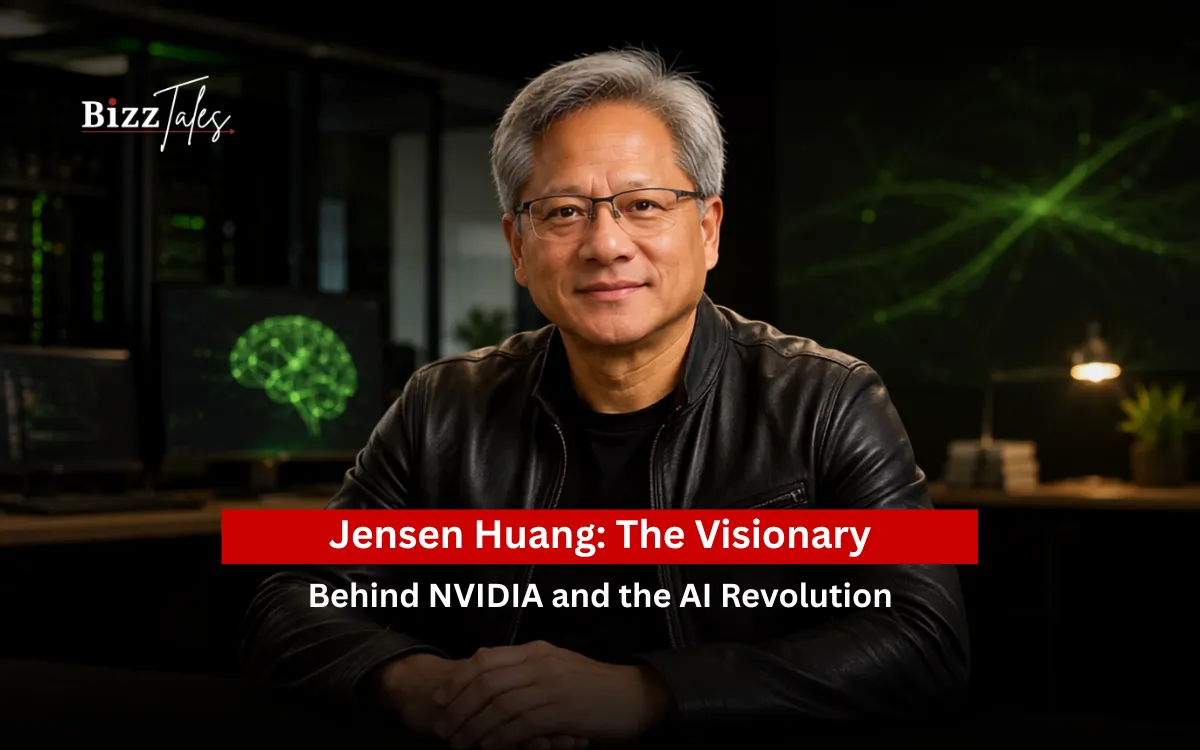
Jensen Huang is one of the most influential technology entrepreneurs of the modern era. As the co-founder, president, and CEO of NVIDIA, he transformed a small semiconductor startup into one of the most valuable companies in the world. What began as a company focused on graphics processing for video games eventually became the backbone of artificial intelligence, data centers, autonomous vehicles, robotics, scientific research, and advanced computing.
In recent years, Huang has emerged as one of the wealthiest businessmen on the planet, largely due to NVIDIA explosive growth during the artificial intelligence boom. While many entrepreneurs achieved success through software or internet services, Huang built his fortune by developing hardware that powers some of the world’s most advanced technologies.
His journey from an immigrant child with modest beginnings to the leader of a trillion-dollar technology company is one of the most remarkable entrepreneurial stories in modern business history. Along the way, he faced market crashes, technological challenges, competition, failed product launches, and periods when NVIDIA’s survival was uncertain.
Today, Jensen Huang is widely regarded as one of the architects of the AI revolution, and his influence continues to shape the future of computing.
Forbes Ranking & Net Worth History
| Year | Forbes Rank | Net Worth |
| 2026 | #8 | $182 Billion |
| 2025 | #11 | $118 Billion |
| 2024 | #20 | $77 Billion |
The rapid increase in Huang’s wealth over the past three years has been fueled by NVIDIA’s dominance in artificial intelligence chips, data center technology, and high-performance computing infrastructure.
Early Life and Family Background
Jen-Hsun Jensen Huang was born on February 17, 1963, in Tainan, Taiwan. His family later moved to Thailand before eventually immigrating to the United States.
Like many immigrant families seeking better opportunities, Huang’s parents believed education would provide a pathway to success. The transition was not always easy. Moving to a new country involved cultural adjustments, language challenges, and financial uncertainty.
Despite these obstacles, Huang quickly adapted and developed a strong work ethic. His early experiences taught him resilience, discipline, and determination—qualities that would later define his entrepreneurial journey.
As a child, Huang demonstrated curiosity about science, mathematics, and technology. He enjoyed solving problems and understanding how systems worked, interests that eventually guided him toward engineering.
Education and Technical Foundation
Huang attended Oregon State University, where he earned a degree in electrical engineering.
His passion for technology and innovation continued to grow throughout his academic years. Unlike many students who focused solely on coursework, Huang constantly explored how technology could be used to solve real-world challenges.
After completing his undergraduate studies, he earned a master’s degree in electrical engineering from Stanford University.
His education provided a strong technical foundation that would later help him navigate the highly competitive semiconductor industry.
More importantly, it strengthened his belief that computing would become one of the most important forces shaping the future.
Early Career Before NVIDIA
Before launching NVIDIA, Huang gained valuable experience working at major technology companies.
He held positions at Advanced Micro Devices (AMD) and LSI Logic, where he learned about semiconductor design, engineering management, and business operations.
These experiences exposed him to the challenges and opportunities within the computer hardware industry.
During the late 1980s and early 1990s, personal computers were becoming increasingly popular, and demand for advanced graphics technology was beginning to grow.
Huang recognized an opportunity that many others overlooked.
He believed graphics processing would eventually become a critical component of computing.
This vision led to the creation of NVIDIA.
Founding NVIDIA
In 1993, Jensen Huang co-founded NVIDIA alongside Chris Malachowsky and Curtis Priem.
The company was founded with a simple but ambitious goal: developing graphics technologies capable of transforming computer experiences.
The early years were extremely challenging.
NVIDIA operated in a highly competitive industry dominated by larger and better-funded companies.
Securing customers, attracting investors, and developing innovative products required significant effort.
At times, the company’s future appeared uncertain.
However, Huang remained committed to his vision.
He believed that graphics processing would eventually become essential for gaming, professional computing, and future technologies.
His conviction helped NVIDIA survive its difficult early years.
The Struggle for Survival
One of the most difficult periods in NVIDIA’s history occurred during the late 1990s.
Several product launches failed to meet expectations, creating financial pressure on the company.
Competition intensified, and many analysts doubted whether NVIDIA could survive.
Huang later revealed that the company was often just months away from running out of money.
Rather than giving up, he pushed the team to innovate and improve.
This persistence eventually paid off.
NVIDIA launched products that gained traction in the gaming industry and established the company as a serious competitor.
The experience taught Huang valuable lessons about resilience, adaptability, and leadership.
Revolutionizing Computer Graphics
NVIDIA’s breakthrough came with the development of advanced graphics processing units, commonly known as GPUs.
These chips dramatically improved visual performance for computer games and professional applications.
As gaming became increasingly popular worldwide, demand for NVIDIA’s products grew rapidly.
The company developed a reputation for innovation and technical excellence.
Its graphics technology became widely adopted by gamers, content creators, engineers, scientists, and technology professionals.
This success transformed NVIDIA into a major player in the semiconductor industry.
The AI Opportunity
While GPUs were originally designed for graphics processing, Huang recognized another opportunity.
Researchers discovered that GPUs could perform complex mathematical calculations far more efficiently than traditional processors.
This capability made them ideal for artificial intelligence and machine learning applications.
Long before AI became mainstream, NVIDIA invested heavily in developing hardware and software tools for AI research.
Many observers underestimated the importance of these investments.
Huang did not.
He believed artificial intelligence would become one of the most transformative technologies in human history.
His vision proved correct.
Becoming the Face of the AI Revolution
As artificial intelligence adoption accelerated, demand for NVIDIA’s chips exploded.
Technology companies, research institutions, governments, and startups all required powerful computing infrastructure to train and deploy AI models.
NVIDIA became the dominant supplier of AI hardware.
The company’s GPUs powered many of the world’s most advanced AI systems.
This unprecedented demand caused NVIDIA’s revenue, profits, and market value to surge dramatically.
As the company’s largest individual shareholder, Huang’s personal fortune increased significantly.
He became one of the richest businessmen in the world.
Expansion Beyond Gaming
Although gaming remains an important part of NVIDIA’s business, the company has expanded into numerous industries.
Its technologies now support data centers, cloud computing, autonomous vehicles, robotics, healthcare, scientific research, cybersecurity, and industrial automation.
This diversification has strengthened NVIDIA’s position and reduced dependence on any single market.
Huang’s ability to identify emerging opportunities has been a major factor behind the company’s continued growth.
His long-term vision consistently places NVIDIA at the forefront of technological innovation.
Challenges and Competition
Despite NVIDIA’s success, Huang has faced numerous challenges.
The semiconductor industry is highly competitive, with rivals constantly developing new technologies.
Companies such as AMD, Intel, and other global chip manufacturers compete aggressively for market share.
Supply chain disruptions, geopolitical tensions, and regulatory concerns have also created obstacles.
Additionally, the rapid pace of technological change requires continuous innovation.
Huang has successfully navigated these challenges through strategic planning, research investment, and strong leadership.
Leadership Style
Jensen Huang is known for his hands-on leadership style and deep technical expertise.
Unlike some executives who focus primarily on finance or management, Huang remains closely involved in product development and engineering.
Employees often describe him as demanding but highly inspiring.
He encourages innovation, accountability, and long-term thinking.
His ability to combine technical knowledge with business strategy has helped NVIDIA maintain its competitive advantage.
Many entrepreneurs admire his willingness to make bold decisions and pursue ambitious goals.
Other Investments and Interests
Beyond NVIDIA, Huang has invested in education, technology research, and entrepreneurial initiatives.
He supports programs that encourage innovation, engineering, and scientific advancement.
His contributions to education reflect his belief in the importance of developing future generations of technology leaders.
Although he is less publicly active than many billionaires, his influence extends throughout the global technology ecosystem.
Philanthropy and Personal Life
Jensen Huang and his family have contributed significant resources to educational institutions, engineering programs, and scientific research initiatives.
He has donated millions of dollars to universities and programs focused on technology education.
Despite his immense wealth, Huang is often described as humble, approachable, and focused on long-term impact.
His personal story resonates with many aspiring entrepreneurs because it demonstrates how determination and vision can overcome difficult circumstances.
Lessons Entrepreneurs Can Learn from Jensen Huang
One of the most important lessons from Huang’s journey is the value of long-term thinking.
He invested in artificial intelligence years before it became mainstream, positioning NVIDIA for extraordinary success.
His story also demonstrates the importance of resilience. NVIDIA faced significant challenges during its early years, yet Huang remained committed to his vision.
Entrepreneurs can learn from his willingness to adapt, innovate, and identify emerging trends before competitors.
Perhaps most importantly, his journey highlights the power of combining technical expertise with strategic leadership.
Conclusion
Jensen Huang’s transformation from an immigrant student to one of the richest businessmen in the world is one of the most inspiring entrepreneurial stories of the modern era. Through NVIDIA, he helped revolutionize computer graphics, artificial intelligence, and advanced computing.
His ability to anticipate future technological trends and invest in innovation has positioned NVIDIA at the center of some of the world’s most important technological developments.
As artificial intelligence continues reshaping industries worldwide, Huang’s influence is likely to grow even further. His story serves as a powerful reminder that vision, persistence, and innovation can create extraordinary success.
For entrepreneurs, engineers, and business leaders, Jensen Huang’s journey offers valuable lessons about leadership, resilience, and the importance of thinking ahead.
FAQs
1. Who is Jensen Huang?
Jensen Huang is the co-founder, president, and CEO of NVIDIA.
2. What is Jensen Huang’s net worth in 2026?
His estimated net worth is approximately $182 billion.
3. When was NVIDIA founded?
NVIDIA was founded in 1993.
4. What is NVIDIA known for?
NVIDIA is known for GPUs, artificial intelligence hardware, gaming technology, and advanced computing solutions.
5. Where was Jensen Huang born?
He was born in Tainan, Taiwan.
6. Why is Jensen Huang considered important in AI?
NVIDIA’s GPUs power many of the world’s leading artificial intelligence systems and platforms.
7. Did NVIDIA always focus on AI?
No. The company initially focused on graphics processing for gaming before expanding into AI and data centers.
8. What challenges did Huang face?
He faced financial struggles, failed product launches, intense competition, and market uncertainty during NVIDIA’s early years.
9. Is Jensen Huang active on social media?
He maintains a relatively limited personal social media presence.
10. What can entrepreneurs learn from Jensen Huang?
Entrepreneurs can learn the importance of long-term vision, resilience, innovation, adaptability, and strategic thinking.